
CO-31 denial code: patient not identified as insured
CO-31 says the payer found no member that matches the identifiers on the claim. It is a matching failure, so the answer is almost always in the ID, name or birth date.
 Written by Salman Saeed, CEO and Co-Founder · Reviewed by a Certified Medical Coder · Last reviewed October 2026
In short: CO-31 means the payer could not match the patient to one of its insureds. Re-run eligibility, compare every identity field to the card, contact the patient for other coverage, and send a corrected claim. Do not bill the patient until coverage is ruled out.
What does CO-31 mean when the patient cannot be identified?
X12 defines claim adjustment reason code (CARC) 31 as "Patient cannot be identified as our insured." The list gives a start date of 01/01/1995 and a last-modified date of 09/30/2007.
The payer searched its member file with the identifiers on your claim and found no match. That is an identity problem, not a benefit decision. The patient may well be covered, under a different spelling, birth date, member number or even a different plan. X12 gives CARC 31 no group code usage note. If the remit shows CO, Medicare Claims Processing Manual chapter 22, section 60.1, describes that group as generally a write-off that is not billed to the patient, so do not move the balance to the patient before you confirm coverage. Reviewed October 26, 2026.
How is CARC 31 different from the other eligibility codes?
| CARC | X12 wording | What it points to |
|---|---|---|
| 31 | Patient cannot be identified as our insured. | No member match at all |
| 32 | Our records indicate the patient is not an eligible dependent. | Member found, dependent not eligible |
| 33 | Insured has no dependent coverage. | Subscriber has no dependent coverage |
| 140 | Patient/Insured health identification number and name do not match. | ID and name disagree; see CO-140 |
| 200 | Expenses incurred during lapse in coverage | Coverage lapsed; compare CO-27 |
Read the row that fits the remit, since each one has a different fix.
Which claim fields carry the identity?
For Medicare, chapter 26 says CMS-1500 item 1a takes the patient's Medicare beneficiary identifier, item 2 takes the patient's name as shown on the Medicare card, and item 3 takes the 8-digit birth date and sex. Commercial plans use the same boxes for the member ID, so the same transcription errors apply.
Look for the usual causes: a transposed digit in the ID, a missing prefix or suffix on the member number, a nickname or hyphenated surname, a birth date entered day first, and a policy that ended before the service date. A card copied in an emergency department may be several years old.
Which remark codes accompany CO-31?
| RARC | X12 wording | Reading |
|---|---|---|
| N382 | Missing/incomplete/invalid patient identifier. | The ID field itself failed. |
| MA27 | Missing/incomplete/invalid entitlement number or name shown on the claim. | Medicare number or name mismatch. |
| MA36 | Missing/incomplete/invalid patient name. | Name field problem. |
| MA130 | Your claim contains incomplete and/or invalid information, and no appeal rights are afforded because the claim is unprocessable. Please submit a new claim with the complete/correct information. | Correct and send a new claim, do not appeal. |
When a remark says the claim is unprocessable, the right move is a new claim. See CO-16 for that path.
How do you resolve CO-31?
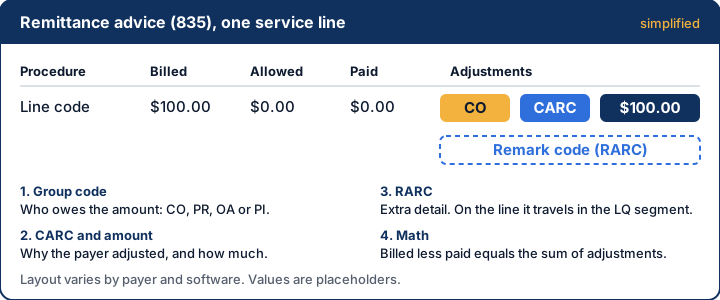
How does CO-31 read on the remittance?
X12 gives no group code for CO-31. Remarks N382, MA27, MA36 and MA130 are on the page above. The fix is a patient identification check: name, date of birth and member ID. CARC 32, 33, 140 and 200 are the neighbours.
Example of a CO-31 in the emergency department
An unconscious patient is registered from a driver's license and an old card in a wallet. The claim goes out with the old member ID.
Registration quality drives this code in emergency medicine billing, urgent care billing and family medicine billing. Related codes are CO-19, a work injury that belongs to another payer, and CO-39, services denied when authorization was requested. If these denials keep coming back, our denial management team can work them.
Related codes
- X12 claim adjustment reason codes list · X12
- X12 remittance advice remark codes list · X12
- X12 claim adjustment group codes list · X12
- Medicare Claims Processing Manual, chapter 22, section 60.1 (group codes) · CMS
- Medicare Claims Processing Manual, chapter 26 (CMS-1500 items and place of service codes) · CMS
We check every rule, code and deadline against the official source. See our editorial policy.
Common questions
Straight answers from the team that does the work.
Ask a billing lead directly. A 20-minute call, Monday to Friday, 9am to 5pm Eastern.
01How do I resolve CO-31 when the patient cannot be identified?
Re-run eligibility with the identifiers exactly as shown on the card and the real date of service, then compare every identity field on the claim to the card. If coverage turns up, send a corrected claim. If not, contact the patient before moving the account to self-pay.
02Does CO-31 mean the patient is not insured?
No. X12 words it as the patient not being identified as the payer's insured, which is a matching failure. A wrong ID, spelling or birth date, or a plan change can cause it. Coverage may exist under a different identifier or at a different payer.
03Can I bill the patient after a CO-31?
Not yet. Medicare Claims Processing Manual chapter 22 describes the CO group code as generally a write-off that is not billed to the patient. X12 gives CARC 31 no group code note, so check the remit. Confirm that coverage does not exist before you move the balance.
04What is the difference between CO-31 and CO-140?
CARC 31 means the payer found no insured matching the patient. CARC 140 means the health identification number and the name do not match each other. The first is no match at all, and the second is a mismatch between two fields on the claim.
05Should I appeal a CO-31?
Usually not. When the remark code says the claim is unprocessable, such as MA130, the fix is a new claim with correct information, and no appeal rights apply. Appeal only if the payer agrees the patient is a member and still denies the claim.

Identity denials at registration?
We catch ID and eligibility errors before the claim is sent.