
CO-16 Denial Code: Missing or Invalid Claim Information
CO-16 is a claim adjustment reason code that says the claim or service lacks information or has a submission or billing error. The remark code names the field. For Medicare, a claim returned this way is unprocessable, so you correct it and send a new claim rather than appeal.
 Written by Salman Saeed, CEO and Co-Founder · Reviewed by a Certified Medical Coder · Last reviewed October 2026
In short: CO-16 means something required is missing or wrong on the claim, and X12 requires a remark code to say what. Medicare treats it as unprocessable with no appeal rights (MA130), so fix the field, such as the rendering NPI in item 24J, and resubmit.
What Does CO-16 Mean?
X12 defines claim adjustment reason code (CARC) 16 as: "Claim/service lacks information or has submission/billing error(s)." The list gives a start date of 01/01/1995 and a last-modified date of 03/01/2018.
Two usage rules ride with it. X12 says not to use this code for claim attachments or other documentation. It also says at least one remark code must be provided, either an NCPDP reject reason code or a remittance advice remark code that is not an alert. So a CO-16 with no remark code does not follow X12's own usage note, and you should ask the payer which field it means. Reviewed October 25, 2026.
Which Remark Code Tells You What Is Missing?
CO-16 is a bucket, and the RARC is the label on the bucket. These X12 remark codes are the ones that name a field.
| RARC | X12 wording | Field to check |
|---|---|---|
| MA130 | Your claim contains incomplete and/or invalid information, and no appeal rights are afforded because the claim is unprocessable. Please submit a new claim with the complete/correct information. | The whole claim. See MA130. |
| N290 | Missing/incomplete/invalid rendering provider primary identifier. | Rendering NPI, CMS-1500 item 24J. See N290. |
| N265 | Missing/incomplete/invalid ordering provider primary identifier. | Ordering or referring provider, item 17 and 17b. |
| N516 | Records indicate a mismatch between the submitted NPI and EIN. | The NPI and tax ID pair on file for the billing provider. |
| M51 | Missing/incomplete/invalid procedure code(s). | Item 24D. |
| M77 | Missing/incomplete/invalid/inappropriate place of service. | The place of service on the line. |
N290, N265 and N516 all concern an NPI or its pairing with a tax ID, so check the enrollment record as well as the claim.
Is CO-16 a Denial You Can Appeal?
For Medicare, usually it is not a denial at all. Claims Processing Manual chapter 1, section 80.3.1, says a claim returned as unprocessable for incomplete or invalid information "does not meet the criteria to be considered as a claim, is not denied, and, as such, is not afforded appeal rights." That is what MA130 says in its own words.
Section 80.3.2 adds that the notice to the provider will not contain the usual reconsideration notice, only each applicable error code, and that the provider may correct and resubmit, as a corrected claim or an entirely new one, depending on how the claim was returned. A front-end return can leave no remittance advice at all, because the claim data are not kept. Filing a redetermination on an MA130 is wasted effort, since there is no determination to review.
Section 80.3.1 defines the terms. Incomplete means a required or conditional element is missing. Invalid means it is present but illogical, incorrect or no longer in effect, such as an expired number. A conditional element becomes required when its condition exists; the manual's own example is that a primary insurer's group name and number must be entered if there is insurance primary to Medicare. Other payers' rules for CO-16 are in their provider manuals, which this page does not summarize.
How Do You Fix a CO-16?
A new physician joined an urgent care group and saw patients before the group's enrollment record was updated.
How Do You Read CO-16 on the Remittance?
CARC 16 is one of the generic codes. CMS chapter 22 says contractors must send at least one remark code with such a code, and X12 repeats it in the CARC 16 note. At line level the remark is in the LQ segment; at claim level it is in MOA or MIA. So the CO-16 alone never tells you what to fix.
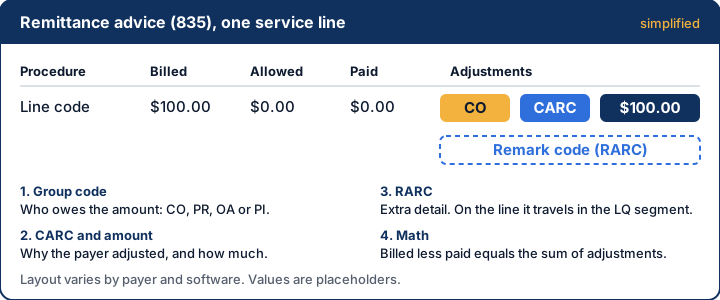
Take the remark, then locate the field it names: a diagnosis or modifier on the CMS-1500, or the revenue code in FL 42 or HCPCS code in FL 44 on the facility form. MA130 means the claim was unprocessable, so send a new claim.
An ED facility claim returns CO-16 for the whole $1,250.00 with RARC MA130 and N290.
Where Does CO-16 Turn up Most?
It follows any front-desk or enrollment gap in urgent care billing, family medicine billing and internal medicine billing. Compare it with CO-18, an exact duplicate, and CO-11, a diagnosis mismatch. If these denials keep coming back, our denial management team can work them.
Related Codes
- X12 claim adjustment reason codes list · X12
- X12 remittance advice remark codes list · X12
- X12 claim adjustment group codes list · X12
- Medicare Claims Processing Manual, chapter 1, sections 70, 80.3 and 120 · CMS
- Medicare Claims Processing Manual, chapter 26 (CMS-1500 items) · CMS
- Medicare Claims Processing Manual, chapter 22, sections 60.1 to 60.3 (group codes, CARC, RARC on the remittance) · CMS
- Medicare Claims Processing Manual, chapter 25, section 75 (UB-04 form locators 42 and 44) · CMS
We check every rule, code and deadline against the official source. See our editorial policy.
Common Questions
Straight answers from the team that does the work.
Ask a billing lead directly. A 20-minute call, Monday to Friday, 9am to 5pm Eastern.
01What does CO-16 mean and how do I fix it?
CO-16 means the claim or service lacks information or has a submission or billing error. Look at the remark code to find the field, such as N290 for the rendering NPI or M51 for the procedure code. Correct the source data, then resubmit as the remit instructs. For Medicare unprocessable claims, that means a new claim.
02Do I need to appeal a CO-16 denial?
For Medicare, usually no. Chapter 1 of the Claims Processing Manual says a claim returned as unprocessable is not denied and has no appeal rights, and MA130 says the same. Correct the information and send a new claim. Appeal only if a later determination actually denies the corrected claim.
03Is CO-16 a rejection or a denial?
Medicare's manual treats an unprocessable claim as not a claim and not a denial, so it is closer to a rejection. Other payers set their own rules. Check whether the line carries appeal language. If it does not, correct and resubmit rather than appeal.
04What if my CO-16 has no remark code?
X12's usage note for CARC 16 says at least one remark code must be provided, so a CO-16 without one is incomplete by X12's own rule. Contact the payer's provider service line, quote the claim number and ask which field failed. Record the answer so the same gap is closed in your front-end edits.
05Does MA130 take away my appeal rights?
MA130 states that no appeal rights are afforded because the claim is unprocessable. There is nothing to appeal, because the claim was not accepted for adjudication. Submit a new claim with complete and correct information, and mind the 12-month filing limit.

Rejections Eating Your Week?
We catch missing fields in front-end checks before claims go out.