
CO-18 Denial Code: Exact Duplicate Claim or Service
CO-18 is a claim adjustment reason code that says the claim or service is an exact duplicate. It is not always true. Medicare defines a duplicate by matching elements, and a separate encounter can match unless the claim says otherwise.
 Written by Salman Saeed, CEO and Co-Founder · Reviewed by a Certified Medical Coder · Last reviewed October 2026
In short: CO-18 means the payer matched this claim or line to one it already holds. Find the first claim, then check whether the elements match and whether a modifier or condition code should show a separate service. Medicare appeal rights depend on who billed.
What Does CO-18 Mean, and Why Is the Group Code Odd?
X12 defines claim adjustment reason code (CARC) 18 as: "Exact duplicate claim/service (Use only with Group Code OA except where state workers' compensation regulations requires CO)." The list gives a start date of 01/01/1995 and a last-modified date of 06/02/2013.
That usage note matters when you read the remit. X12 names OA "Other Adjustment" and CO "Contractual Obligation" on its group code list. A CO-18 outside a workers' compensation claim departs from the usage note, so confirm with the payer and post the group code the remit actually carries. Reviewed October 25, 2026.
Which RARCs Describe a Duplicate?
| RARC | X12 wording | Reading |
|---|---|---|
| N111 | No appeal right except duplicate claim/service issue. This service was included in a claim that has been previously billed and adjudicated. | Tells you the earlier claim already has an outcome. The appeal right is limited to the duplicate question. |
| M86 | Service denied because payment already made for same/similar procedure within set time frame. | Paid already, possibly a similar rather than identical service. |
| N522 | Duplicate of a claim processed, or to be processed, as a crossover claim. | The payer expects, or already holds, the same claim through crossover. Do not send it again. |
| M80 | Not covered when performed during the same session/date as a previously processed service for the patient. | Same-day logic; see M80. |
Read the remark code before anything else, because the right move for N522 (wait for the crossover) is the opposite of the right move for a genuinely separate service (correct and resubmit).
Is CO-18 Always a True Duplicate?
No. Medicare Claims Processing Manual chapter 1, section 120.2, defines an exact duplicate as a match on a set of elements, and the set depends on who billed.
| Billed by | Elements that must all match | Appeal |
|---|---|---|
| Institutions (UB-04) | Medicare beneficiary identifier, type of bill, provider ID, from and through dates of service, total charges on the line or bill, and procedure code modifiers | Rejected; no appeal rights |
| Physicians and other suppliers (CMS-1500) | Beneficiary identifier, provider number, from and through dates, type of service, procedure code, place of service, billed amount | Denied; may be appealed |
| DMEPOS suppliers | Beneficiary identifier, dates, place of service, HCPCS code, type of service, billed amount, supplier | Denied; may not be appealed |
Section 120.1 says exact duplicates are auto-denied or rejected "absent appropriate modifiers", and that biller-reported modifiers or condition codes are how a line that looks like a duplicate but is a separate service gets through. Its example is RT and LT for the right and left side. Section 120.2 also says the exact-duplicate edits are hard coded and a contractor cannot override them, so the fix is in your claim data. Suspect duplicates, a looser match, are reviewed, and section 120.3 says the denial may be appealed when it rests on criteria other than the exact-duplicate elements.
What Do You Do with a CO-18?
Changing a charge amount or a date just to defeat the match is not a fix. It hides the problem and risks a double payment. See Medicare appeal levels for the appeal route.
How Does CO-18 Read on the Remittance?
X12 says CO-18 goes with group OA, except where state workers compensation requires CO. If you see it with CO, check the line type. Remarks N111, M86, N522 and M80 are the ones on the page above. The usual source is a second submission of the same line, so compare the claim and line control numbers with what was already paid before you do anything.
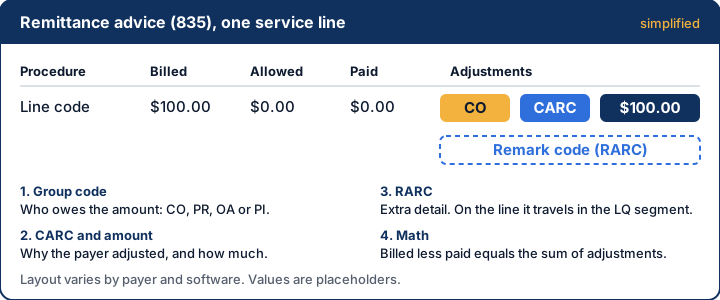
Example of a False Duplicate
An emergency department bills two visits on the same date of service for one patient, a morning visit and a return that evening, both at the same charge.
This pattern is common in emergency medicine billing and urgent care billing, and the same checks apply to pediatric billing. Related codes are CO-22, another payer responsible, and CO-16, missing information. If these denials keep coming back, our denial management team can work them.
Related Codes
- X12 claim adjustment reason codes list · X12
- X12 remittance advice remark codes list · X12
- X12 claim adjustment group codes list · X12
- Medicare Claims Processing Manual, chapter 1, sections 70, 80.3 and 120 · CMS
- Medicare Claims Processing Manual, chapter 34, section 10 (reopenings) · CMS
- Medicare Claims Processing Manual, chapter 22, sections 60.1 to 60.3 (group codes, CARC, RARC on the remittance) · CMS
We check every rule, code and deadline against the official source. See our editorial policy.
Common Questions
Straight answers from the team that does the work.
Ask a billing lead directly. A 20-minute call, Monday to Friday, 9am to 5pm Eastern.
01Is CO-18 always a true duplicate?
No. Medicare chapter 1, section 120.2, defines an exact duplicate by matching elements such as dates, procedure code, place of service and billed amount, and the edit is hard coded. A separate service on the same date can match unless a modifier or condition code identifies it. Check the elements before you accept the denial.
02Can I appeal a CO-18 duplicate denial?
It depends on who billed. Medicare section 120.2 says exact duplicates from institutions are rejected with no appeal rights, physician and supplier denials may be appealed, and DMEPOS denials may not. If you believe a claim was wrongly flagged, chapter 34 treats it as a clerical error handled by reopening.
03Why does CO-18 sometimes come with group code CO?
X12's usage note says to use CARC 18 only with group code OA, except where state workers' compensation regulations require CO. A CO-18 on a different kind of claim does not follow that note. Post the group code on the remit, and ask the payer if the mismatch affects how the balance is handled.
04What does N111 mean on a CO-18?
X12 words N111 as no appeal right except the duplicate claim or service issue, because the service was included in a claim that was previously billed and adjudicated. It confirms an earlier outcome exists. Find that claim, and appeal only if you can show the second claim is a separate service.
05What if the duplicate is a crossover?
N522 means the claim duplicates one processed, or to be processed, as a crossover claim. Hold the claim and ask the payer whether the crossover claim is in process. Resubmit only if they say it was never received, and note the date of that call in the account history.

Duplicate Denials on Real Visits?
We trace the first claim and prove the second is a separate encounter.