
CO-27 denial code: coverage ended before the service
CO-27 is a claim adjustment reason code that says the expenses were incurred after coverage terminated. The payer's records show no active coverage on the date of service, so the work starts with proving or finding coverage for that exact date, not with the claim form.
 Written by Salman Saeed, CEO and Co-Founder · Reviewed by a Certified Medical Coder · Last reviewed October 2026
In short: CO-27 means the payer found the date of service after the patient's coverage ended. Pull eligibility for the exact service date, then either dispute a wrong termination with that proof or move to the patient's other coverage. The group code shows who the payer says owes the balance.
What does CO-27 mean on a remittance?
X12 defines claim adjustment reason code (CARC) 27 as: "Expenses incurred after coverage terminated." The list shows a start date of 01/01/1995 and no later modification.
Two neighbours matter. CARC 26 reads "Expenses incurred prior to coverage." CARC 28, "Coverage not in effect at the time the service was provided," stopped on 10/16/2003 with the X12 note "Redundant to codes 26&27." So a coverage-date denial now says either before (26) or after (27).
The group code in front of the CARC shows who the payer says owes the amount. Medicare Claims Processing Manual chapter 22, section 60.1, says CO is generally a write-off for the provider and PR is an amount that may be billed to the patient. X12 sets no group code restriction on CARC 27, so read the one on your 835.
Which remark codes explain a CO-27?
The X12 entry for CARC 27 requires no particular remark code, so the RARC may be absent. These are the remark codes whose X12 wording points at eligibility.
| RARC | X12 wording | What to do |
|---|---|---|
| N30 | Patient ineligible for this service. | Check the member's coverage dates for the service date and the specific benefit. |
| N216 | We do not offer coverage for this type of service or the patient is not enrolled in this portion of our benefit package. | The member may be enrolled in the plan but not in the benefit that covers this service. Ask which portion. |
| N581 | Investigation of coverage eligibility is pending. | The decision may not be final. Ask the payer for the outcome before you write anything off. |
How do you confirm coverage on the date of service?
For Medicare, the CMS fact sheet MLN8816413 (November 2025) says you check eligibility through a MAC online portal, a clearinghouse or software vendor, or the HIPAA Eligibility Transaction System (HETS). You need the patient's MBI, first and last name and date of birth.
The response shows Part A and Part B entitlement. For a Medicare Advantage enrollee it shows the plan with enrollment effective and termination dates, and the fact sheet says to direct your eligibility query to that plan. HETS gives you 4 years of eligibility data, so a past date can be checked.
Hospital stays have a special rule. Medicare Claims Processing Manual chapter 1, section 90, says that for an inpatient acute care hospital, the patient's status at admission decides liability. If the patient was not an MA enrollee at admission but enrolls before discharge, the MA organization is not responsible for payment.
Marketplace plans have a grace period. Under 45 CFR 156.270(d), an issuer must give an enrollee receiving advance payments of the premium tax credit a grace period of 3 consecutive months. The issuer must pay claims for the first month and may pend claims for the second and third months, and it must tell providers that claims in those months may be denied. A CO-27 on a month-two or month-three service can be a pended claim that was denied later. See eligibility verification for how we check this at registration.
What do you do with a CO-27?
Which claim fields carry the coverage data?
On the CMS-1500, chapter 26 says item 1a holds the Medicare beneficiary identifier whether Medicare is the primary or secondary payer, and item 11 is a required field for the policy or group number. A wrong identifier or a stale policy number sends the payer to the wrong member record.
How does CO-27 read on the remittance?
CO-27 says the service came after coverage ended. Compare the date of service in item 24A with the coverage dates on the eligibility response. N30, N216 and N581 are the remarks the page lists. Check item 1a and item 11 of the CMS-1500 for the right plan; CARC 26 is the neighbour for dates before coverage.
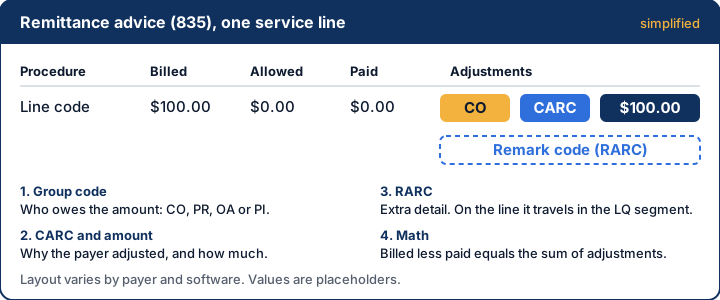
A claim returns CO-27 for $210.00 with RARC N30.
Where does CO-27 show up most?
Emergency medicine billing sees it because patients arrive without a prior check. Hospitalist billing and neonatology billing meet it on stays that span a coverage change. Its neighbours are CO-29, CO-22 and CO-45. If these denials keep coming back, our denial management team can work them.
Related codes
- X12 claim adjustment reason codes list · X12
- X12 remittance advice remark codes list · X12
- X12 claim adjustment group codes list · X12
- Medicare Claims Processing Manual, chapter 1, sections 70.7.2 and 90 · CMS
- Medicare Claims Processing Manual, chapter 22, section 60.1 · CMS
- Medicare Claims Processing Manual, chapter 26 (CMS-1500) · CMS
- Medicare Claims Processing Manual, chapter 29, section 310.2 · CMS
- MLN8816413 Checking Medicare Eligibility · CMS
- 45 CFR 156.270 grace period · eCFR
We check every rule, code and deadline against the official source. See our editorial policy.
Common questions
Straight answers from the team that does the work.
Ask a billing lead directly. A 20-minute call, Monday to Friday, 9am to 5pm Eastern.
01What do I do when coverage terminated before the date of service (CO-27)?
Pull eligibility for the exact service date and save the response. If it shows active coverage, send that proof and ask the payer to reprocess. If coverage truly ended, look for other coverage, including retroactive Medicare entitlement, and follow the group code for the balance.
02Can I bill the patient after a CO-27 denial?
Read the group code. Medicare chapter 22 says CO is generally a write-off for the provider and PR is an amount that may be billed to the patient. First confirm that coverage really ended, and check whether the patient has other coverage that should pay before you send a statement.
03How far back can I check Medicare eligibility?
The CMS fact sheet MLN8816413 says HETS gives you 4 years of eligibility data. Use a MAC portal, a clearinghouse or HETS, and have the patient's MBI, first and last name and date of birth ready. Save the response for the service date you are disputing.
04Is a CO-27 denial with remark code N581 final?
Not necessarily. X12 words N581 as investigation of coverage eligibility is pending, so the payer may still be deciding. Ask for the outcome before you write the balance off or bill the patient, and keep the filing deadline in view while you wait.


Eligibility denials after the visit?
We run automated eligibility checks before the visit and work CO-27 within 48 hours.