
M80 remark code: not covered with another same-day service
M80 is a remittance advice remark code that says the service is not covered when performed during the same session or on the same date as a previously processed service for the patient. The fix depends on whether the two services were truly separate encounters or one service reported twice.
 Written by Salman Saeed, CEO and Co-Founder · Reviewed by a Certified Medical Coder · Last reviewed October 2026
In short: M80 flags a service because another service for the patient was already processed for the same session or date. Decide whether it is a duplicate, a bundled pair or a real separate encounter, then correct, add a supported modifier, or accept the adjustment.
What does the M80 remark code mean?
X12 lists M80 as: "Not covered when performed during the same session/date as a previously processed service for the patient." The entry shows a start date of 01/01/1997 and a last-modified date of 10/31/2002, with no "Alert:" label. It is a remittance advice remark code (RARC), so it explains an adjustment rather than creating one.
Read the wording closely. It compares the service on this line with a service the payer already processed for the same patient in the same session or on the same date. It does not say the earlier service was on your claim, the same code, or from your practice. The earlier line is a different thing from the one you are looking at, and you have to find it. Reviewed October 25, 2026.
What is the earlier service, and which kind of M80 is it?
Three situations can sit behind a same-session remark, and the correction is different for each. Check them in this order.
| Situation | What to look for | Where to go next |
|---|---|---|
| Same service reported twice | Same code, same date, same patient on two claims or two lines | CO-18, the exact duplicate |
| Two services the payer treats as one | A code pair in an edit table, with the second code adjusted | CO-97 and CO-236 |
| Two truly separate services | Different encounters or sites that the claim does not show | The modifier rules below |
X12 does not tie M80 to one adjustment reason, so the table is a way to sort your own remits, not a list of official pairings. Your remit shows which adjustment reason sits beside the remark.
When can a modifier separate the two services?
For Medicare, the NCCI Policy Manual, chapter I, governs most same-date pairs. It says that when both codes of an edit pair are reported, the Column One code is eligible for payment and the Column Two code is denied, unless it is clinically appropriate to use an NCCI PTP-associated modifier.
The manual gives the limits. A modifier may be appended only if the clinical circumstances justify it, and never solely to bypass an edit. Each PTP edit carries a correct coding modifier indicator. A value of 0 means associated modifiers cannot bypass the edit, 1 means they may under appropriate circumstances, and 9 means use is not specified. In general, the manual says the justifying circumstances relate to separate patient encounters, separate anatomic sites or separate specimens.
Modifiers 22, 76 and 77 are not PTP-associated modifiers, and the manual says they do not bypass a PTP edit. See modifier 59 for distinct procedural services.
How do you respond to M80?
A patient has two procedures on one date at two body sites, both billed on separate claims a day apart.
How does M80 read on the remittance?
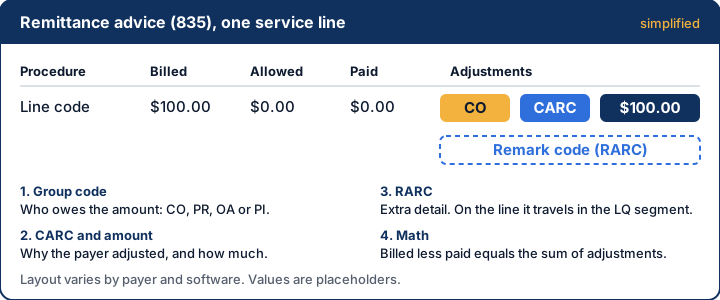
M80 is a remark, not a reason code, so it rides with a CARC such as 97 or 236 in the LQ segment of the line. It compares this line with a service already processed for the patient. Read the indicator for the pair in NCCI chapter I (0, 1 or 9) before you add a modifier.
Where does M80 appear?
Any specialty that bills several services on one date sees it, so dermatology billing, physical therapy billing and radiology billing teams check same-date lines before resubmitting. If the claim is instead returned incomplete, see MA130. For missing modifiers, see N822, and for a missing rendering identifier, N290. Back to the code library. If these denials keep coming back, our denial management team can work them.
Related codes
- X12 remittance advice remark codes list · X12
- Medicare NCCI Policy Manual, chapter I (2026) · CMS
- Medicare Claims Processing Manual, chapter 26 (CMS-1500 items) · CMS
- Medicare Claims Processing Manual, chapter 22, sections 60.1 to 60.3 (group codes, CARC, RARC on the remittance) · CMS
We check every rule, code and deadline against the official source. See our editorial policy.
Common questions
Straight answers from the team that does the work.
Ask a billing lead directly. A 20-minute call, Monday to Friday, 9am to 5pm Eastern.
01What does M80 mean about same-session services?
M80 means the payer treated the service as not covered because another service for the same patient was already processed in the same session or on the same date. Find the earlier service, decide whether it is a duplicate, a bundled pair or a separate encounter, and respond accordingly.
02Is M80 the same as an NCCI denial?
Not by definition. X12 words M80 around a previously processed same-session or same-date service and does not mention NCCI. An NCCI edit can produce a same-date adjustment, so check your remit for the adjustment reason beside it. Chapter I of the NCCI manual governs those pairs for Medicare.
03Can a modifier fix M80?
Sometimes. The NCCI manual allows PTP-associated modifiers only when clinical circumstances justify them and the edit's indicator is 1. With an indicator of 0, no modifier bypasses the edit. A modifier added only to get paid is not allowed, so the record must support separate encounters or sites.
04What if the earlier service was on a different claim?
The X12 wording refers to any previously processed service for the patient, so the earlier line may sit on another claim. Search by patient and date of service, including other clinicians in your group. If it is the same service twice, withdraw the later submission.
05Should I appeal M80?
Appeal only after you have confirmed the service was separate and the record supports it. If a modifier or date was wrong, a corrected claim is the fix, not an appeal. For Medicare disputes, see the appeal levels page for the order and the deadlines.

Same-day denials stacking up?
We sort duplicates, bundled pairs and real separate services before anything is resubmitted.