
CO-236 denial code: procedure or modifier combination not compatible
CO-236 is a claim adjustment reason code that says a procedure, or procedure and modifier pair, is not compatible with another procedure billed the same day. X12 ties it to the National Correct Coding Initiative or to workers' compensation rules. One code of the pair gets paid and the other does not.
 Written by Salman Saeed, CEO and Co-Founder · Reviewed by a Certified Medical Coder · Last reviewed October 2026
In short: CO-236 means the payer applied an NCCI or workers' compensation edit between two codes billed on the same day. Identify the pair, check whether the edit allows a modifier, and add one only if the record supports it. Medicare NCCI denials can be appealed to the MAC.
What does CO-236 mean?
X12 defines claim adjustment reason code (CARC) 236 as: "This procedure or procedure/modifier combination is not compatible with another procedure or procedure/modifier combination provided on the same day according to the National Correct Coding Initiative or workers compensation state regulations/ fee schedule requirements." The list gives a start date of 01/30/2011 and a last-modified date of 07/01/2013.
It carries two sources of rules in one code. NCCI is the CMS program Medicare uses, and many payers copy it. The workers' compensation reference means state regulations or fee schedule requirements can trigger the same code. Reviewed October 26, 2026.
Which remark codes appear with CO-236?
| RARC | X12 wording | Reading |
|---|---|---|
| N19 | Procedure code incidental to primary procedure. | The denied code is treated as part of the main one. |
| N20 | Service not payable with other service rendered on the same date. | A same-day pairing rule. |
| M15 | Separately billed services/tests have been bundled as they are considered components of the same procedure. Separate payment is not allowed. | Bundling, closest to CO-97. |
| N525 | These services are not covered when performed within the global period of another service. | A global-period rule, not a same-day one. |
How does an NCCI pair work?
Chapter I of the 2026 NCCI Policy Manual says each PTP edit has a Column One and a Column Two code. If you report both for the same beneficiary on the same date of service, the Column One code is eligible for payment and the Column Two code is denied unless a clinically appropriate NCCI PTP-associated modifier is allowed and reported.
| Correct Coding Modifier Indicator | What the manual says |
|---|---|
| 0 | PTP-associated modifiers cannot be used to bypass the edit. |
| 1 | PTP-associated modifiers may be used to bypass the edit under appropriate circumstances. |
| 9 | Use of PTP-associated modifiers is not specified. Used for pairs whose deletion date equals the effective date. |
The manual lists the modifiers that can bypass an edit: anatomic modifiers such as RT, LT and E1 to E4, global surgery modifiers 24, 25, 57, 58, 78 and 79, and 27, 59, 91, XE, XS, XP and XU. It also says modifiers 22, 76 and 77 are not PTP-associated and do not bypass an edit. See modifier 59 and modifier 25 for the two most used.
The manual adds that a modifier shall not be appended solely to bypass an edit when the clinical circumstances do not justify it. Whether a given pair exists, and its indicator, is in the CMS PTP files for the quarter of the date of service, so look it up there rather than guessing.
How do you fix a CO-236?
For a modifier that conflicts with the code itself, see CO-4.
How does CO-236 read on the remittance?
CO-236 sits on one line of an NCCI pair. Remarks N19, N20, M15 and N525 help show which. Find the other code of the pair on the same date, look up its indicator (0, 1 or 9), and only then decide. A modifier is allowed only on an indicator 1 pair.
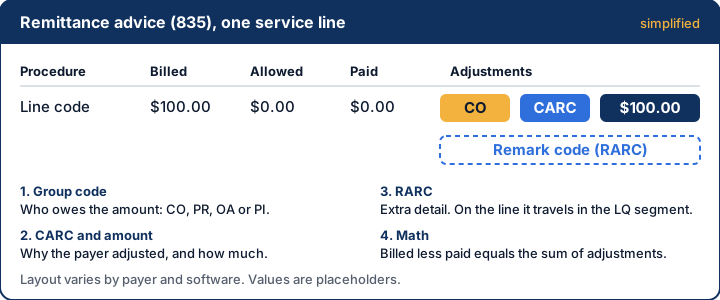
A pair of codes returns CO-236 on the second code for $90.00.
Where does CO-236 hit hardest?
Anesthesia billing, gastroenterology billing and general surgery billing see it most, since several procedures routinely share a session. Related codes are CO-204 and CO-252. If these denials keep coming back, our denial management team can work them.
Related codes
- X12 claim adjustment reason codes list · X12
- X12 remittance advice remark codes list · X12
- Medicare NCCI Policy Manual 2026, all chapters · CMS
- Medicare Claims Processing Manual, chapter 26 (CMS-1500 completion) · CMS
- Medicare Claims Processing Manual, chapter 22, sections 60.1 to 60.3 (group codes, CARC, RARC on the remittance) · CMS
We check every rule, code and deadline against the official source. See our editorial policy.
Common questions
Straight answers from the team that does the work.
Ask a billing lead directly. A 20-minute call, Monday to Friday, 9am to 5pm Eastern.
01What does CO-236 mean about modifier combinations?
CO-236 says a procedure, or a procedure and modifier pair, is not compatible with another procedure or pair provided on the same day under NCCI or workers' compensation rules. It points to an edit between two codes, so you need to identify the pair and check whether a modifier may be used.
02Can a modifier overcome CO-236?
Sometimes. The NCCI Policy Manual says a modifier indicator of 1 allows PTP-associated modifiers under appropriate circumstances, and 0 does not. The modifier must be clinically justified and supported by the record. Modifiers 22, 76 and 77 do not bypass a PTP edit.
03Is CO-236 only for Medicare?
No. X12 names NCCI and workers' compensation state regulations or fee schedule requirements as the sources. NCCI is the Medicare program, and other payers set their own edit policy, so confirm the pair and the modifier rule in that payer's manual before assuming Medicare rules apply.
04Which code gets paid in a CO-236 pair?
In an NCCI PTP edit, the manual says the Column One code is eligible for payment and the Column Two code is denied unless an allowed modifier is reported. So the denied line is normally the Column Two code. Verify against the pair in the PTP file for that quarter.
05Can I appeal an NCCI denial?
Yes. The 2026 NCCI Policy Manual says NCCI edits are auto-deny edits, denials may be appealed, and appeals are submitted to the MAC, not the NCCI contractor. Appeal when the edit was misapplied or the record supports the modifier; do not appeal to bypass an edit with an indicator of 0.


Same-day code pairs getting denied?
We check each pair against the edit and the record before a modifier goes on.