
CO-204 denial code: service not covered under the patient's plan
CO-204 is a claim adjustment reason code that says the service, equipment or drug is not covered under the patient's current benefit plan. It is a benefit finding, not a documentation finding, so records rarely change it. The work is to confirm the plan, the date and the code.
 Written by Salman Saeed, CEO and Co-Founder · Reviewed by a Certified Medical Coder · Last reviewed October 2026
In short: CO-204 means the payer says the patient's plan does not cover the service, equipment or drug. Check that the right plan and date were used, that the code is the one you meant, and what the remark code cites. If the exclusion is real, the question becomes who owes the balance.
What does CO-204 mean?
X12 defines claim adjustment reason code (CARC) 204 as: "This service/equipment/drug is not covered under the patient's current benefit plan." The list gives a start date of 02/28/2007 and shows no later modification.
The word that matters is current. The finding is about the plan in force when the claim was processed, which may not be the plan that was active on the date of service, and it may not be the plan the patient says they have. Reviewed October 26, 2026.
Which remark codes explain why it is not covered?
| RARC | X12 wording | Reading |
|---|---|---|
| N130 | Consult plan benefit documents/guidelines for information about restrictions for this service. | A plan restriction. Get the plan document. |
| N425 | Statutorily excluded service(s). | Excluded by law, so no documentation fixes it. |
| N623 | Not covered when deemed unscientific/unproven/outmoded/experimental/excessive/inappropriate. | An experimental or excessive finding. |
| N567 | Not covered when considered preventative. | A preventive-service exclusion. |
| N383 | Not covered when deemed cosmetic. | A cosmetic exclusion. |
| N428 | Not covered when performed in this place of service. | The service is covered somewhere else. Check the place of service. |
An N428 is the most fixable of these, because a wrong place of service on the claim is a billing error. An N425 is the least.
What does Medicare exclude?
The Medicare Benefit Policy Manual, chapter 16, section 10, lists general exclusions from coverage. Among them are items and services that are not reasonable and necessary, personal comfort items, routine services and appliances, custodial care, cosmetic surgery, dental services, and services paid or expected to be paid under workers' compensation.
Section 20 of the same chapter says items and services that are not reasonable and necessary for the diagnosis or treatment of illness or injury, or to improve the functioning of a malformed body member, are not covered. That is a coverage exclusion in the manual, which is why a medical necessity finding can also arrive as a not-covered one. See CO-50 for the medical necessity version.
How do you test a CO-204?
How does CO-204 read on the remittance?
Before you bill the patient, read the group code: CO is a contractual adjustment and PR may be billed to the patient. The remark on the line (N130, N425, N623, N567, N383 or N428) tells you why the benefit does not apply. Medicare benefit categories are in the Benefit Policy Manual chapter 16, sections 10 and 20.
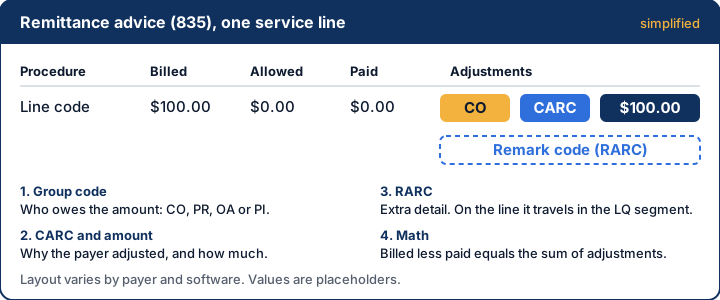
A line returns CO-204 for $60.00 with RARC N130.
Where does CO-204 show up?
It is common in oncology billing for drugs outside plan formularies, in neurology billing for testing and devices, and in DME billing for equipment a plan limits by type. Related codes are CO-197 and CO-236. If these denials keep coming back, our denial management team can work them.
Related codes
- X12 claim adjustment reason codes list · X12
- X12 remittance advice remark codes list · X12
- X12 claim adjustment group codes list · X12
- Medicare Benefit Policy Manual, chapter 16 (General exclusions from coverage) · CMS
- Medicare Claims Processing Manual, chapter 22, sections 60.1 to 60.3 (group codes, CARC, RARC on the remittance) · CMS
We check every rule, code and deadline against the official source. See our editorial policy.
Common questions
Straight answers from the team that does the work.
Ask a billing lead directly. A 20-minute call, Monday to Friday, 9am to 5pm Eastern.
01What does CO-204 mean?
CO-204 means the service, equipment or drug is not covered under the patient's current benefit plan. It is a benefit decision rather than a documentation request. Check the plan and effective dates, the code and place of service, and the remark code before treating it as final.
02Why does CO-204 deny a service the plan should cover?
Usually one of four reasons: the claim was processed against a different or lapsed plan, the code or place of service was wrong, the plan covers it only for certain diagnoses or settings, or the payer made an error. Verify eligibility on the date of service, then read the plan language.
03What is the difference between CO-204 and CO-50?
CO-50 is a finding that the service is not medically necessary, which clinical records can answer. CO-204 is a finding that the plan does not cover the service at all, which records rarely change. Medicare's chapter 16 treats not reasonable and necessary as a coverage exclusion, so the two can overlap.
04Can I bill the patient after a CO-204?
It depends on the group code, the contract and any notice the patient signed. X12 defines CO as Contractual Obligation and PR as Patient Responsibility. Do not bill the patient until you have confirmed what the remit assigns and what your payer agreement allows.
05What does N425 mean with CO-204?
X12 words N425 as statutorily excluded service. It means a law, not a plan choice, excludes the service. Documentation will not change that, so the work moves to the patient-responsibility question and to making sure the code reflects what was actually done.


Not-covered denials that look wrong?
We verify the plan on the date of service and test the code against the exclusion.