
CO-167 denial code: diagnosis is not covered
CO-167 is a claim adjustment reason code that says the diagnosis on the claim is not covered. The service may be fine; the payer's policy does not list that diagnosis for it. X12 adds a usage note that points you to the policy named in the 835.
 Written by Salman Saeed, CEO and Co-Founder · Reviewed by a Certified Medical Coder · Last reviewed October 2026
In short: CO-167 means the payer does not cover the service for the diagnosis reported. Look in the 835 for the policy identification segment, read that coverage policy, and compare its diagnosis list to what the record supports. Correct a coding or pointer error, or appeal with the record.
What does CO-167 mean, and what is the 835 usage note?
X12 defines claim adjustment reason code (CARC) 167 as: "This (these) diagnosis(es) is (are) not covered. Usage: Refer to the 835 Healthcare Policy Identification Segment (loop 2110 Service Payment Information REF), if present." The list gives a start date of 06/30/2005 and a last-modified date of 07/01/2017.
That usage note is the fastest lead you have. When the payer fills the policy identification segment in the 835 electronic remittance, it names the coverage policy it applied. If your remittance viewer or paper remit shows no policy, ask the payer or clearinghouse whether the segment was sent. Reviewed October 26, 2026.
Which remark codes explain a diagnosis denial?
| RARC | X12 wording | Reading |
|---|---|---|
| N569 | Not covered when performed for the reported diagnosis. | The most direct match. The service is covered for other diagnoses. |
| N115 | This decision was based on a Local Coverage Determination (LCD). An LCD provides a guide to assist in determining whether a particular item or service is covered. A copy of this policy is available at www.cms.gov/mcd, or if you do not have web access, you may contact the contractor to request a copy of the LCD. | Medicare contractor policy. Pull the LCD and its billing article. |
| N386 | This decision was based on a National Coverage Determination (NCD). An NCD provides a coverage determination as to whether a particular item or service is covered. Visit CMS.gov and search for Medicare Coverage Database to find a copy of the policy. | Nationwide Medicare policy, so a local appeal argument is weaker. |
| N130 | Consult plan benefit documents/guidelines for information about restrictions for this service. | Commercial or plan language. Read the plan document. |
| M76 | Missing/incomplete/invalid diagnosis or condition. | A claim data problem, closer to CO-16. |
Who writes the diagnosis list?
For Medicare, the Program Integrity Manual, chapter 13, section 13.1.1, defines a local coverage determination as a determination by a Medicare Administrative Contractor about whether an item or service is covered on a contractor-wide basis under section 1862(a)(1)(A) of the Social Security Act. See LCDs and NCDs for how the two differ.
For other payers the list sits in a medical policy or the plan document. The denial is only as good as the policy it cites, so get the policy version in force on the date of service, not today's.
How do you work a CO-167?
A diagnosis that fails to match the procedure at all is a different denial. See CO-11 for that case and CO-50 for a medical necessity determination.
How does CO-167 read on the remittance?
Find the diagnosis the payer rejected. The 835 policy segment in loop 2110 REF may carry the policy number. Then look at item 21 and the pointer in 24E to see which diagnosis the line points to. Remarks N569, N115, N386, N130 and M76 are the ones the page above lists.
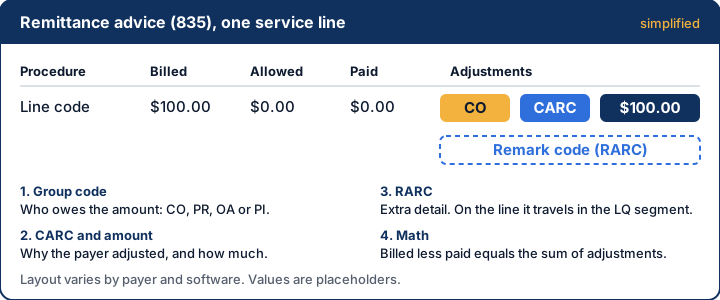
A line returns CO-167 for $150.00 with RARC N115.
Where does CO-167 show up?
It is routine in emergency medicine billing, where the presenting diagnosis changes after workup, in radiology billing, where the ordering diagnosis drives coverage, and in pathology billing. Related codes are CO-197 and CO-204. If these denials keep coming back, our denial management team can work them.
Related codes
- X12 claim adjustment reason codes list · X12
- X12 remittance advice remark codes list · X12
- Medicare Claims Processing Manual, chapter 26 (CMS-1500 completion) · CMS
- Medicare Program Integrity Manual, chapter 13 (Local Coverage Determinations) · CMS
- Medicare Claims Processing Manual, chapter 22, sections 60.1 to 60.3 (group codes, CARC, RARC on the remittance) · CMS
We check every rule, code and deadline against the official source. See our editorial policy.
Common questions
Straight answers from the team that does the work.
Ask a billing lead directly. A 20-minute call, Monday to Friday, 9am to 5pm Eastern.
01What does CO-167 mean?
CO-167 means the diagnosis, or diagnoses, on the claim are not covered. X12 adds that you should refer to the 835 Healthcare Policy Identification Segment in loop 2110, if present. That segment names the policy the payer applied, which is where you check the diagnosis list.
02What do I do with a CO-167 diagnosis denial?
Identify the policy from the 835 or the remark code, then compare its covered diagnoses to the record. If the claim carried a wrong code or a bad pointer, correct it. If the diagnosis is accurate and excluded, appeal with the chart and rationale. Never change the diagnosis to fit.
03Is CO-167 the same as CO-11?
No. X12 uses CO-11 for a diagnosis that is inconsistent with the procedure. CO-167 says the diagnosis is not covered. A diagnosis can be consistent with the procedure and still be missing from the payer's covered list, so the fixes differ.
04What does N569 mean with CO-167?
X12 words N569 as: not covered when performed for the reported diagnosis. It tells you the service has coverage, just not for this diagnosis. Look for a policy diagnosis list, then check whether the record supports a different documented diagnosis that you coded incorrectly.
05Can a Medicare LCD denial be appealed?
Yes, through the normal Medicare appeal route, and you can cite the record against the LCD. An NCD-based denial is harder to overturn because the policy is national, not contractor-wide. See the Medicare appeal levels page for steps and deadlines.


Diagnosis denials on covered services?
We pull the policy, check the coding and build the appeal from the record.