
CO-197 denial code: precertification or authorization absent
CO-197 is a claim adjustment reason code that says precertification, authorization, notification or pre-treatment approval is absent. It does not always mean nobody asked. It also appears when the authorization on file does not line up with the claim.
 Written by Salman Saeed, CEO and Co-Founder · Reviewed by a Certified Medical Coder · Last reviewed October 2026
In short: CO-197 means the payer found no matching precertification, authorization or notification for the service. First prove whether one was obtained and whether it matches the claim on provider, dates and codes. Retro requests and appeals depend on the payer, and Medicare outpatient prior authorization has fixed rules.
What does CO-197 mean?
X12 defines claim adjustment reason code (CARC) 197 as: "Precertification/authorization/notification/pre-treatment absent." The list gives a start date of 10/31/2006 and a last-modified date of 05/01/2018.
The four words in that description cover different payer requirements: a precertification before an admission, an authorization before a service, a notification after an emergency, and a pre-treatment review. Your payer contract or manual says which applies. The group code on the remit matters here, because it decides whether the balance can go to the patient. Reviewed October 26, 2026.
Which remark codes come with CO-197?
| RARC | X12 wording | Reading |
|---|---|---|
| N54 | Claim information is inconsistent with pre-certified/authorized services. | An authorization exists, but the claim does not match it. |
| M62 | Missing/incomplete/invalid treatment authorization code. | The claim lacks the authorization number or carries a wrong one. |
| N758 | Adjusted based on the prior authorization decision. | The payer applied what it approved. Compare the approved services to the claim. |
| N630 | Referral not authorized by attending physician. | A referral problem rather than a missing authorization. |
These split the denial in two. M62 is a data fix on the claim. N54 means pulling the approval and comparing it line by line to what was billed. Neither needs a new authorization.
Does Medicare require prior authorization?
For a defined list of hospital outpatient services, yes. Under 42 CFR 419.82(a), prior authorization is a condition of Medicare payment for the service categories listed in 42 CFR 419.83(a): blepharoplasty, botulinum toxin injections, panniculectomy, rhinoplasty and vein ablation from July 1, 2020, cervical fusion with disc removal and implanted spinal neurostimulators from July 1, 2021, and facet joint interventions from July 1, 2023.
The same regulation sets the mechanics. Section 419.82(c)(1)(ii) requires the request before the service is provided and before the claim is submitted. Section 419.82(b)(1) says CMS or its contractors will deny a claim for a listed service if the provider has not received a provisional affirmation. Section 419.82(d)(1)(iii) sets a decision within 7 calendar days, and 419.82(d)(2) sets 2 business days for an expedited request. The CMS program page confirms the 7 calendar days apply to requests submitted on or after January 1, 2025. A non-affirmation can be resubmitted under 419.82(e).
Even a provisional affirmation does not protect the claim for good. Section 419.82(b)(2) lets CMS deny it for technical requirements that can only be checked after the claim is submitted, or for information not available at the time of the request.
How do you fix a CO-197 when authorization was obtained?
A missing authorization should be caught before the visit. Our prior authorization service and eligibility verification cover that front end.
How do you read CO-197 on the remittance?
CO-197 sits at the level where the authorization was checked. Read the remark: M62 is a data fix on the claim, while N54 means pulling the approval and comparing it with the billed line. Then find where the number lives: item 23 of the CMS-1500, or the corresponding authorization field on the facility claim.
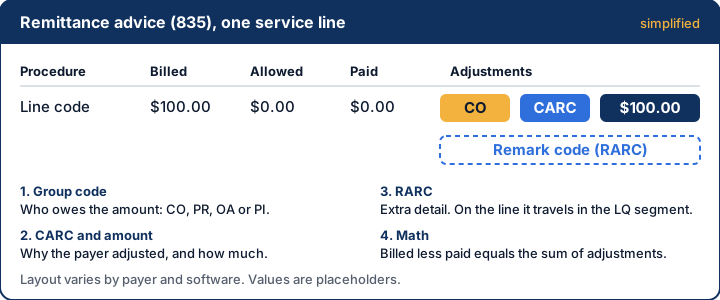
The group code is CO, so a patient statement is not the next step. Match the approval's dates, code list and facility to the denied line. If the approval was in place, send a corrected claim with the number. If it was never obtained, ask whether retro review is open at that payer.
A hospital outpatient line returns CO-197 for $890.00 with RARC N54.
Where does CO-197 hit hardest?
It is most common in radiology billing for advanced imaging, in orthopedic billing for surgery and implants, and in oncology billing for infused drugs. Related codes are CO-204, service not covered under the plan, and CO-236. If these denials keep coming back, our denial management team can work them.
Related codes
- X12 claim adjustment reason codes list · X12
- X12 remittance advice remark codes list · X12
- X12 claim adjustment group codes list · X12
- Medicare Claims Processing Manual, chapter 26 (CMS-1500 completion) · CMS
- 42 CFR 419.82, prior authorization for certain hospital outpatient department services · eCFR
- 42 CFR 419.83, list of hospital outpatient department services requiring prior authorization · eCFR
- Prior Authorization for Certain Hospital Outpatient Department (OPD) Services · CMS
- Medicare Claims Processing Manual, chapter 22, sections 60.1 to 60.3 (group codes, CARC, RARC on the remittance) · CMS
We check every rule, code and deadline against the official source. See our editorial policy.
Common questions
Straight answers from the team that does the work.
Ask a billing lead directly. A 20-minute call, Monday to Friday, 9am to 5pm Eastern.
01What does CO-197 mean?
CO-197 means precertification, authorization, notification or pre-treatment is absent. It can mean nothing was requested, or that what exists does not match the claim. Read the remark code. N54 says the claim is inconsistent with the authorization, and M62 says the authorization code is missing or invalid.
02How do I fix CO-197 when authorization was obtained?
Pull the approval and compare provider, dates, procedure codes and units to the claim. If the number was missing or the claim differs, send a corrected claim. If the approval truly does not cover the service, ask the payer whether it will amend it before you appeal.
03Can I appeal a CO-197 denial?
Usually yes, but the basis matters. Appeals that show an authorization was issued, or that the payer's policy excused the requirement, fare better than pleading that care was needed. Follow the appeal deadline in your contract, and for Medicare see the appeal levels page.
04Does Medicare deny claims without prior authorization?
For listed hospital outpatient services, yes. 42 CFR 419.82(b)(1) says CMS or its contractors will deny a claim for a listed service if the provider has not received a provisional affirmation. The categories are in 42 CFR 419.83(a). Services outside that list are not subject to this rule.
05How long does Medicare take to decide a prior authorization request?
CMS says standard decisions take 7 calendar days for requests submitted on or after January 1, 2025, and expedited requests take 2 business days. Expedited review needs documentation that delay would seriously jeopardize the patient's life, health or ability to regain maximum function.


Authorizations that exist but do not match?
We compare each approval to the claim before it goes out.