
CO-4 denial code: procedure code conflicts with modifier
CO-4 is a claim adjustment reason code that tells you the procedure code on a service line is inconsistent with the modifier used on that line. The correction is made on that line, and which kind of correction depends on the remark code beside it.
 Written by Salman Saeed, CEO and Co-Founder · Reviewed by a Certified Medical Coder · Last reviewed October 2026
In short: CO-4 means the modifier and the procedure code on one line do not fit together. Read the RARC for the reason (N822 missing, N823 invalid, N519 bad combination), fix the line, then use a reopening for a Medicare clerical error or a redetermination if you disagree with the coding decision.
What does CO-4 mean on a remittance?
X12 defines claim adjustment reason code (CARC) 4 as: "The procedure code is inconsistent with the modifier used." The X12 list shows a start date of 01/01/1995, a last-modified date of 03/01/2020, and a usage note to look at the 835 Healthcare Policy Identification Segment (loop 2110 REF) when it is present.
The CO in front is the group code, which X12 names "Contractual Obligation". The CARC says what the payer found, and the RARC beside it says more. Read CO-4 against the individual service line, not the claim as a whole. Reviewed October 25, 2026.
Which RARCs explain a CO-4?
X12 does not tie CO-4 to one remark code, so the RARC on your 835 decides what to fix. These are the remark codes whose X12 wording points at modifiers.
| RARC | X12 wording | Where to look |
|---|---|---|
| N519 | Invalid combination of HCPCS modifiers. | Two or more modifiers on the same line that do not belong together. |
| N822 | Missing procedure modifier(s). | A code that needs a modifier and went out without one. See N822. |
| N823 | Incomplete/invalid procedure modifier(s). | A modifier that is mistyped or does not exist for that code. |
| N657 | This should be billed with the appropriate code for these services. | The code itself, not the modifier, may be the problem. |
| N837 | Alert: Missing modifier was added. | The payer added the modifier itself. Check your own charge, since the line was adjusted. |
Which modifier rules produce a CO-4?
The 2026 NCCI Policy Manual, chapter 1, says a modifier may be appended only if the clinical circumstances justify it, and never solely to get past an NCCI procedure-to-procedure edit. It sorts the modifiers that can bypass an NCCI edit into anatomic modifiers, global surgery modifiers (24, 25, 57, 58, 78, 79) and others (27, 59, 91, XE, XS, XP, XU).
The same chapter says modifiers 22, 76 and 77 do not bypass an NCCI edit. Each pair carries a correct coding modifier indicator: 0 means no modifier can bypass it, 1 means one may under the right circumstances, 9 means not specified. For the two most-used bypass modifiers, see modifier 25 and modifier 59.
Therapy claims have their own rule. Medicare Claims Processing Manual chapter 5, section 20, says GN, GO and GP apply only to speech-language pathology, occupational therapy and physical therapy plans of care. For institutional claims, Medicare edits that a GN, GO or GP is present on lines with revenue codes 042X, 043X or 044X, that no more than one sits on a line, that revenue code 42x lines carry only GP and that 43x lines carry only GO. See physical therapy billing.
How do you fix a CO-4 denial?
A reopening is discretionary and is not appealable. Chapter 34, section 10, adds that requesting one does not stop the clock on an appeal. If the contractor stands by a coding decision and the line was right, the route is a redetermination, which chapter 29 says must be filed within 120 days of receiving the notice. See Medicare appeal levels.
How do you read CO-4 on the remittance?
On the 835 the group code, the reason code and the dollar amount travel together on the service line, and the remark code rides in the LQ segment of that same line. For CO-4 the remark code is the instruction. CMS chapter 22 says remarks at the line level go in the LQ segment and those for the whole claim go in MOA (outpatient) or MIA (inpatient).
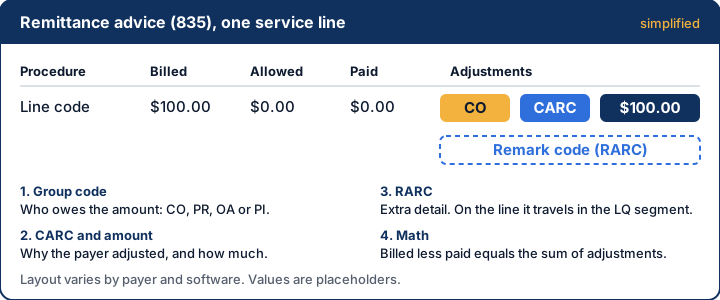
The code you correct is the one in item 24D or FL 44, so find the matching line first. Do not touch the other lines on the claim. CO means the adjustment is a contractual write-off unless you correct and resubmit, so a patient bill is not the next step.
Line 2 of a clinic claim returns CO-4 for $75.00 with RARC N822.
Where else does this show up?
CO-4 is a first stop for dermatology billing, where procedures and visits share a day, and for emergency medicine billing. Its neighbours are CO-11, where the diagnosis conflicts with the procedure, and CO-16, where information is missing. If these denials keep coming back, our denial management team can work them.
Related codes
- X12 claim adjustment reason codes list · X12
- X12 remittance advice remark codes list · X12
- X12 claim adjustment group codes list · X12
- Medicare NCCI Policy Manual 2026, chapter 1 (revision date 1/1/2026) · CMS
- Medicare Claims Processing Manual, chapter 5, section 20 (therapy modifiers) · CMS
- Medicare Claims Processing Manual, chapter 26 (CMS-1500 items) · CMS
- Medicare Claims Processing Manual, chapter 34, section 10 (reopenings) · CMS
- Medicare Claims Processing Manual, chapter 29, section 220 (redetermination) · CMS
- Medicare Claims Processing Manual, chapter 22, sections 60.1 to 60.3 (group codes, CARC, RARC on the remittance) · CMS
- Medicare Claims Processing Manual, chapter 25, section 75 (UB-04 form locators 42 and 44) · CMS
We check every rule, code and deadline against the official source. See our editorial policy.
Common questions
Straight answers from the team that does the work.
Ask a billing lead directly. A 20-minute call, Monday to Friday, 9am to 5pm Eastern.
01What does CO-4 mean and which modifier is missing?
CO-4 means the payer found the procedure code inconsistent with the modifier on the line. It does not name the modifier. The RARC does: N822 points to a missing modifier, N823 to an invalid one, and N519 to a bad combination. Compare that remark code with the service line before you change anything.
02Can I add modifier 59 to clear a CO-4?
Only if the chart supports a distinct service. The 2026 NCCI Policy Manual says a modifier must not be appended solely to bypass an edit when the clinical circumstances do not justify it, and that on a pair with indicator 0 no modifier bypasses it. Adding 59 blindly can turn one denial into an audit risk.
03Is CO-4 an appeal or a corrected claim?
For Medicare it is usually a reopening. Chapter 34 of the Claims Processing Manual treats the use of a modifier as a clerical error, handled as a reopening, available within 1 year for any reason. If the line was right and the payer disagrees, a redetermination within 120 days is the appeal route.
04Does CO-4 mean my procedure code is wrong?
Not necessarily. X12 words it as the code and modifier being inconsistent with each other, so either could be the problem. RARC N657 says the service should be billed with a different code, but N822, N823 and N519 point at the modifier. Check the chart before deciding which to change.
05How many modifiers fit on one CMS-1500 line?
Four. Medicare chapter 26 says item 24D has the capacity to capture up to four modifiers with the HCPCS code. A line that needs more than four needs a closer look at whether each one is justified, since an invalid combination is exactly what N519 reports.

Modifier denials coming back?
We check each modifier against the note and the code pair before the claim goes out.