
CO-19 denial code: work-related injury, workers' comp liable
CO-19 says the payer reads the visit as a work injury or illness and points you to the workers' compensation carrier. The patient may still have coverage for other care.
 Written by Salman Saeed, CEO and Co-Founder · Reviewed by a Certified Medical Coder · Last reviewed October 2026
In short: CO-19 means the payer treats the injury as work related and the workers' compensation carrier as liable. Confirm the cause with the patient, bill the carrier with a claim number, and resubmit to the health plan only after the carrier decides.
What does CO-19 mean for a work-related injury?
X12 defines claim adjustment reason code (CARC) 19 as: "This is a work-related injury/illness and thus the liability of the Worker's Compensation Carrier." The list gives a start date of 01/01/1995 and a last-modified date of 09/30/2007.
In plain terms, the payer reads the claim as an on-the-job injury or illness and sends you to the workers' compensation insurer instead. It does not say the patient has no coverage. It says this plan is not the first payer for this visit. X12 gives CARC 19 no group code usage note, so post the group code the payer printed. Reviewed October 26, 2026.
How does CARC 19 differ from 20 and 21?
| CARC | X12 wording | Who the payer points to |
|---|---|---|
| 19 | This is a work-related injury/illness and thus the liability of the Worker's Compensation Carrier. | Workers' compensation |
| 20 | This injury/illness is covered by the liability carrier. | A liability insurer |
| 21 | This injury/illness is the liability of the no-fault carrier. | A no-fault insurer |
All three share a start date of 01/01/1995 and a last-modified date of 09/30/2007. They are close cousins of CO-22, which says another payer may be responsible under coordination of benefits. CARC 19 names the kind of payer; CO-22 does not.
What does Medicare say about workers' compensation?
Medicare Secondary Payer Manual chapter 1, section 20.4, states that Medicare is secondary to workers' compensation plans, citing 42 CFR 411.40. It adds that payment may not be made for items and services to the extent that payment has been made, or can reasonably be expected to be made, under a workers' compensation law or plan.
Two exceptions in the same manual matter for billing. If workers' compensation cannot pay because a service was furnished by a source not authorized by that program, Medicare can pay. And if payment has not been made and cannot be expected promptly, Medicare may make a conditional payment, which is repaid when the primary plan pays. See Medicare Secondary Payer.
Which claim fields flag a work injury?
On the CMS-1500, items 10a through 10c ask whether the condition relates to employment, auto liability or other accident. Chapter 26 says any item checked YES indicates there may be other insurance primary to Medicare, and item 11 must be completed to show a good faith effort to find the primary payer. A wrong YES or NO here is a common source of this denial.
A claim sent to a health plan with item 10a marked NO for what was in fact a job injury gives the payer nothing to flag until the remit tells you. Registration should ask how and where the injury happened, for every injury visit, not only those labeled occupational.
Which workers' compensation remark codes can follow?
| RARC | X12 wording | Reading |
|---|---|---|
| N625 | Missing/Incomplete/Invalid Workers' Compensation Claim Number. | Get the claim number from the employer or carrier. |
| N624 | The associated Workers' Compensation claim has been withdrawn. | The case may no longer be a workers' compensation claim. |
| N612 | Medical provider not authorized/certified to provide treatment to injured workers in this jurisdiction. | Check your state authorization. X12's P16 gives the same wording and says to use it with group code CO or OA. |
| N728 | A workers' compensation insurer has reported having ongoing responsibility for medical services (ORM) for this diagnosis. | Another insurer owns this diagnosis. |
What do you do with a CO-19?
Our workers' comp and no-fault billing team handles carrier bills, fee schedule rules and denial follow-up.
How does CO-19 read on the remittance?
X12 gives no group code for CO-19, so the group on the line decides the next step. The remark (N625, N624, N612 or N728) is on the line. The claim has to go to the workers compensation carrier. CARC 20 and 21 are the neighbours for liability and no-fault.
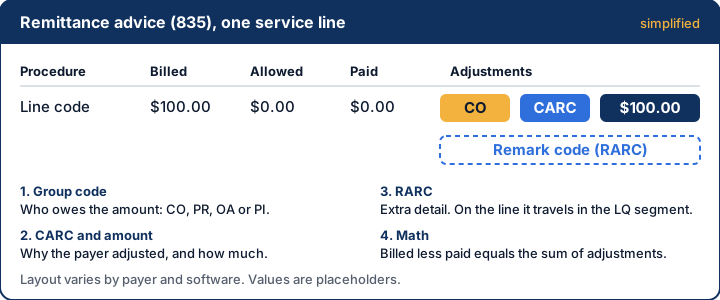
Example of a CO-19 at urgent care
A warehouse worker comes to an urgent care clinic with a wrist injury and gives his health plan card. Item 10a is marked NO.
This turns up in urgent care billing, orthopedic billing and chiropractic billing. Related codes are CO-31 and CO-5. If these denials keep coming back, our denial management team can work them.
Related codes
- X12 claim adjustment reason codes list · X12
- X12 remittance advice remark codes list · X12
- X12 claim adjustment group codes list · X12
- Medicare Secondary Payer Manual, chapter 1, sections 10 and 20.4 · CMS
- Medicare Claims Processing Manual, chapter 26 (CMS-1500 items and place of service codes) · CMS
- Medicare Claims Processing Manual, chapter 22, sections 60.1 to 60.3 (group codes, CARC, RARC on the remittance) · CMS
We check every rule, code and deadline against the official source. See our editorial policy.
Common questions
Straight answers from the team that does the work.
Ask a billing lead directly. A 20-minute call, Monday to Friday, 9am to 5pm Eastern.
01What do I do with CO-19 work-related denials?
Confirm with the patient whether the injury happened at work, then bill the workers' compensation carrier with the claim number. If it declines, ask for the written decision and ask the health plan what it needs. Watch the health plan's filing deadline while you wait.
02Does CO-19 mean the patient has no insurance?
No. X12 words it as a work-related injury or illness that is the liability of the workers' compensation carrier. The patient may be fully covered by the health plan for non-work conditions. This plan is simply pointing to a different primary payer for this visit.
03How is CO-19 different from CO-20 and CO-21?
X12 words CARC 20 as covered by the liability carrier and CARC 21 as the liability of the no-fault carrier. CARC 19 names the workers' compensation carrier. Each one tells you which kind of payer should be billed first, so use the one on the remit.
04Does Medicare pay for a work injury?
Medicare is secondary to workers' compensation under 42 CFR 411.40, as the Medicare Secondary Payer Manual states. If workers' compensation cannot pay because the source was not authorized, Medicare can pay. If payment is not made promptly, Medicare may make a conditional payment subject to repayment.
05Which CMS-1500 items matter on a possible work injury?
Items 10a through 10c ask whether the condition involves employment, auto liability or other accident, and item 11 documents the search for a primary payer. Medicare chapter 26 says any YES in 10a to 10c indicates there may be other insurance primary to Medicare.

Work injury claims bouncing?
We route injury visits to the right carrier and chase the written decision.