
CO-5 denial code: code conflicts with place of service
CO-5 is a claim adjustment reason code that says the procedure code or bill type does not fit the place of service on the claim. The payer cannot tell which one is wrong, so you have to.
 Written by Salman Saeed, CEO and Co-Founder · Reviewed by a Certified Medical Coder · Last reviewed October 2026
In short: CO-5 means the procedure code or type of bill is inconsistent with the place of service. Read the remark code, confirm the real setting and status from the chart, correct the field that is wrong, and send a corrected claim before the filing limit runs.
What does CO-5 say about the place of service?
X12 defines claim adjustment reason code (CARC) 5 as: "The procedure code/type of bill is inconsistent with the place of service." The list adds the usage note "Refer to the 835 Healthcare Policy Identification Segment (loop 2110 Service Payment Information REF), if present," a start date of 01/01/1995 and a last-modified date of 03/01/2018.
The wording covers two claim types. On a professional claim the conflict is between the procedure code and the place of service code. On an institutional claim it is between the code and the bill type. X12 attaches no group code usage note to CARC 5, so read the group code the payer printed. Reviewed October 26, 2026.
Where do these fields sit on the claim?
| Claim | Field | What goes there |
|---|---|---|
| CMS-1500 | Item 24B | The two-digit place of service code for each service line |
| CMS-1500 | Item 32 | Service facility location, which should match the setting in 24B for most office services |
| UB-04 | Form locator 4 | The four-character type of bill; CMS reads the leading zero as ignored, so the second digit is the type of facility and the third the type of care |
Medicare chapter 26 says the place of service code in item 24B must come from the national code set, and chapter 25 describes form locator 4 as a four-digit code where the fourth digit is the frequency of the bill.
What does Medicare do with a mismatch?
Chapter 26, section 10.6, tells the Medicare Administrative Contractor (MAC) to edit for consistency between the place of service and site-specific procedure codes. Its example is a valid place of service that conflicts with the procedure, such as inpatient hospital paired with an office visit code. In that case the manual says to return the service as unprocessable, because the contractor typically will not know whether the procedure code or the place of service is wrong.
The payer cannot say which field is wrong, so the fix is your call. Open the chart, confirm where the patient was physically seen and under what status, then correct the field that is wrong.
Which place of service codes cause the most trouble?
The Medicare code set in chapter 26, section 10.5, marks each code as facility or non-facility for fee schedule payment.
| POS | Setting | Medicare payment rate |
|---|---|---|
| 11 | Office | Non-facility |
| 19 | Off campus outpatient hospital | Facility |
| 20 | Urgent care facility | Non-facility |
| 22 | On campus outpatient hospital | Facility |
| 23 | Emergency room, hospital | Facility |
| 24 | Ambulatory surgical center | Facility |
Section 10.6 also carries an exception that trips up provider-based clinics. For a patient who is a registered outpatient of a hospital, the correct place of service is the outpatient hospital code, at a minimum 19 for off campus or 22 for on campus, regardless of where the face-to-face service happens. A clinic billing POS 11 for such a patient is the standard route to a CO-5. See place of service codes and provider-based billing.
Which remark codes come with it?
| RARC | X12 wording | Reading |
|---|---|---|
| M77 | Missing/incomplete/invalid/inappropriate place of service. | The place of service field itself is the issue. |
| N428 | Not covered when performed in this place of service. | The code is not payable in that setting. |
| N535 | Payment is adjusted when procedure is performed in this place of service based on the submitted procedure code and place of service. | Paid, but at the rate for that setting. |
| MA30 | Missing/incomplete/invalid type of bill. | On an institutional claim, check form locator 4. |
| N93 | A separate claim must be submitted for each place of service. Services furnished at multiple sites may not be billed in the same claim. | Split by setting. |
How do you fix a CO-5?
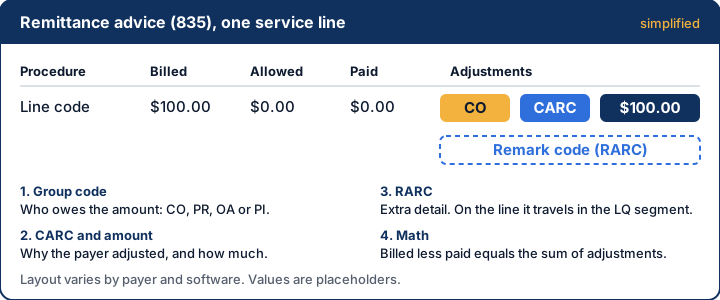
How does CO-5 read on the remittance?
X12 gives no group code for CO-5. The remarks M77, N428, N535, MA30 and N93 are on the page. Compare the code with the place of service in item 24B, or the bill type in FL 4 on a facility claim. A mismatch there is the usual cause.
Example of a CO-5 at an urgent care
A hospital-owned urgent care clinic bills an office visit with POS 11. The patient is a registered outpatient of the hospital.
This is frequent in urgent care billing, emergency medicine billing and ambulatory surgery center billing. Look-alikes are CO-58, where X12 says the payer deemed treatment rendered in an inappropriate or invalid place of service, and CO-19. If these denials keep coming back, our denial management team can work them.
Related codes
- X12 claim adjustment reason codes list · X12
- X12 remittance advice remark codes list · X12
- Medicare Claims Processing Manual, chapter 26 (CMS-1500 items and place of service codes) · CMS
- Medicare Claims Processing Manual, chapter 25 (UB-04 form locator 4) · CMS
- Medicare Claims Processing Manual, chapter 22, sections 60.1 to 60.3 (group codes, CARC, RARC on the remittance) · CMS
We check every rule, code and deadline against the official source. See our editorial policy.
Common questions
Straight answers from the team that does the work.
Ask a billing lead directly. A 20-minute call, Monday to Friday, 9am to 5pm Eastern.
01What does CO-5 say about place of service?
X12 defines CARC 5 as the procedure code or type of bill being inconsistent with the place of service. It means the code and the setting you reported do not fit each other. The payer cannot tell which field is wrong, so the chart decides what to correct.
02Is CO-5 always paired with the CO group code?
No. X12 attaches no group code usage note to CARC 5, so the group code comes from the payer. Read the one printed on the remit and post it as sent. Do not assume a CO line is a write-off until you have checked what the payer means by it.
03Can I fix a CO-5 by changing only the procedure code?
Only if the procedure code is the wrong field. Medicare chapter 26 says the contractor usually cannot tell whether the code or the place of service is wrong. Confirm the setting and the service from the chart, then change the field that does not match.
04What place of service applies to a hospital outpatient seen in a clinic?
Medicare chapter 26, section 10.6, says a registered hospital outpatient gets the outpatient hospital code, at least 19 for off campus or 22 for on campus, regardless of where the visit happens. Billing POS 11 for that patient can produce a place of service conflict.
05Does a bill type error cause CO-5?
It can. X12 words the code as the procedure code or type of bill being inconsistent with the place of service. On a UB-04, check form locator 4 first. RARC MA30 means the type of bill is missing, incomplete or invalid, which is a related but separate problem.

Place of service edits recurring?
We trace each setting and status back to the chart before the claim goes out.