
CO-140 denial code: member ID and name do not match
CO-140 is a claim adjustment reason code that says the patient or insured health identification number and name do not match. The ID and the name on the claim point to different people, or to nobody, in the payer's eligibility file. It is a data match problem, not a coverage decision.
 Written by Salman Saeed, CEO and Co-Founder · Reviewed by a Certified Medical Coder · Last reviewed October 2026
In short: CO-140 means the ID and the name on the claim do not agree with the payer's record. Compare the claim with the card, run a live eligibility check with ID, name and date of birth, correct the registration record and resubmit. The group code on the remit shows who owes the balance if the claim cannot be fixed.
What does CO-140 mean?
X12 defines claim adjustment reason code (CARC) 140 as: "Patient/Insured health identification number and name do not match." The list gives a start date of 06/30/1999 and shows no later modification. Reviewed October 26, 2026.
X12 attaches no usage note to 140, so read the group code on the remittance advice to see who owes any balance. The payer's complaint is narrow. It is not saying the service is excluded or the patient lost coverage. It is saying the pair of ID and name on the claim does not line up with the member file.
The nearest code is CARC 31, worded by X12 as "Patient cannot be identified as our insured." See CO-31. Read 31 as no member found. Read 140 as an ID and a name that disagree.
Which remark codes explain the mismatch?
X12 does not pair a remark code with CARC 140. These remittance advice remark codes name the field that failed, so check which one prints beside it.
| RARC | X12 wording | Reading |
|---|---|---|
| MA27 | Missing/incomplete/invalid entitlement number or name shown on the claim. | Medicare-style wording for the ID or name field. |
| MA36 | Missing/incomplete/invalid patient name. | Look at spelling, order and suffix of the name. |
| N382 | Missing/incomplete/invalid patient identifier. | Look at the ID, character by character. |
| N329 | Missing/incomplete/invalid patient birth date. | A wrong date of birth can break the match as well. |
What does Medicare match on?
The CMS fact sheet MLN8816413, Checking Medicare Eligibility (November 2025), says you need the patient's Medicare Beneficiary Identifier (MBI), first and last name, and date of birth in MM/DD/YYYY form. It adds that when the information matches a Medicare record, Medicare returns an eligibility response with entitlement, deductibles and coinsurance.
The claim side uses the same pair. In chapter 26 of the Medicare Claims Processing Manual, section 10.2, Item 1a of the CMS-1500 is the patient's Medicare beneficiary identifier and Item 2 is the patient's last name, first name and middle initial "as shown on the patient's Medicare card." Item 4 carries the insured's name when another insurer is primary.
The same fact sheet says an eligibility response for a Medicare Advantage enrollee shows the plan, and to direct your query to the plan it names. A claim sent to the wrong payer leads to CO-109, not to this code.
How do you fix a CO-140?
How does CO-140 read on the remittance?
X12 gives no group code for CO-140 and the remark names the mismatch: MA36, N382, MA27 or N329 on the page above. Medicare matches on the MBI, first and last name and date of birth (MLN8816413). Item 1a of the CMS-1500 carries the insured ID. Check each field against the card before you resend.
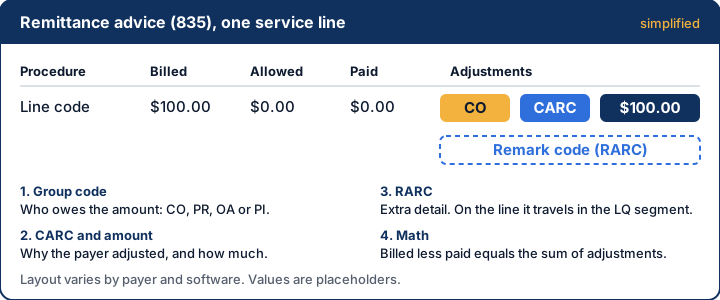
A claim returns CO-140 for $130.00 with RARC MA27.
Where does CO-140 show up?
It lands wherever registration is done fast or after treatment. That includes emergency medicine billing and urgent care billing, where the card or ID may be keyed from what the patient can say. In pediatric billing, compare the child's name to the plan file, because the child may be listed under a parent's ID. When the member truly is not on file, the answer is CO-31, and a claim missing a field is CO-16. If these denials keep coming back, our denial management team can work them.
Related codes
- X12 claim adjustment reason codes list · X12
- X12 remittance advice remark codes list · X12
- MLN8816413 Checking Medicare Eligibility (November 2025) · CMS
- Medicare Claims Processing Manual, chapter 26, completing the CMS-1500 · CMS
- Medicare Claims Processing Manual, chapter 22, sections 60.1 to 60.3 (group codes, CARC, RARC on the remittance) · CMS
We check every rule, code and deadline against the official source. See our editorial policy.
Common questions
Straight answers from the team that does the work.
Ask a billing lead directly. A 20-minute call, Monday to Friday, 9am to 5pm Eastern.
01What does CO-140 mean and how do I confirm the member ID?
X12 words CARC 140 as: patient or insured health identification number and name do not match. Confirm the ID with a live eligibility response using the ID, first and last name and date of birth, then compare it with both sides of the card. Correct the claim to match the plan's file.
02Is CO-140 a coverage denial?
No. The X12 wording is about a mismatch between the ID and the name, not about excluded services or lost coverage. Fix the data and resubmit. If the payer's answer is that the member is not on file, that is the territory of CARC 31, covered under CO-31.
03How is CO-140 different from CO-31?
X12 words CARC 31 as: patient cannot be identified as our insured. CARC 140 says the ID and the name do not match. In practice 31 means the payer found no member, while 140 means the two fields on your claim disagree with each other or with its file.
04Which remark codes appear with CO-140?
X12 pairs none. MA36 flags a missing, incomplete or invalid patient name, N382 flags the patient identifier, MA27 flags the entitlement number or name, and N329 flags the birth date. Whichever prints beside the 140 tells you the field to check first.
05What does Medicare need to confirm a patient's eligibility?
The CMS fact sheet MLN8816413 lists the patient's MBI, first and last name, and date of birth in MM/DD/YYYY form. When the information matches a Medicare record, Medicare returns an eligibility response. A mismatch in any of the three is the likely reason for an ID-and-name denial.
06Can I bill the patient after a CO-140?
Wait. The claim usually can still pay once the ID or name is corrected, so a statement sent now may be wrong. Read the group code, fix the data, resubmit, and bill the patient only for the balance the corrected remit assigns to them.

ID and name denials slowing your cash?
We check ID, name and date of birth against a live eligibility response before the claim goes out.