
CPT 90791: psychiatric diagnostic evaluation
90791 reports a psychiatric diagnostic evaluation that has no medical services in it. The clinician takes the history, assesses symptoms and reaches a diagnosis, and Medicare allows 1 unit per date of service. It is the usual intake code for a new therapy or psychiatry patient.
 Written by Salman Saeed, CEO and Co-Founder · Reviewed by a Certified Medical Coder · Last reviewed October 2026
In short: 90791 is the evaluation-only intake code. NCCI policy keeps it off the same day as psychotherapy or an E/M visit, and the CY 2026 final rule made it an allowed initiating visit for community health integration.
What does CPT 90791 report?
90791 is the psychiatric diagnostic evaluation without medical services. Chapter XI of the NCCI Policy Manual sets it apart from 90792, the evaluation that includes medical E/M work. Practitioners who add medical services at the same visit, such as a psychiatrist reviewing medication, look to 90792 or an E/M code instead, according to the First Coast Service Options billing article A57520.
| Item | Value in the file |
|---|---|
| Short label CMS uses | Psych diagnostic evaluation |
| Payment status | A (active code) |
| Work RVU | 3.84 |
| Non-facility total RVU | 5.19 |
| Facility total RVU | 4.11 |
| Global period | XXX |
| MUE | 1 per date of service, adjudication indicator 3 (clinical) |
It is an intake code: the clinician takes a history, assesses symptoms and reaches a working diagnosis. It is not a timed code, so no minute threshold applies the way it does for 90834 or 90837.
When can you bill 90791, and what cannot go with it?
Bill 90791 for the evaluation and nothing else that day. NCCI Policy Manual Chapter XI, section C, says 90791 and 90792 are not separately reportable with individual, group, family, crisis or other psychotherapy codes for the same date of service.
- E/M codes such as 99202 to 99215 are not reported with 90791 or 90792, per the same section of Chapter XI.
- Neurobehavioral status exams 96116 and 96121 are not reported with 90791.
- Psychological testing evaluation (96130 to 96133) and test administration (96136 to 96146) on the same date must be distinct services from the interview.
- The First Coast article says not to report psychotherapy for crisis (90839) with 90791 or 90792.
A licensed clinical social worker meets a new patient for an intake and bills 90791. The first follow-up session a week later is billed by its length, as 90834 or 90837, and not as a second evaluation.
What changed for 90791 in 2026?
The CY 2026 fee schedule final rule lets 90791 serve as the initiating visit for community health integration (CHI) services. CHI is a monthly service, HCPCS G0019, in which trained auxiliary personnel such as a community health worker help a patient with needs that get in the way of diagnosis or treatment, and it requires an initiating visit.
CMS declined to accept every psychotherapy code from 90791 to 90853 as an initiating visit, writing that 90791 and the health behavior assessment and intervention codes are the services most analogous to E/M visits (90 FR 49481 to 49482).
The same rule keeps HCPCS G0136, the standardized physical activity and nutrition risk assessment, billable with 90791. The rule limits G0136 to once every 6 months per practitioner per beneficiary.
Who can bill 90791, and can it be done by telehealth?
MLN1986542 lists physicians, clinical psychologists, clinical social workers, clinical nurse specialists, nurse practitioners, physician assistants, certified nurse-midwives, marriage and family therapists and mental health counselors among the Part B professionals for mental health services.
90791 is on the CMS Medicare telehealth list for calendar year 2026 with the action "Maintain", and MLN1986542 marks it as a current telehealth code. Telehealth claims use POS 02 or POS 10, per the CMS telehealth FAQ. The full telehealth setup for therapy practices is on mental health billing, and the GT modifier page covers the institutional case.
How does 90791 appear on the claim?
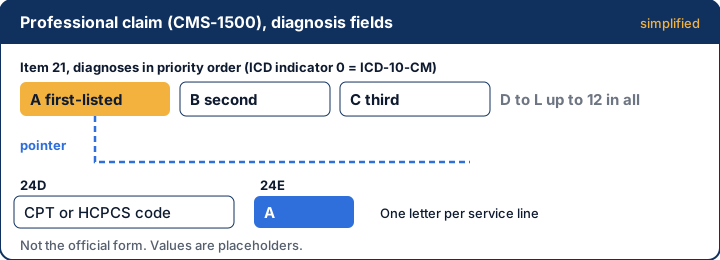
On the CMS-1500, Item 24D carries 90791 and Item 24G carries 1 unit, which matches the MUE of 1. Item 24E points to the diagnosis from the mental health diagnosis list, and the First Coast article adds that when a patient arrives with an organic diagnosis and a mental health diagnosis is established, the mental health diagnosis is the one billed.
Which claim fields does 90791 use?
A diagnostic evaluation is billed once, so Item 24D carries 90791 and Item 24G carries 1. Item 24A holds the date of the evaluation session and Item 24B the place of service. Chapter 26 gives each service line only one pointer letter in Item 24E, so choose the primary mental health diagnosis from Item 21 for the line.
RVU26D gives 90791 status A with a work RVU of 3.84 and global XXX. The MUE table allows 1 per date with indicator 3, so a second evaluation on the same date cannot be billed by adding units.
Example: A new patient is evaluated on 10/07 for depression. Item 21 reads A F32.1. The line is 90791, pointer A, 1 unit, $225.00, with a note that records the history, mental status and diagnosis. If the line points to a letter with no diagnosis behind it, the payer returns it under CO-16.
Why is 90791 denied?
| Code | What X12 says | What usually causes it |
|---|---|---|
| CO-97 | The benefit is included in the payment for another service already adjudicated | 90791 billed on the same date as psychotherapy or an E/M visit |
| CO-16 | Claim lacks information or has a submission or billing error | Missing diagnosis pointer or rendering provider detail |
| CO-170 | Payment is denied when billed by this type of provider | The plan does not list the billing license for evaluations |
| CO-151 | Information does not support this many or this frequency of services | A repeat evaluation inside the plan's limit |
| CO-24 | Charges are covered under a capitation or managed care plan | Behavioral health is carved out to a separate vendor |
If these denials keep coming back, our denial management team can work them. For the codes that follow an intake, see 90834, 90837 and 90839.
Related codes
- Physician Fee Schedule relative value files, RVU26D (October 2026) · CMS
- Medicare NCCI Medically Unlikely Edits, practitioner services table, effective 10-01-2026 · CMS
- 2026 NCCI Medicare Policy Manual, Chapter XI: Medicine and Evaluation and Management Services · CMS
- Medicare Claims Processing Manual, Chapter 26: Completing and Processing Form CMS-1500 Data Set · CMS
- Claim Adjustment Reason Codes · X12
- Billing and Coding: Psychiatric Diagnostic Evaluation and Psychotherapy Services (A57520), First Coast Service Options · CMS Medicare Coverage Database
- Medicare & Mental Health Coverage (MLN1986542, March 2026) · CMS
- List of Telehealth Services for Calendar Year 2026 · CMS
- Telehealth FAQ, updated October 2026 · CMS
- CY 2026 Physician Fee Schedule final rule (90 FR 49266) · Federal Register
We check every rule, code and deadline against the official source. See our editorial policy.
Common questions
Straight answers from the team that does the work.
Ask a billing lead directly. A 20-minute call, Monday to Friday, 9am to 5pm Eastern.
01What is the difference between 90791 and 90792?
90791 is the psychiatric diagnostic evaluation without medical services, and 90792 is the evaluation with medical services. NCCI Policy Manual Chapter XI describes them that way and bars E/M codes alongside either one. Use 90791 when the visit contains no medical work such as prescribing.
02How do I bill a psychiatric diagnostic evaluation?
Report 90791 in Item 24D of the CMS-1500 with 1 unit and a pointer to the mental health diagnosis. Do not add psychotherapy or an E/M code on the same date. For telehealth, use POS 02 or POS 10 according to where the patient is.
03Can I bill 90791 and psychotherapy on the same day?
No. NCCI Policy Manual Chapter XI, section C, says 90791 is not separately reportable with individual, group, family, crisis or other psychotherapy codes for the same date of service, because psychotherapy already includes continuing psychiatric evaluation. If both were provided, bill the one that matches the work.
04How many units of 90791 does Medicare allow per day?
The practitioner MUE table effective October 1, 2026 lists 90791 at 1 unit per date of service, with adjudication indicator 3, a date of service edit based on clinical rationale. Bill 1 unit on one claim line, and do not split the evaluation across two lines to get around the edit.
05Can 90791 be the initiating visit for community health integration?
Yes. In the CY 2026 final rule CMS finalized that 90791 or the health behavior assessment and intervention codes can serve as initiating visits for CHI services. CMS did not extend that to the other psychotherapy codes, such as 90834 or 90837, so those visits cannot start CHI.
06Is 90791 a telehealth service for Medicare?
Yes. It is on the CY 2026 CMS telehealth services list as a maintained code. Per the CMS telehealth FAQ updated in October 2026, use POS 02 when the patient is away from home and POS 10 when the patient is at home.



Intake claims bouncing back?
We check the same-day pairings and the plan's behavioral health carve-out before the claim goes out.