
CO-151 denial code: payer says the claim does not support this many services
CO-151 is a claim adjustment reason code that says the information submitted does not support this many services or this frequency. The payer is reducing or denying units, not questioning the diagnosis. The fix starts with counting what was billed against the limit that applies.
 Written by Salman Saeed, CEO and Co-Founder · Reviewed by a Certified Medical Coder · Last reviewed October 2026
In short: CO-151 means the payer adjusted payment because the claim does not back up the number or frequency of services billed. Check the units on the line, the frequency history and the payer limit, then send records if the extra units were needed. Medicare unit edits can be appealed to the MAC.
What does CO-151 mean?
X12 defines claim adjustment reason code (CARC) 151 as: "Payment adjusted because the payer deems the information submitted does not support this many/frequency of services." The list gives a start date of 10/31/2002 and a last-modified date of 01/27/2008.
Two problems hide in that sentence: a count problem, more units or visits than the payer allows, and a support problem, where the payer would allow the count if the record showed why. The remark code tells you which. Reviewed October 26, 2026.
Which remark codes come with CO-151?
| RARC | X12 wording | Reading |
|---|---|---|
| N640 | Exceeds number/frequency approved/allowed within time period. | A limit on how often or how many. Find the limit before you argue. |
| N435 | Exceeds number/frequency approved /allowed within time period without support documentation. | The limit can be passed with support. This is the one where records help. |
| N362 | The number of Days or Units of Service exceeds our acceptable maximum. | A per-line or per-day unit cap. Check the units you keyed. |
| M90 | Not covered more than once in a 12 month period. | A once-a-year service that was already used. |
| M86 | Service denied because payment already made for same/similar procedure within set time frame. | Same or similar service paid earlier. See CO-18 for true duplicates. |
N435 and N640 differ by three words, "without support documentation", and that gap decides the appeal. Under N435 the answer is usually the chart.
Is CO-151 the same as a Medicare unit edit?
Not by definition. The X12 description does not mention medically unlikely edits, and how a given payer maps its edits to CARC 151 is the payer's choice. Read the remark code and the payer policy together.
When Medicare is the payer, the edit to know is the MUE, the medically unlikely edit. Chapter I of the 2026 NCCI Policy Manual defines an MUE as the maximum units of service reported for a code on the vast majority of appropriately reported claims by the same provider for the same patient on the same date of service.
| MUE adjudication indicator | What the manual says | What it means for you |
|---|---|---|
| 1 | Claim line edit | Units on each line are compared to the value. Modifiers such as 59, XE, XP, XS, XU, 76, 77, 91 or anatomic modifiers may allow the same code on separate lines when the facts support it. |
| 2 | Date of service edit based on policy | Units above the value are contrary to policy. The manual says override on reopening or redetermination would be contrary to CMS policy. |
| 3 | Date of service edit based on clinical benchmarks | Units above the value are possible but medically highly unlikely. A contractor with evidence may pay the extra units. |
The manual says MUE denials may be appealed to the local claims processing contractor, and that with an indicator of 1 or 3 the MAC may pay correctly coded, medically necessary units above the value.
How do you work a CO-151?
How does CO-151 read on the remittance?
CO-151 reduces the line because the number of services is not supported. Read the units in item 24G or FL 46 against what the payer allowed. N640, N435, N362, M90 and M86 on the page above are the remarks that explain it. A medically unlikely edit with adjudication indicator 1, 2 or 3 is one cause, so compare the units on the line with the edit.
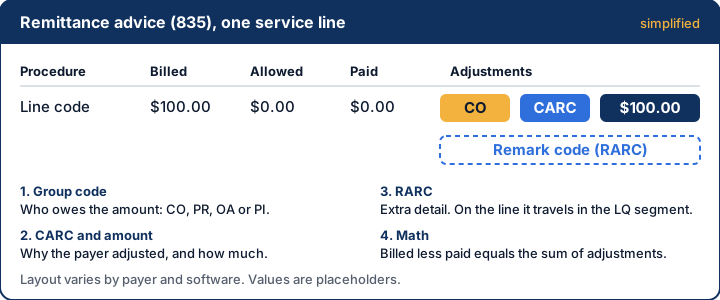
Example of a frequency denial
A clinic bills 6 units of one code on a single line. The payer limit for that code on one date of service is 4 units.
This denial is common in physical therapy billing, chiropractic billing and pain management billing, where repeat services are routine. Related codes are CO-167, diagnosis not covered, and CO-197, authorization absent. If these denials keep coming back, our denial management team can work them.
Related codes
- X12 claim adjustment reason codes list · X12
- X12 remittance advice remark codes list · X12
- X12 claim adjustment group codes list · X12
- Medicare NCCI Policy Manual 2026, all chapters · CMS
- Medicare Claims Processing Manual, chapter 26 (CMS-1500 completion) · CMS
- Medicare Claims Processing Manual, chapter 25 (UB-04 completion) · CMS
- Medicare Claims Processing Manual, chapter 22, sections 60.1 to 60.3 (group codes, CARC, RARC on the remittance) · CMS
We check every rule, code and deadline against the official source. See our editorial policy.
Common questions
Straight answers from the team that does the work.
Ask a billing lead directly. A 20-minute call, Monday to Friday, 9am to 5pm Eastern.
01What does CO-151 mean on a remit?
CO-151 means the payer adjusted payment because it deems the information submitted does not support this many services or this frequency. It is about units or how often, not about the diagnosis. Read the remark code beside it: N640 points to a limit, N435 to a limit that records can overcome.
02What is the difference between N640 and N435 with CO-151?
X12 words N640 as exceeding the number or frequency approved or allowed within a time period. N435 adds "without support documentation". With N435 the payer is inviting records that justify the extra services. With N640 check the limit and your unit count first.
03Can I appeal a Medicare unit denial?
Yes. The 2026 NCCI Policy Manual says MUE denials may be appealed to the local claims processing contractor. For an indicator of 1 or 3 the MAC may pay medically necessary units above the value. For an indicator of 2 the manual says override would be contrary to CMS policy.
04Where do units go on the claim form?
On the CMS-1500, the Medicare manual says item 24G holds the number of days or units. On the UB-04, FL 46 holds units of service, and for HCPCS-coded services the units equal the number of times the service was performed. Check both before assuming the payer is wrong.
05Is CO-151 the same as a duplicate denial?
No. A duplicate is CARC 18, an exact copy of a claim or line already held. CO-151 is about the count or frequency across services. M86 can appear beside either, so compare the dates, codes and units against the paid claim before you choose the fix.

Frequency denials stacking up?
We count units against the limit and send the notes that support the rest.