
Highmark billing: timely filing, corrected claims and appeals
Highmark's Provider Manual says that when your contract is silent, claims must be received within 365 days of the last date of service in Pennsylvania and West Virginia and within 180 days in Delaware. New York initial claims get 365 days. Since September 1, 2026, corrected claims have 455 days from the date Highmark finalized the original.
 Written by Salman Saeed, CEO and Co-Founder · Reviewed by a Certified Medical Coder · Last reviewed October 2026
In short: file inside the limit in your Highmark contract, or the manual default for your state if the contract is silent (365 days in PA, WV and NY, 180 in DE). Send corrected claims with bill type or frequency code 5 or 7 within 455 days of the original claim's finalization date, and run disputes through Availity.
Highmark filing, prior authorization and portal
Appeal levels
Top denials from Highmark
| Code | Meaning | Our fix |
|---|---|---|
| CO-197 | Precertification, authorization or notification absent | Request retrospective review with records, and appeal if the denial is for medical necessity. |
| CO-29 | The time limit for filing has expired | Resubmit with proof of the earlier timely submission along with the appeal. |
| CO-129 | Prior processing information appears incorrect (with N770 on adjusted claims) | Confirm the XX7 or XX8 replacement paid. No action on the original. |
| CO-16 | Claim lacks information or has submission or billing errors | Add the missing data and resubmit; use bill type XX7 with the original claim number if the claim already processed. |
What is the Highmark timely filing limit?
Your Highmark contract controls. Highmark's Provider Manual, Chapter 6, Unit 1, says claims not received within the time frame in your contract are denied for untimeliness. If the contract is silent, the manual sets 365 days from the last date of service in Pennsylvania and West Virginia and 180 days from the date of service in Delaware, unless the member's policy provides a different period.
| State | Limit when the contract is silent | Source in the manual |
|---|---|---|
| Pennsylvania | 365 days from the last date of service | 6.1 Timely Filing Policy |
| West Virginia | 365 days from the last date of service | 6.1 Timely Filing Policy |
| Delaware | 180 days from the date of service | 6.1 Timely Filing Policy |
| New York (initial claims) | 365 days from date of service, discharge or last treatment, counting weekends | New York Timely Filing Policy |
| Pennsylvania CHIP | 180 days from date of service or discharge | PA CHIP Timely Filing |
A secondary claim has the same limits with a different start. The manual says if Highmark is secondary, the claim must carry the primary payer's explanation of benefits and be received inside the same time frames, counted from the primary payer's finalized or payment date shown on that EOB.
If a claim denies for timely filing and you did file it inside 365 days, the New York policy says to resubmit the claim and the denial with your appeal. For the general rule on filing clocks, see timely filing limits by payer, and use the timely filing calculator once you have the limit from your contract.
How long do I have to send a corrected claim to Highmark?
Since September 1, 2026, Highmark requires corrected claims within 15 months, which is 455 calendar days, of the finalization date of the original claim. The Highmark news notices say corrected claims are identified by a bill type ending in 5 or 7 on facility claims or frequency code 5 or 7 on professional claims, and that later ones are denied for timely filing. The notices exclude corrected claims for BlueCard Home and the Federal Employee Program.
The clock starts at finalization, not receipt. Highmark defines the receipt date as the date it received the original claim and the finalization date as the date it completed processing, so the 455 days begin when the original claim finishes processing.
Highmark said its Provider Manual section 6.1 would be updated on September 1, 2026 to match. The May 2026 manual page this guide quotes for state defaults still showed the earlier New York corrected claim wording, so treat the news notice as the current rule for corrected claims.
Bill types and the original claim number
For facility claims, Unit 3 of Chapter 6 tells facilities to use adjustment bill types XX7, XX8 or XX5 for claims previously submitted on paper or electronically. The table in the manual separates the three.
| Bill type ending | Use | Highmark action |
|---|---|---|
| 5 | Late charges only. The manual says to use XX7 for BlueCard | Adjusts the original claim to add the charges |
| 7 | Replacement of a prior claim, restated in full | Treats the original as null and void and processes the replacement as a new claim |
| 8 | Void or cancel a prior claim | Cancels the bill completely from Highmark's system |
Highmark requires the original claim number for XX5, XX7 and XX8 claims sent through Availity Claims and Encounters or the 837I. Report it in the Adjustment Claim Link field. On the 835, Highmark denies the superseded claim with CARC CO-129, prior processing information appears incorrect, and adds RARC N770, which says the adjustment request was processed. That CO-129 is expected on adjusted claims, so check that the replacement paid before you chase it.
How do I submit claims and check status with Highmark?
Highmark expects facility claims electronically and routes status and inquiries through Availity. Unit 3 says Highmark requires facility providers to bill electronically on the 837 Institutional (837I), that UB claim submission is also available in Availity, and that paper UB-04 is allowed in some cases.
- Billing disputes: network participating providers can send an inquiry with Message this Payer in Availity, call Provider Services, or write to Customer Service.
- BlueCard members: open a Claim Inquiry in Availity rather than calling the member's home plan.
- Remittances: the manual says Delaware, Pennsylvania and West Virginia 835s come from PNC-ECHO Health Trust under ECHO payer ID 58379, and New York 835s come from either PNC-ECHO Health Trust under ECHO payer ID 55204 or Administrative Services of Kansas.
What are the Highmark appeal levels and deadlines?
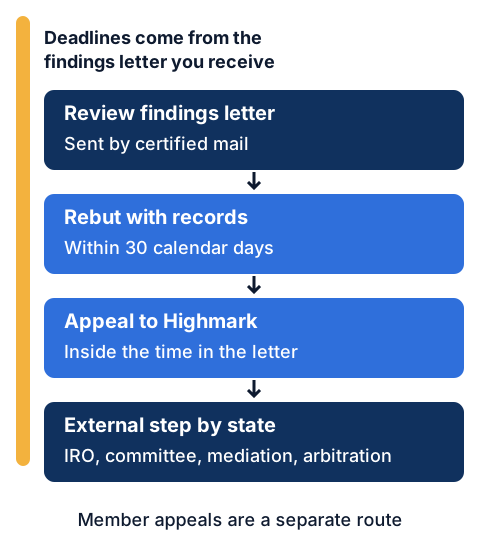
Highmark splits disputes into a billing dispute about how a claim processed and a post-payment review dispute about a coding or clinical review. The manual states no single day count for the billing dispute, and it sets deadlines for post-payment appeals in the letter you receive. Read each letter's date as the clock.
| State | Where the appeal can go after Highmark's internal review |
|---|---|
| Pennsylvania | Professional health service doctors: Medical Review Committee. Facilities: an IRO for coding issues, or mediation or arbitration for non-coding issues |
| Delaware | Medical necessity denials: Highmark Delaware Utilization Management appeal. Other denials: Provider Services. Coding: IRO. Then the Delaware Department of Insurance |
| West Virginia | Professional: appeal, then an IRO. Facilities: an IRO for coding, mediation or arbitration for non-coding |
| New York | Professional: an IRO. Facilities: mediation or arbitration under the contract; the manual describes arbitration with the American Health Lawyers Association in Buffalo or Albany |
Member appeals are separate. The manual says every Highmark policy has an anti-assignment provision, an assignment of benefits form is not valid, and a provider appeals as the member's authorized representative to use the member appeal route. In West Virginia, the Retroactive Denial Act gives the provider 40 days after a retroactive denial to say it will reimburse or ask for a written explanation, then 30 days to repay or give notice it disputes the denial.
What happens in a Highmark post-payment review, and how long can Highmark recover money?
Highmark's Financial Investigations and Provider Review unit selects providers by utilization and billing pattern against peers, reviews a statistically random sample of records, and usually uses a certified professional coder or registered nurse. It can also pend a claim for review before payment. The results come in writing by certified mail, and fax if applicable.
- Read the findings letter. The provider has 30 calendar days to rebut with clarification or supporting documentation.
- Ask in writing for the review worksheets, and ask for a meeting with the review staff if you want to go through the results, give more documents or discuss repayment arrangements.
- If you still disagree, request an appeal inside the time stated in the findings letter. A determination letter follows.
- Take the external step your state and provider type allow, shown in the table above.
For E/M reviews, Highmark checks the AMA CPT guidelines and the CMS documentation guidelines. The manual says each entry must show who documented it, with credentials, the date and the specific time, including start and stop times for timed services, and that cloned or conflicting records may be disallowed and counted at zero in the overpayment calculation. A reviewer who finds documentation that supports a higher code than billed gives credit for the underpayment.
| State | Law named in the manual | Recovery limit |
|---|---|---|
| West Virginia | Prompt Pay Act, W.Va. Code 33-45-1 and following | Retroactive denial of an entire paid claim within one year of the original payment. You then have 40 days to say you will repay or ask for a written explanation, and 30 days after the explanation to repay or dispute |
| Pennsylvania | Retroactive Denial of Reimbursement Act, 40 Pa. C.S. 3801 and following | No retroactive denial more than 24 months after the insurer's initial payment. Time you take to collect records Highmark requested is added to the 24 months |
| Delaware | Collection Overpayment Act, 18 Del. C. 2730 | No collection started more than 24 months after the original payment |
| New York | Insurance Law 3224-b | No recovery effort more than 24 months after the provider received the original payment, with 30 days written notice before further recovery efforts |
Each limit has exceptions the manual lists, including fraud, duplicate claims, self-funded plan requests, government program requirements and, in West Virginia, BlueCard claims. Check the exception list before you assume a recovery is out of time.
How do I check eligibility and submit prior authorization for Highmark members?
Highmark requires authorization for all inpatient admissions, medical and behavioral health, and for certain outpatient services, procedures, durable medical equipment and supplies, before you perform them. That comes from Chapter 5, Unit 2 of the Provider Manual; the detailed lists sit behind the Availity login.
Facilities should hold the claim until the authorization decision is final. Unit 3 recommends waiting to submit until all authorization determinations are made and, if inpatient admission is not authorized, until the facility decides whether to appeal. If the inpatient stay is judged not medically necessary, the outpatient services in the stay, including emergency and observation, may be billed.
If an inpatient claim went out before the final determination, the process is a void and a new claim: submit an XX8 adjustment to void the original inpatient claim, then bill the outpatient emergency or observation services. A facility that bills an inpatient stay with no preservice review and no authorization gets a denial; it can ask for retrospective review with the medical records, and appeal rights apply to a medical necessity denial.
What facility billing rules does Highmark set for hospitals and ERs?
| Rule | What the manual says |
|---|---|
| Professional services | Hospitals bill physician and associated professional services on an 837P, or in rare cases a 1500 claim form. If an audit finds professional services billed in error on an 837I or UB-04 claim, payments are retracted |
| NCCI edits | Highmark applies NCCI edits systematically to outpatient commercial and Medicare Advantage claims from acute care hospitals, based on the date of service. It follows quarterly CMS updates after CMS does, not on the CMS effective date |
| Off-campus departments | Report modifier PO with every HCPCS or CPT code for outpatient services at an off-campus provider-based department, in loop 2400 SV2 on the 837I or locator 44 on paper. Off-campus means more than 250 yards from the main buildings |
| Service facility location | Report it when it differs from the billing address, in loop 2310E on the 837I |
| Present on admission | Highmark can reduce payment when listed hospital-acquired conditions were not present on admission |
Highmark's Pennsylvania Billing Highlights, which show the UB-04 locator fields needed by facility type, sit in the Provider Resource Center behind Availity, under Claims and then Reimbursement Resources.
Which denials come up most on Highmark claims?
The manual's own examples point to authorization, adjustment and timeliness denials. The table maps each to the CARC you will see on the 835.
| Situation in the manual | CARC | Read more |
|---|---|---|
| Inpatient claim with no preservice review or authorization | CO-197, precertification/authorization/notification/pre-treatment absent | CO-197 |
| Corrected claim filed after the 455-day limit, or original claim after the contract or state default | CO-29, the time limit for filing has expired | CO-29 |
| Original claim superseded by an XX7 or XX8 adjustment | CO-129, prior processing information appears incorrect, with RARC N770 | See CO-18 for true duplicates |
| Claim missing required data elements | CO-16, claim lacks information or has submission or billing error(s) | CO-16 |
Overpayments show up on the remittance. Unit 7 says Highmark lists overpayments in a separate section of the EOB and 835, sends no letter, and deducts the amount from a later EOB or 835 about 60 days after notification unless you appeal or pay by check.
How do I dispute an out-of-network underpayment from Highmark?
Highmark's Provider Manual covers participating provider billing, so out-of-network payment disputes run under federal and state surprise billing rules. Our No Surprises Act pages cover them: open negotiation, federal IDR and state surprise billing laws.
- Highmark Provider Manual, Chapter 6, Unit 1: General Claim Submission Guidelines · Highmark
- Highmark Provider Manual, Chapter 6, Unit 3: Facility (UB-04/837I) Billing · Highmark
- Highmark Provider Manual, Chapter 6, Unit 8: Payment Review · Highmark
- Updated: Corrected Claims Must Be Filed Within 15 Months of Original Claim Finalization Date · Highmark
- X12 claim adjustment reason codes · X12
We check every rule, code and deadline against the official source. See our editorial policy.
Common questions
Straight answers from the team that does the work.
Ask a billing lead directly. A 20-minute call, Monday to Friday, 9am to 5pm Eastern.
01What is the Highmark timely filing limit for claims?
Your contract controls. If it is silent, Highmark's Provider Manual says 365 days from the last date of service in Pennsylvania and West Virginia and 180 days from the date of service in Delaware. New York initial claims get 365 days. Secondary claims count from the primary payer's finalized date.
02What are the Highmark appeal levels and deadlines for a denied claim?
Start with a billing dispute through Availity, phone or mail. Post-payment review appeals must be requested within the date stated in Highmark's findings letter. Coding disputes can then go to an independent review organization, and non-coding facility disputes to mediation or arbitration under the contract.
03What is the Highmark timely filing rule for New York claims?
New York initial claims must reach Highmark within 365 days of the date of service, discharge or last treatment, counting weekends. Corrected claims, bill type ending in 5 or 7, must arrive within 455 days of the original claim's finalization date, effective September 1, 2026.
04How do I check eligibility and submit prior authorization for Highmark members?
Use Availity. Highmark requires authorization for all inpatient admissions and for certain outpatient services, equipment and supplies before they are performed. Facilities should wait to bill until the authorization decision is final. The detailed service lists are inside the Availity-protected provider resource center.
05What are the most common Highmark denial reasons for hospital and ER claims?
Inpatient admissions billed without preservice review and authorization, claims filed or corrected after the time limit, and claims missing required data. Adjusted claims also carry CO-129 and N770 on the original, which is expected when a replacement or void was processed.
06How do I dispute an out-of-network underpayment from Highmark through open negotiation and IDR?
Highmark's Provider Manual covers participating provider billing, so out-of-network payment disputes run under the No Surprises Act and any state law. Start open negotiation within 30 business days of the initial payment or denial, then federal IDR if it fails. See our open negotiation and IDR pages.
07Which portal or clearinghouse do I use to submit claims and check status with Highmark?
Availity. Highmark takes facility claims on the 837I or through UB claim entry in Availity, and billing disputes through Message this Payer in Availity. BlueCard inquiries also go through a Claim Inquiry in Availity, not the member's home plan, so register every billing user.
Talk to a billing lead.
A 20-minute call about your payers, volume and setup. Monday to Friday, 9am to 5pm Eastern.