
CO-96 denial code: non-covered charges
CO-96 is a claim adjustment reason code for non-covered charges. It gives no reason by itself: X12 requires at least one remark code, and that remark tells you what to fix, appeal or write off.
 Written by Salman Saeed, CEO and Co-Founder · Reviewed by a Certified Medical Coder · Last reviewed October 2026
In short: CO-96 means the payer treats the charge as non-covered and must send a remark code saying why. Read the remark (N425 for a statutory exclusion, N569 for the reported diagnosis, N356 for a line tied to a non-covered service), check the group code, and appeal only where a covered path exists.
What does CO-96 mean?
X12 defines claim adjustment reason code (CARC) 96 as: "Non-covered charge(s). At least one Remark Code must be provided (may be comprised of either the NCPDP Reject Reason Code, or Remittance Advice Remark Code that is not an ALERT.)" The usage note says to refer to the 835 Healthcare Policy Identification Segment (loop 2110 Service Payment Information REF), if present. The start date is 01/01/1995 and it was last modified on 07/01/2017.
CO-96 is the general non-covered code. It says the charge is not covered and nothing more. X12 requires at least one remark code to explain, and that remark, not the CARC, holds the reason. A CO-96 with no remark code is a remit that does not follow X12's own rule, which is worth a call to the payer.
X12 gives no note tying CARC 96 to one group code. Read the group code on the 835 before you decide who owes the balance.
Which remark codes explain a CO-96?
| RARC | X12 wording | What it points to |
|---|---|---|
| N425 | Statutorily excluded service(s). | The law excludes the service. Appeals on medical grounds do not apply. |
| N569 | Not covered when performed for the reported diagnosis. | The service is covered for other diagnoses. Check the diagnosis pointer. |
| N356 | Not covered when performed with, or subsequent to, a non-covered service. | Another line on the claim was non-covered, and this one followed it. |
| N383 | Not covered when deemed cosmetic. | A cosmetic finding. Compare the chart with the payer's cosmetic policy. |
| N130 | Consult plan benefit documents/guidelines for information about restrictions for this service. | The plan terms hold the limit. |
Other denials say more. CO-204 says the service is not covered under the patient's current benefit plan, and CO-109 says the claim belongs with another payer. CO-96 is what you see when the payer chose the general code.
What does Medicare exclude by law?
42 CFR 411.15 lists services excluded from Medicare coverage. Among them are routine physical checkups (paragraph (a)), eye examinations for refractive error only (c), hearing aids and exams to fit them (d), orthopedic shoes and other supportive devices for the feet (f), custodial care (g), cosmetic surgery and related services except for prompt repair of accidental injury or to improve the functioning of a malformed body member (h), and dental services (i).
Chapter 30 of the Claims Processing Manual, section 50.2.1, says an ABN is not required for care that is excluded by statute. CMS strongly encourages one anyway, as a courtesy that forewarns the patient of a financial obligation. In that use, the patient is not asked to pick an option box or sign. Details are in ABN rules.
How do you fix a CO-96 denial?
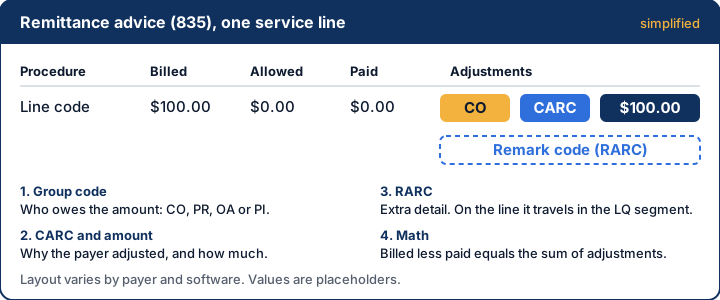
How does CO-96 read on the remittance?
X12 requires at least one remark with CO-96. The remarks on the page (N425, N569, N356, N383 and N130) say why. Medicare exclusions are in 42 CFR 411.15. Read the group code: PR may be billed to the patient with the right notice, CO is a write-off.
Where does CO-96 show up most?
It shows up in podiatry billing for foot-care exclusions, chiropractic billing and dermatology billing for cosmetic and screening services. Its neighbours are CO-119, CO-58 and CO-140. If these denials keep coming back, our denial management team can work them.
Related codes
- X12 claim adjustment reason codes list · X12
- X12 remittance advice remark codes list · X12
- X12 claim adjustment group codes list · X12
- 42 CFR 411.15, particular services excluded from coverage · eCFR
- Medicare Claims Processing Manual, chapter 30, sections 20 and 50 · CMS
- Medicare Claims Processing Manual, chapter 29, section 310.2 · CMS
- Medicare Claims Processing Manual, chapter 22, sections 60.1 to 60.3 (group codes, CARC, RARC on the remittance) · CMS
We check every rule, code and deadline against the official source. See our editorial policy.
Common questions
Straight answers from the team that does the work.
Ask a billing lead directly. A 20-minute call, Monday to Friday, 9am to 5pm Eastern.
01What does CO-96 non-covered mean?
CO-96 is X12's general non-covered charge code. It says the charge is not covered and requires at least one remark code to explain why. The remark, such as N425 for a statutory exclusion or N569 for the reported diagnosis, holds the real reason, so read it first.
02Why does CO-96 always need a remark code?
X12's definition says at least one remark code must be provided, either an NCPDP reject reason code or a remittance advice remark code that is not an alert. If your remit shows CO-96 with none, contact the payer and ask for the reason.
03Is CO-96 a patient responsibility?
It depends on the group code on the remit. CO is a contractual obligation and PR is patient responsibility. X12 does not tie CARC 96 to one of them. Under Medicare, a statutorily excluded service is covered by the ABN guidance in chapter 30, section 50.2.1.
04What does N425 mean with CO-96?
N425 reads: Statutorily excluded service(s). It means a law excludes the service from coverage, as in 42 CFR 411.15 for Medicare. Medical necessity arguments do not change a statutory exclusion, so check only whether the service was billed correctly and who may be billed.
05Can I appeal a CO-96?
Only where a covered path exists. If the remark says the service is not covered for the reported diagnosis, check the diagnosis and the policy. If it is a statutory exclusion, the appeal has nothing to stand on. Medicare redeterminations are due within 120 days of receipt of the notice.
Keep reading

Non-covered charges adding up?
We sort each one by its remark code, fix the claim errors and stop wasting appeals on statutory exclusions.