
CO-119 Denial Code: Benefit Maximum for the Period Reached
CO-119 is a claim adjustment reason code that says the benefit maximum for this time period or occurrence has been reached. The plan caps the service in visits, days or dollars, and the patient has used the cap. Who carries the balance depends on the group code printed beside the 119.
 Written by Salman Saeed, CEO and Co-Founder · Reviewed by a Certified Medical Coder · Last reviewed October 2026
In short: CO-119 means the patient's benefit for the service hit its cap for the period or the occurrence, so the plan paid nothing more. Rebuild the count from your own account before you bill anyone, and read the group code on the remit to see who owes the balance. A wrong payer count is the version worth an appeal.
What Does CO-119 Mean?
X12 defines claim adjustment reason code (CARC) 119 as: "Benefit maximum for this time period or occurrence has been reached." The list gives a start date of 01/01/1995 and a last-modified date of 02/29/2004. Reviewed October 26, 2026.
A benefit maximum is a ceiling a plan puts on a service: so many visits in a year, so many days in a stay, or so many dollars for one occurrence. CO-119 says the claim ran into that ceiling. The service may well be covered. The plan is saying it has already paid its share of it for the period.
X12 gives no usage note for 119, so read the group code on the remittance advice. X12 defines CO as Contractual Obligation, PR as Patient Responsibility and OA as Other Adjustment. Under CO the amount stays with the provider contract. Under PR it moves to the patient.
Where Does the Benefit Maximum Come From?
X12 does not set the cap. The plan does. A commercial or Medicaid plan writes visit, day or dollar limits into its benefit documents, so the first move is to get that plan's own limit from the eligibility response or the payer portal. Medicare has fixed limits for hospital stays.
| Limit | What the source says | Where |
|---|---|---|
| Inpatient hospital days | A beneficiary has a lifetime reserve of 60 days of inpatient hospital services to draw on after having used 90 days in a benefit period. | Medicare Benefit Policy Manual, chapter 5, section 10 |
| Reserve day coinsurance | A coinsurance amount equal to one-half of the inpatient hospital deductible applies to lifetime reserve days. | Chapter 5, section 10 |
| Inpatient psychiatric hospital | A 190-day lifetime limitation applies to inpatient psychiatric hospital services. | Chapter 5, section 10.1 |
Section 10.1 covers payment after benefit days run out. It says a hospital may be paid, under certain conditions, for inpatient services to a beneficiary whose inpatient benefit days are exhausted. That does not apply until the person has used 60 lifetime reserve days, unless the beneficiary is deemed to have elected not to use them. Chapter 2 of the Claims Processing Manual carries the instructions.
Which Remark Codes Describe the Same Limit?
X12 does not assign a remark code to CARC 119. These remittance advice remark codes describe the same kind of ceiling, so one of them often sits beside it.
| RARC | X12 wording | Reading |
|---|---|---|
| N362 | The number of Days or Units of Service exceeds our acceptable maximum. | The cap is on days or units. Start date 11/18/2005. |
| N640 | Exceeds number/frequency approved/allowed within time period. | The cap is on count within a period. Start date 07/15/2013. |
| N435 | Exceeds number/frequency approved /allowed within time period without support documentation. | The wording leaves room for supporting documentation. Start date 07/01/2008. |
Two neighbours get mixed up. X12 words CARC 149 as "Lifetime benefit maximum has been reached for this service/benefit category," a cap on a lifetime, not on a period. CARC 151 is about the payer judging the information submitted not to support the number or frequency of services, covered under CO-151.
How Do You Work a CO-119?
How Does CO-119 Read on the Remittance?
X12 gives no group code for CO-119, so the group on the line decides who owes. A CO means a contractual write-off. A PR means the amount may be billed to the patient, per CMS chapter 22. Read the remark: N362, N640 and N435 describe the same type of limit. Then compare the dates and units with the plan's benefit limit before you bill the patient.
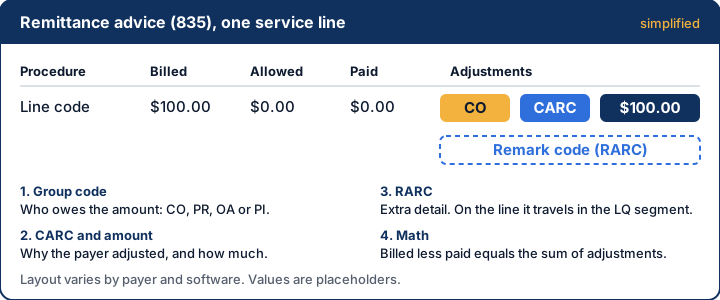
A therapy line returns CO-119 for $95.00 after the plan's visit limit.
Where Does CO-119 Show Up?
Services billed over repeated visits reach a cap fastest, so physical therapy billing, mental health billing and chiropractic billing teams see it most. If these denials keep coming back, our denial management team can work them.
Related Codes
- X12 claim adjustment reason codes list · X12
- X12 remittance advice remark codes list · X12
- Medicare Benefit Policy Manual, chapter 5, lifetime reserve days · CMS
- Medicare Claims Processing Manual, chapter 22, sections 60.1 to 60.3 (group codes, CARC, RARC on the remittance) · CMS
We check every rule, code and deadline against the official source. See our editorial policy.
Common Questions
Straight answers from the team that does the work.
Ask a billing lead directly. A 20-minute call, Monday to Friday, 9am to 5pm Eastern.
01What does CO-119 mean on a remittance?
X12 defines CARC 119 as: benefit maximum for this time period or occurrence has been reached. The plan has a cap on the service, in visits, days or dollars, and the patient has used it for the period. Read the group code beside it to see whether the balance falls on the provider contract or the patient.
02Can CO-119 benefit maximum denials be appealed?
Yes, when the payer's count is wrong. Rebuild the count from your own dates of service, ask the payer which claims it counted, and appeal with both. If the cap is real, an appeal has little to stand on. Find the filing limit in the denial letter or the payer's provider manual.
03Who pays the balance after a CO-119?
The group code decides. X12 defines CO as Contractual Obligation and PR as Patient Responsibility. Under CO the amount stays with the provider contract. Under PR it moves to the patient, after you check for a secondary payer. X12 gives no usage note for 119 itself.
04Is CO-119 the same as CARC 149?
No. X12 words CARC 149 as the lifetime benefit maximum reached for the service or benefit category. CARC 119 is the maximum for a time period or occurrence. Check the plan document to see whether the cap resets each year or never resets.
05How many inpatient days does Medicare cover before the benefit runs out?
Chapter 5 of the Medicare Benefit Policy Manual says a beneficiary has 60 lifetime reserve days to draw on after using 90 days in a benefit period, with coinsurance of one-half the inpatient deductible. Section 10.1 adds a 190-day lifetime limit for inpatient psychiatric hospital services.
06Which remark code tells me which limit was hit?
X12 pairs no remark code with CARC 119. N362 says days or units exceed the maximum, N640 says number or frequency exceeds the period allowance, and N435 says the same without supporting documentation. If none prints, call the payer and ask for the benefit line.

Benefit Maximum Denials Piling Up?
We rebuild the visit count from your account and challenge the payer when its number is wrong.