
CPT 95819: routine EEG recorded awake and asleep
95819 reports a routine electroencephalogram that records the patient both awake and asleep. The state recorded picks the code, since CMS labels the neighbors 95816 for awake and drowsy and 95822 for coma or sleep only, and a study is billed once with the code that matches what the recording captured.
 Written by Salman Saeed, CEO and Co-Founder · Reviewed by a Certified Medical Coder · Last reviewed October 2026
In short: 95819 bills one routine EEG recorded awake and asleep. It has a recording side (modifier TC) and a reading side (modifier 26), Medicare allows 1 unit a day, and it is not billed on top of a sleep study unless a complete EEG was done at a separate encounter.
What does CPT 95819 report?
95819 is the code for a routine electroencephalogram (EEG, a recording of the brain's electrical activity from scalp electrodes) in which the recording captures the patient both awake and asleep. CMS labels it "Eeg awake and asleep" in the October 2026 fee schedule file, and the same file labels its neighbors 95816 "awake and drowsy" and 95822 "coma or sleep only".
It is a diagnostic test with a professional and a technical side. The file carries three rows for it, one with no modifier and one each for modifier 26 and modifier TC.
| Item in RVU26D | No modifier | Modifier 26 | Modifier TC |
|---|---|---|---|
| Payment status | A | A | A |
| Work RVU | 1.05 | 1.05 | 0.00 |
| Total RVU, office or facility | 14.44 | 1.70 | 12.74 |
| PC/TC indicator | 1 | 1 | 1 |
| Global period | XXX | XXX | XXX |
Medicare's practitioner and hospital outpatient MUE tables, effective October 1, 2026, both list 95819 at 1 unit a day with adjudication indicator 3.
Should you report 95819, 95816 or 95822?
Choose by the states the recording captured. 95819 is for a study that records the patient awake and then asleep, 95816 for awake and drowsy, and 95822 for coma or sleep only. Report one of the three for a routine study, not two.
Time-based EEG codes sit beside them: CMS labels 95812 as 41 to 60 minutes and 95813 as extended monitoring of 61 to 119 minutes. Those are chosen by recording length, not by patient state, so a coder has to read the technologist's note before the code is set. The AMA descriptors have the full wording, so check them when the note is unclear.
Long-term and video monitoring is a different family. See neurology billing for how those studies are split.
How do you bill the EEG recording and the interpretation?
Because the PC/TC indicator is 1, the CMS file allows modifier 26 for the physician's reading and modifier TC for the equipment, technologist and recording. A practice that owns the machine, records the study and reads it bills the global line with no modifier. A physician who only reads a study recorded elsewhere bills 95819 with modifier 26, and the party that recorded it bills modifier TC.
The technical side holds most of the value: 12.74 of the 14.44 total RVUs sit on the TC row.
A neurology office records a routine awake and asleep EEG on its own machine and the neurologist reads it the same week. One line: 95819, no modifier, 1 unit. If a hospital lab records it and the neurologist reads it from the report, the neurologist's claim is 95819-26 and the hospital reports its own side.
Can 95819 be billed the same day as a sleep study?
Usually not. Chapter XI of the 2026 NCCI Policy Manual says EEG is not reported separately with polysomnography unless a complete diagnostic EEG is performed in the usual manner at a separate patient encounter on the same date. In that case modifier 59 or XE goes on the EEG code.
The manual adds that continuous EEG monitoring (95700 to 95726) may be reported with sleep testing only if it is a significant, separately identifiable service, with modifier 59 or XU. See CPT 95810 for the sleep study side, and the pages for modifier 59, XE and XU.
How does 95819 appear on the claim?
On the CMS-1500, Item 24D carries 95819 with modifier 26 or TC when the study is split, Item 24G carries 1 unit, and Item 24B carries the place of service. Chapter 26 of the Claims Processing Manual says a patient registered as a hospital outpatient takes POS 22 (on campus) or 19 (off campus), and POS 11 is the office.
With adjudication indicator 3, a MAC may pay more than one unit after review, but a second routine EEG on the same date needs a note that explains why.
What fields and modifiers does an EEG use?
An EEG with awake and asleep recording is one line, 95819 in Item 24D with 26 or TC as needed, and 1 unit in Item 24G. Item 24E points to the seizure or spell diagnosis. The place of service in Item 24B reflects the lab or hospital.
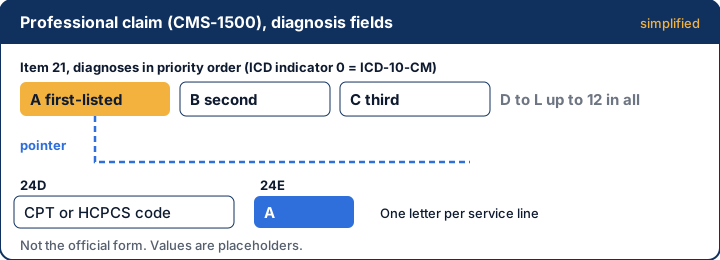
On a hospital outpatient bill, the revenue code is in FL 42, 95819 in FL 44, the date in FL 45 and units in FL 46. RVU26D gives 95819 status A and global XXX, and the MUE table allows 1 per date with indicator 3.

Example: A patient with a first seizure has an EEG on 10/09. The line is 95819, pointer A (R56.9), 1 unit, $430.00. Billing the global line from both the lab and the reader draws OA-18 on the second claim.
Why is 95819 denied?
| CARC | What X12 says | What usually causes it |
|---|---|---|
| 97 | The benefit for this service is included in the payment/allowance for another service/procedure that has already been adjudicated | EEG billed on the same date as polysomnography without modifier 59 or XE |
| 4 | The procedure code is inconsistent with the modifier used | Global line sent when another party already billed the TC, or 26 and TC missing |
| 50 | Non-covered services because this is not deemed a 'medical necessity' by the payer | Diagnosis that does not support a routine EEG |
| 151 | Payment adjusted because the payer deems the information submitted does not support this many/frequency of services | A second 95819 on the same date or a repeat study without a changed condition |
If these denials keep coming back, our denial management team can work them. Related pages: CPT 95910, CPT 64615 and the MUE rule.
Related codes
- Physician Fee Schedule relative value files, RVU26D (October 2026) · CMS
- Medicare NCCI Medically Unlikely Edits, practitioner and outpatient hospital tables, effective 10-01-2026 · CMS
- 2026 NCCI Medicare Policy Manual, Chapter XI: Medicine, Evaluation and Management · CMS
- 2026 NCCI Medicare Policy Manual, Chapter I: General Correct Coding Policies · CMS
- Medicare Claims Processing Manual, Chapter 26: Completing and Processing Form CMS-1500 Data Set · CMS
- Claim Adjustment Reason Codes · X12
- Place of service code set · CMS
- Medicare Claims Processing Manual, Chapter 25: Completing and Processing the Form CMS-1450 Data Set · CMS
We check every rule, code and deadline against the official source. See our editorial policy.
Common questions
Straight answers from the team that does the work.
Ask a billing lead directly. A 20-minute call, Monday to Friday, 9am to 5pm Eastern.
01What does CPT 95819 mean?
It reports a routine EEG that records the patient both awake and asleep. CMS labels it "Eeg awake and asleep". The study has a technical side (the recording) and a professional side (the reading), and Medicare's global period for it is XXX, meaning no global concept applies.
02What is the difference between 95819, 95816 and 95822?
The patient state recorded. CMS labels 95819 awake and asleep, 95816 awake and drowsy, and 95822 coma or sleep only. A routine study uses the one that matches what the recording captured, and the AMA descriptor sets the exact wording, so check it before coding.
03How do I bill EEG recording and interpretation?
Bill 95819 with no modifier if you record and read it. If you only read it, add modifier 26. If you only record it, add modifier TC. The October 2026 CMS file gives 95819 a PC/TC indicator of 1, which allows all three forms, and each party bills only its own side.
04Can I bill 95819 with a polysomnography?
Not as a routine matter. NCCI Chapter XI says EEG is not reported with polysomnography unless a complete diagnostic EEG is done at a separate patient encounter on the same date, and then modifier 59 or XE goes on the EEG. The note must show two encounters.
05How many units of 95819 can I bill?
One per date of service. The Medicare practitioner MUE effective October 1, 2026 is 1, with adjudication indicator 3, a clinical-benchmark edit. Billing 2 units for a longer recording is wrong; if the study ran longer, look at the time-based EEG codes instead.


EEG claims paid on the wrong line?
We check the 26 and TC split and the sleep study overlap before the claim goes out.