
CPT 95910: nerve conduction studies, seven or eight studies
95910 reports a nerve conduction test in which seven or eight nerve studies were recorded and interpreted in one session. The count picks the code, so a clinic counts studies, not minutes or limbs, and a total of nine or more moves the claim up the ladder to 95911.
 Written by Salman Saeed, CEO and Co-Founder · Reviewed by a Certified Medical Coder · Last reviewed October 2026
In short: 95910 is one rung of a seven-code ladder chosen by the total number of nerve studies. Medicare allows one ladder code a day, the reading and recording can be split with modifiers 26 and TC, and repeat studies for one diagnosis are limited by local policy.
What does CPT 95910 report?
95910 is the nerve conduction study (NCS, a test that measures how fast and how strongly a nerve carries an electrical signal) code for seven or eight studies recorded and interpreted in one session. The code is picked by the number of nerve studies, not by time or by limb. CMS labels it "Nrv cndj test 7-8 studies" in the October 2026 fee schedule file.
It sits in a seven-rung ladder. Each rung covers a total study count, and every rung is a stand-alone code with its own professional and technical rows.
CMS labels the rungs 95907 for 1 to 2 studies, 95908 for 3 to 4, 95909 for 5 to 6, 95910 for 7 to 8, 95911 for 9 to 10, 95912 for 11 to 12 and 95913 for 13 or more. The practitioner MUE for every rung, effective October 1, 2026, is 1 with adjudication indicator 2.
NCCI Chapter I calls indicator 2 a policy-based date-of-service edit that cannot be overridden, so one ladder code a day is the working limit.
| Item in RVU26D | No modifier | Modifier 26 | Modifier TC |
|---|---|---|---|
| Work RVU | 1.95 | 1.95 | 0.00 |
| Total RVU, office or facility | 5.53 | 3.18 | 2.35 |
| PC/TC indicator | 1 | 1 | 1 |
| Global period | XXX | XXX | XXX |
Here the reading holds more of the value: 3.18 of the 5.53 total RVUs are on the 26 row.
How do you count the studies for 95910?
The Novitas LCD L35081 counts studies against the AMA Appendix J listing of sensory, motor and mixed nerves, and prints a table of the most studies per date of service it treats as reasonable for each indication. Adding the motor and sensory counts shows where 95910 sits.
| Indication in the LCD table | Motor studies | Sensory studies | Total | Code |
|---|---|---|---|---|
| Carpal tunnel, one side | 3 | 4 | 7 | 95910 |
| Carpal tunnel, both sides | 4 | 6 | 10 | 95911 |
| Polyneuropathy or multiple mononeuropathy | 4 | 4 | 8 | 95910 |
| Tarsal tunnel, one side | 4 | 4 | 8 | 95910 |
| Plexopathy | 4 | 6 | 10 | 95911 |
The LCD lists studies beyond the AMA Appendix J maximum among the services it does not treat as reasonable and necessary, and says extra studies may be considered on redetermination. A claim that shows more studies than the table allows needs the reason in the note.
Can you bill needle EMG with 95910?
Yes, with the EMG add-on codes, which ride on the nerve study. CMS gives 95885 and 95886 a ZZZ global period, meaning the code is always part of another service, and a practitioner MUE of 4 for each. NCCI Chapter XI separately limits 95887, the non-extremity EMG add-on, to 1 unit.
The LCD adds that the NCS must be performed and interpreted with the needle exam on site and in real time, and lists delayed interpretation as not reasonable and necessary. See neurology billing for how the two tests combine on a claim.
How often can the same patient have nerve studies repeated?
The Novitas LCD, which covers its jurisdictions H and L, suggests no more than two studies per 12 months, per diagnosis, per provider for carpal tunnel, radiculopathy, mononeuropathy, polyneuropathy, myopathy and neuromuscular junction disorders. It suggests three for motor neuron disease and plexopathy.
Those limits do not apply when a second provider is asked for an opinion, and a repeat study needs the reason and a comparison with the earlier results in the note. The LCD also treats testing with portable hand-held or point-of-care devices that cannot show waveforms in real time as not reasonable and necessary, and includes such an exam in the evaluation and management service.
When is 95910 not separately reportable?
NCCI Chapter XI says nerve testing done to judge the level of paralysis during anesthesia or mechanical ventilation is not separately reportable. It also says the surgeon performing an operation does not report 95907 to 95913 for intraoperative testing, because those codes sit inside the global package.
How does 95910 appear on the claim?
On the CMS-1500, Item 24D carries one line for the rung that matches the total study count, with modifier 26 or TC if the sides are split. Item 24G carries 1 unit, since the count of studies is already inside the code, and Item 24B carries POS 11 for an office or 22 or 19 for a hospital outpatient department.
The EMG add-on goes on its own line. Two rungs on one date are an edit risk, so the count in the note has to add up to a single code.
How are nerve study codes and units entered?
A nerve conduction study line carries 95910 in Item 24D with 26 or TC as needed and 1 unit in Item 24G, since the code is picked by the number of studies. Item 24E points to the nerve symptom or diagnosis, such as hand numbness. The study count must match the report.
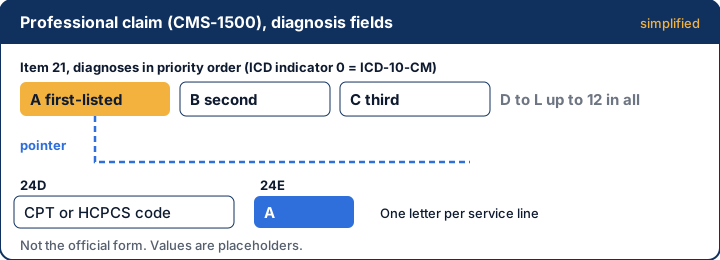
RVU26D gives 95910 status A and global XXX, and the MUE table allows 1 per date with indicator 2, a policy edit. If an EMG is done the same day, it is its own code on its own line.
Example: A patient with numbness in both hands has seven studies on 10/12. The line is 95910, pointer A (G56.03), 1 unit, $380.00. A claim for 95910 plus a lower-count code for the same studies double counts and may draw CO-97.
Why is 95910 denied?
| CARC | What X12 says | What usually causes it |
|---|---|---|
| 151 | Payment adjusted because the payer deems the information submitted does not support this many/frequency of services | More than two studies in 12 months for one diagnosis, or counts above the LCD table |
| 97 | The benefit for this service is included in the payment/allowance for another service/procedure that has already been adjudicated | Two ladder codes on one date, or testing inside an operation |
| 50 | Non-covered services because this is not deemed a 'medical necessity' by the payer | Point-of-care device or delayed interpretation |
| 119 | Benefit maximum for this time period or occurrence has been reached | Plan limit on the number of studies a year |
If these denials keep coming back, our denial management team can work them. See also CPT 95819 and the NCCI edits rule.
Related codes
- Physician Fee Schedule relative value files, RVU26D (October 2026) · CMS
- Medicare NCCI Medically Unlikely Edits, practitioner and outpatient hospital tables, effective 10-01-2026 · CMS
- 2026 NCCI Medicare Policy Manual, Chapter XI: Medicine, Evaluation and Management · CMS
- 2026 NCCI Medicare Policy Manual, Chapter I: General Correct Coding Policies · CMS
- LCD L35081, Nerve Conduction Studies and Electromyography (Novitas) · CMS Medicare Coverage Database
- Medicare Claims Processing Manual, Chapter 26: Completing and Processing Form CMS-1500 Data Set · CMS
- Claim Adjustment Reason Codes · X12
We check every rule, code and deadline against the official source. See our editorial policy.
Common questions
Straight answers from the team that does the work.
Ask a billing lead directly. A 20-minute call, Monday to Friday, 9am to 5pm Eastern.
01What does CPT 95910 mean?
It reports nerve conduction studies when seven or eight separate nerve studies were recorded and interpreted in one session. CMS labels it "Nrv cndj test 7-8 studies". The study count picks the code, so the note must list each nerve tested before a coder can set the rung.
02How do I bill nerve conduction studies?
Count the motor, sensory and mixed nerves tested, pick the one ladder code for that total, and bill it with 1 unit. Add modifier 26 or TC if the reading and recording are split. Needle EMG goes on its own add-on lines. The practitioner MUE for every ladder code is 1.
03Can I bill 95910 and 95911 on the same day?
No. Each ladder code covers a total study count, and the Q4 2026 practitioner MUE for each is 1 with indicator 2, a policy-based date-of-service edit that CMS says cannot be overridden. If the count is nine, bill 95911 alone, not 95910 plus another code.
04How often can nerve conduction studies be repeated?
The Novitas LCD suggests two studies per 12 months per diagnosis per provider for conditions like carpal tunnel and polyneuropathy, and three for motor neuron disease and plexopathy. It does not apply when a second provider is asked for an opinion. Other contractors may set different limits.


Nerve study claims cut back?
We check the study count against the ladder and the repeat limits before the claim goes out.