
CPT 95810: attended polysomnography, age 6 and over
95810 reports an attended overnight sleep study with sleep staging and four or more added parameters, for a patient 6 or older. Attended means a technologist is on site during the recording, which is why a Medicare contractor such as Noridian ties this code to a facility-based sleep lab and not to the patient's home.
 Written by Salman Saeed, CEO and Co-Founder · Reviewed by a Certified Medical Coder · Last reviewed October 2026
In short: 95810 bills one attended polysomnography a night, with the technical side (modifier TC) carrying most of the value and the physician's reading on modifier 26. Medicare allows 1 unit a day, an EEG is not added unless it was a separate encounter, and the lab setting depends on the MAC.
What does CPT 95810 report?
95810 is the polysomnography (PSG, an overnight sleep study that records brain waves, breathing, heart rhythm and more) code for a patient 6 years or older, with sleep staging and four or more added parameters, attended by a technologist. CMS labels it "Polysom 6/> yrs 4/> param". NCCI Chapter XI explains that polysomnography differs from a plain sleep study because it requires sleep staging.
| Item in RVU26D | No modifier | Modifier 26 | Modifier TC |
|---|---|---|---|
| Payment status | A | A | A |
| Work RVU | 2.44 | 2.44 | 0.00 |
| Total RVU, office or facility | 20.17 | 3.58 | 16.59 |
| PC/TC indicator | 1 | 1 | 1 |
| Global period | XXX | XXX | XXX |
The practitioner and hospital outpatient MUE tables effective October 1, 2026 list 95810 at 1, a policy-based date-of-service edit (indicator 2). The technical row carries 16.59 of the 20.17 total RVUs, so most of a lab's revenue rides on the TC line.
How is 95810 different from 95811, 95806 and 95800?
The neighbors in the CMS file are 95811, labeled polysomnography for age 6 or older with CPAP and four or more parameters, 95806, a sleep study that is unattended with respiratory effort, and 95800, a sleep study that is unattended. All of them have status A, PC/TC indicator 1, an XXX global and an MUE of 1.
NCCI Chapter XI says a "sleep study" and "polysomnography" shall not be reported separately for the same patient encounter. Home tests and the coverage rules that go with them are on the sleep medicine billing page, and the pulmonology billing page covers the wider test set.
Where can a Medicare 95810 be performed?
It depends on the MAC. Noridian's LCD L36861, which covers its jurisdictions E and F, says polysomnography should be performed in a facility-based sleep laboratory and not in the home or a mobile facility. It defines the covered Type I study as an attended, facility-based test, and says a technologist must be physically present during sleep with the ability to intervene.
The same LCD requires the sleep facility to hold credentials from the American Academy of Sleep Medicine, The Joint Commission or the Accreditation Commission for Health Care. Other MACs publish their own policies, so the place of service and the lab's accreditation have to be checked against the contractor that pays the claim.
Can a split-night study replace two nights?
Under the Noridian LCD, a split-night study, with the diagnostic recording followed by CPAP titration on the same night, is an alternative to two nights if set criteria are met. The criteria are an apnea-hypopnea index (AHI) or respiratory disturbance index of 15 or more events per hour with at least 30 events, or 5 to 14 events per hour with at least 10 events plus documented symptoms or conditions.
When the index is calculated on less than 2 hours of continuous recorded sleep, the total event count must be at least what a 2-hour period would have required. A repeat test in a facility-based setting is described in the LCD as a Type I study. The AMA descriptors decide which CPT code reports a split night, so the coder reads them before choosing between 95810 and 95811.
Can you add an EEG to a sleep study?
Only if a complete diagnostic EEG is done separately in the usual manner at a separate patient encounter on the same date, and then modifier 59 or XE goes on the EEG code. Chapter XI explains that EEG recording for sleep staging differs from diagnostic EEG, which is why it is not paid twice.
Continuous EEG monitoring (95700 to 95726) can be reported with sleep testing only as a significant, separately identifiable service, with modifier 59 or XU. See CPT 95819 for the routine EEG and modifier 59.
How does 95810 appear on the claim?
On the CMS-1500, Item 24D carries 95810 with modifier 26 for a physician who only interprets the study, Item 24G carries 1 unit, and Item 24B carries the place of service: 11 for an office, or 22 or 19 for a hospital outpatient department. The lab that owns the equipment bills the technical side, and the interpreting physician's NPI goes on the 26 line.
Where do sleep study modifiers and the site go?
A sleep study line is 95810 in Item 24D with 26 or TC when the reading and the lab belong to different parties, and 1 unit in Item 24G. Item 24B holds the place of service for the lab or facility. Item 24E points to the sleep diagnosis, such as suspected sleep apnea.
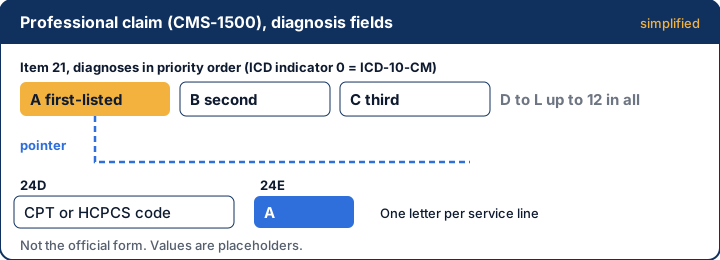
On a hospital outpatient bill, the sleep revenue code is in FL 42, 95810 in FL 44, the date in FL 45 and 1 unit in FL 46. RVU26D gives 95810 status A and global XXX, and the MUE table allows 1 per date with indicator 2.

Example: A patient with loud snoring and daytime sleepiness has an overnight study on 10/14. The global line is 95810, pointer A (G47.33), 1 unit, $1,150.00. A technical-only lab bills TC with the same pointer, and the physician reader bills 26.
Why is 95810 denied?
| CARC | What X12 says | What usually causes it |
|---|---|---|
| 50 | Non-covered services because this is not deemed a 'medical necessity' by the payer | Diagnosis without symptoms of a covered sleep disorder |
| 197 | Precertification/authorization/notification/pre-treatment absent | Lab study done without the plan's approval |
| 4 | The procedure code is inconsistent with the modifier used | Global line sent when only the reading was done |
| 97 | The benefit for this service is included in the payment/allowance for another service/procedure that has already been adjudicated | EEG billed with the study and no modifier 59 or XE |
If these denials keep coming back, our denial management team can work them. For approvals that must come before the study, see prior authorization.
Related codes
- Physician Fee Schedule relative value files, RVU26D (October 2026) · CMS
- Medicare NCCI Medically Unlikely Edits, practitioner and outpatient hospital tables, effective 10-01-2026 · CMS
- 2026 NCCI Medicare Policy Manual, Chapter XI: Medicine, Evaluation and Management · CMS
- LCD L36861, Polysomnography and Other Sleep Studies (Noridian) · CMS Medicare Coverage Database
- Medicare Claims Processing Manual, Chapter 26: Completing and Processing Form CMS-1500 Data Set · CMS
- Claim Adjustment Reason Codes · X12
- Place of service code set · CMS
- Medicare Claims Processing Manual, Chapter 25: Completing and Processing the Form CMS-1450 Data Set · CMS
We check every rule, code and deadline against the official source. See our editorial policy.
Common questions
Straight answers from the team that does the work.
Ask a billing lead directly. A 20-minute call, Monday to Friday, 9am to 5pm Eastern.
01What does CPT 95810 mean?
It reports an attended polysomnography for a patient 6 or older, with sleep staging and four or more added parameters. CMS labels it "Polysom 6/> yrs 4/> param". A technologist attends the study, which is why Medicare contractors tie it to a facility-based sleep lab.
02How do I bill an attended sleep study?
Bill 95810 once per night with 1 unit. If one party owns the lab and another reads the study, the lab bills modifier TC and the physician bills modifier 26. Match the place of service to where the lab is registered and keep the technologist's attendance record.
03Can a Medicare sleep study be done at home under 95810?
Not under Noridian's LCD, which says polysomnography should be done in a facility-based sleep laboratory and not in the home or a mobile facility. Unattended home tests use other codes such as 95800 and 95806. Check your own contractor's policy.
04Can I bill an EEG with 95810?
Only if a complete diagnostic EEG was done at a separate encounter on the same date, with modifier 59 or XE on the EEG. NCCI Chapter XI says EEG is not reported separately with polysomnography otherwise, because sleep staging uses a different EEG procurement.
05How many units of 95810 are allowed?
One per date of service. The practitioner and hospital outpatient MUEs effective October 1, 2026 are both 1, with indicator 2, a date-of-service edit based on policy. A second night is a second date of service and needs its own medical necessity.



Sleep lab claims denied?
We check the TC and 26 split, the lab setting and the EEG overlap before the claim goes out.