
CPT 11042: Debridement of Skin and Subcutaneous Tissue, First 20 Sq Cm
11042 reports surgical debridement, the removal of devitalized tissue from a wound down through the subcutaneous layer, for the first 20 square centimeters or less. Two things set the code: how deep the debridement went and how much surface area it covered, and each has its own line on the claim.
 Written by Salman Saeed, CEO and Co-Founder · Reviewed by a Certified Medical Coder · Last reviewed October 2026
In short: 11042 is the subcutaneous base code with a 000 global, and depth moves the claim to 11043 for muscle or fascia and 11044 for bone. Wound area beyond the first 20 sq cm is reported with add-on codes, and 97597 is never reported for the same wound.
What Does CPT 11042 Report, and What Changes with Depth?
11042 is surgical debridement of a wound through the subcutaneous tissue, first 20 sq cm or less. The CMS file labels it "Dbrdmt subq tis 1st 20sqcm/<" and gives it status A and a 000 global. Deeper layers have their own base codes, and each base code has an add-on for area beyond the first block.
| Deepest tissue | Base code, first 20 sq cm or less | Add-on for more area |
|---|---|---|
| Subcutaneous tissue | 11042: work RVU 0.98, MUE 1 | 11045: work RVU 0.49, MUE 12 |
| Muscle and/or fascia | 11043: work RVU 2.63, MUE 1 | 11046: work RVU 1.00, MUE 10 (hospital table 4) |
| Bone | 11044: work RVU 4.00, MUE 1 | 11047: work RVU 1.76, MUE 10 (hospital table 4) |
Every base code is 000 global and every add-on is ZZZ.
How Do Depth and Area Decide Which Codes You Report?
The depth code comes from the deepest layer removed, and the area decides whether any add-on follows. Chapter 12, section 40.1, says a ZZZ add-on is always billed with another service, that both the primary and the add-on are paid, and that the global period belongs to the primary code. An add-on cannot stand alone on a claim.
The add-on MUE differs by setting for muscle and bone: the practitioner table allows 10 units of 11046 and 11047 on a date of service, and the outpatient hospital table allows 4. Both tables list 11042, 11043 and 11044 at 1 with a policy adjudication indicator of 2, and 11045 at 12 with indicator 3, a clinical edit.
A diabetic foot ulcer measures 15 sq cm and the debridement reaches subcutaneous tissue only. Bill 11042 once and no add-on, because the area is inside the first block. The note needs the measurement and the deepest tissue removed.
When Is Debridement Not Billed Separately?
NCCI Chapter III says debridement of non-viable tissue around a lesion, incision or injury that is needed to complete lesion removal, incision or repair is not separately reportable. It also says debridement of a skin wound before a graft or skin substitute (the list includes 11000, 11042 to 11047, 97597 and 97598) is included in the graft procedure, and so is debridement of a tissue transfer site.
Chapter XI adds two limits for wound care. Based on the CPT book's instructions, codes 97597 to 97602 are not reported with surgical debridement 11042 to 11047 for the same wound, and 97610 is not reported for the same wound with active wound care or debridement codes including 11042 to 11047. The selective-versus-surgical choice is worked through on our wound care billing page, and the CPT 97597 page covers the selective code.
Can You Bill a Visit with 11042?
Only when the visit is a significant, separately identifiable service. 11042 has a 000 global, which NCCI Chapter I treats as a minor procedure: the decision to debride is included in the procedure, and a separate visit takes modifier 25 and does not need a different diagnosis. The podiatry billing page shows how it fits with foot care codes.
How Does 11042 Appear on the Claim?
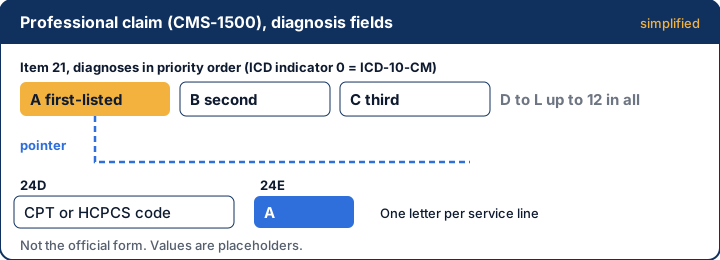
On the CMS-1500, Item 24D carries 11042 and Item 24G carries 1. An add-on goes on its own line with Item 24G showing the units for the added area, and Item 24E points each line to the wound diagnosis. Item 24B carries 11 for an office, or 22 or 19 for a hospital outpatient department. A hospital bills the same codes on its own outpatient claim, where Chapter 4 requires a HCPCS code on each service line.
Which Fields Carry 11042 and Its Wound Size?
A debridement line carries 11042 in Item 24D, 1 unit in Item 24G and a pointer in Item 24E to the wound diagnosis, such as a pressure ulcer or a diabetic foot ulcer. The depth reached and the surface area in square centimeters are documentation, not claim fields, so the note must hold both. An add-on for more area goes on its own line.
On a hospital outpatient bill, the wound care revenue code sits in FL 42, 11042 in FL 44, the procedure date in FL 45 and units in FL 46. Each treatment date is a new line.

RVU26D gives 11042 status A, a 000 global, multiple-procedure indicator 2 and an assistant-at-surgery indicator of 1. The MUE table allows 1 per date with indicator 2.
Example: On 10/14 the clinician removes tissue down to subcutaneous layer from a heel ulcer measuring 12 sq cm. The line reads 11042, pointer A (L97.412), 1 unit, $210.00, and the note records the size before and after, depth and instrument. A note that says only 'wound care' does not show the depth and may draw CO-97.
Why Is 11042 Denied?
| CARC | What X12 says | What usually causes it |
|---|---|---|
| 97 | The benefit is included in the payment for another service already adjudicated | 97597 billed for the same wound, or debridement billed with a graft |
| 236 | The procedure combination is not compatible with another on the same day under NCCI | Debridement reported with a repair or lesion removal at the same site |
| 151 | The information submitted does not support this many or this frequency of services | Add-on units above the MUE or beyond the measured area |
| 50 | Non-covered because the payer does not deem it medically necessary | Notes do not show devitalized tissue or a measured wound |
| 11 | The diagnosis is inconsistent with the procedure | Diagnosis does not describe an ulcer or wound |
If these denials keep coming back, our denial management team can work them.
Related Codes
- Physician Fee Schedule relative value files, RVU26D (October 2026) · CMS
- Medicare NCCI Medically Unlikely Edits, practitioner and outpatient hospital tables, effective 10-01-2026 · CMS
- 2026 NCCI Medicare Policy Manual, Chapter III: Integumentary System · CMS
- 2026 NCCI Medicare Policy Manual, Chapter I: General Correct Coding Policies · CMS
- Medicare Claims Processing Manual, Chapter 12: Physicians/Nonphysician Practitioners · CMS
- Medicare Claims Processing Manual, Chapter 26: Completing and Processing Form CMS-1500 Data Set · CMS
- Medicare Claims Processing Manual, Chapter 4: Part B Hospital (Including Inpatient Hospital Part B and OPPS) · CMS
- Claim Adjustment Reason Codes · X12
- Place of service code set · CMS
- Medicare Claims Processing Manual, Chapter 25: Completing and Processing the Form CMS-1450 Data Set · CMS
We check every rule, code and deadline against the official source. See our editorial policy.
Common Questions
Straight answers from the team that does the work.
Ask a billing lead directly. A 20-minute call, Monday to Friday, 9am to 5pm Eastern.
01What does CPT 11042 mean?
It reports surgical debridement of a wound through subcutaneous tissue, covering the first 20 square centimeters or less. CMS shows it as status A with a 000 global period, and each deeper layer, muscle or fascia and bone, has its own base code.
02How do I bill debridement by depth?
Report the base code for the deepest layer removed: 11042 for subcutaneous tissue, 11043 for muscle or fascia, 11044 for bone. Add-ons 11045, 11046 and 11047 report area beyond the first block, and each add-on can be billed only with its own base code.
03How many units of 11042 can I bill?
One. The NCCI practitioner MUE for 11042 effective October 1, 2026 is 1, with a policy adjudication indicator of 2. Extra wound area is billed with the add-on 11045, whose MUE is 12, rather than with more units of 11042.
04Can I bill 11042 and 97597 together?
Not for the same wound. NCCI Chapter XI, citing the CPT book, says 97597 to 97602 are not reported with surgical debridement 11042 to 11047 for the same wound.The rule applies wound by wound, so the note should identify which wound received which service, with its measured area and depth.
05Is the decision to debride a separate visit?
No. 11042 has a 000 global, so NCCI Chapter I treats the decision to perform it as included in the procedure. A visit that is significant and separately identifiable can be billed with modifier 25, and per NCCI it does not need a different diagnosis from the debridement.
06Is debridement billed separately before a skin graft?
No. NCCI Chapter III says debridement of a skin wound, including 11042 to 11047, before a graft or skin substitute is included in the graft or skin substitute procedure and is not reported separately. The same applies to debridement of a tissue transfer site.



Wound Claims Denied as Bundled?
We match depth, measured area and add-on units to the note before the claim goes out.