
PR-2 denial code: patient coinsurance
PR-2 is the patient's percentage share of an allowed charge. It is billable to the patient, but the base is the allowed amount, and some emergency visits carry federal limits on what a patient can owe.
 Written by Salman Saeed, CEO and Co-Founder · Reviewed by a Certified Medical Coder · Last reviewed October 2026
In short: PR-2 means the payer assigned coinsurance to the patient. Check that the percentage applies to the allowed amount, look for a secondary payer, rule out waiver and QMB flags, and bill only the PR-2 figure. Out-of-network emergency visits carry federal cost-sharing limits.
What does PR-2 say about the patient balance?
PR-2 tells you the patient owes coinsurance, a percentage share of the allowed charge. X12 words claim adjustment reason code (CARC) 2 as "Coinsurance Amount", with a start date of 01/01/1995. The PR group code marks it as patient responsibility.
Read it as a number, not a verdict. The payer has already decided what it allows, subtracted any deductible, and then taken the plan's percentage of what remains. Coinsurance is the patient's percentage of that remainder. Reviewed October 26, 2026.
How is the coinsurance amount figured?
Medicare.gov describes Part B coinsurance as usually 20% of the cost for each Medicare-covered service or item after the deductible is paid, as long as the provider accepts the Medicare-approved amount as full payment. The base is the approved amount, never your billed charge.
That base matters on the remit. The difference between a charge and the allowed amount is a contractual adjustment, normally reported under CARC 45, which X12 words as a charge exceeding the fee schedule or contracted arrangement. You post that difference as a write-off. Only the PR-2 figure goes to the patient. See CO-45 for the other side of the split.
| Remit line | What it represents | Billable to the patient |
|---|---|---|
| CO-45 | Charge above the allowed amount | No, it is a write-off |
| PR-1 | Deductible applied | Yes |
| PR-2 | Coinsurance on the remaining allowed amount | Yes |
| Payer payment | Plan share | Not applicable |
What changes for out-of-network emergency visits?
Federal rules cap what a patient can be charged for emergency care at a hospital emergency department or independent freestanding emergency department. Under 45 CFR 149.410(a), a nonparticipating provider or facility must not bill a covered patient more than the in-network cost-sharing requirement for those emergency services. A PR-2 figure that looks like a normal out-of-network coinsurance on such a visit is worth a second look.
The rules for how that cost-sharing is set, and the exceptions, sit on our No Surprises Act pages. Start with the No Surprises Act FAQ and the guide for ER groups and the page on state surprise billing laws for state rules.
Which remark codes can come with PR-2?
| RARC | X12 wording | Reading |
|---|---|---|
| M137 | Part B coinsurance under a demonstration project or pilot program. | The coinsurance follows a special program, not the usual rule. |
| N765 | This payer does not cover coinsurance assessed by a previous payer. | A secondary will not pay the primary's PR-2. |
| N782 | Alert: Patient is a Medicaid/ Qualified Medicare Beneficiary. Review your records for any wrongfully collected coinsurance. This amount may be billed to a subsequent payer. | Refund anything collected and bill the next payer. |
| N364 | Alert: According to our agreement, you must waive the deductible and/or coinsurance amounts. | Your contract bars billing the patient. |
Only the remark codes printed on your remit apply to that claim, so read those first.
What do you do with PR-2?
How do you read PR-2 on the remittance?
PR-2 is a percentage of the allowed amount, so the way to check it is to divide it by the allowed. If the answer is not the plan's coinsurance rate, the plan or the billing office has something wrong. CMS chapter 22 puts PR amounts in the class of patient billable adjustments.
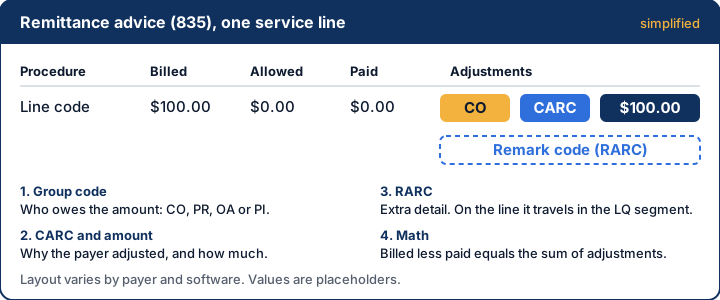
When more than one adjustment appears on the line, add every PR and every CO and confirm the total with the payment.
Allowed $320.00, plan coinsurance 25%.
Example of PR-2 on an emergency visit
A hospital emergency department visit has an allowed amount of $500. The deductible is already met, and the plan's coinsurance is 20%.
This is common in emergency medicine billing, cardiology billing and orthopedic billing. Neighbors are PR-1 for the deductible and PR-3 for a flat copay. If these denials keep coming back, our denial management team can work them.
Related codes
- X12 claim adjustment reason codes list · X12
- X12 remittance advice remark codes list · X12
- X12 claim adjustment group codes list · X12
- Medicare Claims Processing Manual, chapter 22, section 60.1 (group codes) · CMS
- What does Medicare cost? Part B costs · Medicare.gov
- 45 CFR 149.410, balance billing in cases of emergency services · eCFR
We check every rule, code and deadline against the official source. See our editorial policy.
Common questions
Straight answers from the team that does the work.
Ask a billing lead directly. A 20-minute call, Monday to Friday, 9am to 5pm Eastern.
01What does PR-2 coinsurance tell me about the patient balance?
It gives the patient's percentage share of the allowed amount after any deductible. X12 defines CARC 2 as Coinsurance Amount, and PR marks it billable to the patient. Bill that figure only, less what you collected and any secondary payment, never a percentage of your billed charge.
02Is PR-2 the same as CO-45?
No. CO-45 is the gap between your charge and the allowed or contracted amount, which you write off. PR-2 is a share of the allowed amount that the patient owes. A remit often carries both on one line, and only the PR-2 figure goes on the patient statement.
03What is the usual Medicare Part B coinsurance?
Medicare.gov says it is usually 20% of the cost for each Medicare-covered service or item after the deductible is paid, as long as the provider accepts the Medicare-approved amount as full payment. The percentage applies to the approved amount, not to the charge you billed.
04Can I bill the patient full coinsurance after an out-of-network ER visit?
Not if the federal emergency cost-sharing limit applies. 45 CFR 149.410(a) says a nonparticipating provider must not bill a covered patient more than the cost-sharing requirement for those emergency services. Check the visit against our No Surprises Act pages before you send the statement.
05What does N782 mean on a PR-2 line?
X12 words N782 as an alert that the patient is a Medicaid or Qualified Medicare Beneficiary, with a prompt to review records for wrongfully collected coinsurance. Do not hold the patient to that amount. Refund anything collected and bill the subsequent payer instead.

Coinsurance balances piling up?
We tie each PR-2 line back to the allowed amount before a statement is sent.