
PR-1 denial code: patient deductible
PR-1 is not really a denial. It is the part of an allowed charge that a payer applied to the patient's deductible, and it moves that amount from the plan to the patient.
 Written by Salman Saeed, CEO and Co-Founder · Reviewed by a Certified Medical Coder · Last reviewed October 2026
In short: PR-1 means the payer applied part of the allowed amount to the patient's deductible. The claim can still pay. Check the amount against the eligibility response, rule out waiver and Qualified Medicare Beneficiary flags, then bill the patient only that figure.
What does PR-1 mean on a remittance?
PR-1 is a deductible adjustment. X12 words claim adjustment reason code (CARC) 1 as "Deductible Amount" and lists a start date of 01/01/1995. The PR in front of it is the group code for patient responsibility. Together they tell you the payer applied part of the allowed charge to the patient's deductible, so that dollar amount is not the payer's to pay.
It is not a denial of the service. The claim can be paid under the plan's rules and still carry a PR-1 line, because the deductible comes off the allowed amount before the plan pays anything. Reviewed October 26, 2026.
Why is a deductible filed under PR and not CO?
Medicare Claims Processing Manual chapter 22, section 60.1, describes PR as the group code used "when the adjustment represent an amount that may be billed to the patient or insured," and adds that it "would typically be used for deductible and copay adjustments." CO, by contrast, is for contractual obligations that are generally a write-off and are not billed to the patient.
X12 attaches no group code usage note to CARC 1 itself. The pairing with PR is the working convention, and X12's own history supports it: the retired CARC 126, "Deductible -- Major Medical," carried the note "Use Group Code PR and code 1" before it stopped on 04/01/2008. Your own check on a live remit is simple. If a deductible line arrives under CO, ask the payer why before you write it off, because a PR line can be billed to the patient and a CO line generally cannot.
How big is the deductible, and when does it reset?
For Original Medicare, CMS published the 2026 amounts on its fact sheet "2026 Medicare Parts A and B Premiums and Deductibles."
| Medicare deductible, 2026 | Amount | How it applies |
|---|---|---|
| Part B (physician and outpatient services) | $283 | CMS gives it as the annual deductible for all Part B beneficiaries; Medicare.gov says you pay it once each year |
| Part A (inpatient hospital stay) | $1,736 | CMS gives it as the amount a beneficiary pays if admitted to the hospital, covering the first 60 days of a benefit period |
The Part B figure rose from $257 in 2025, per the same fact sheet. A claim processed after the deductible is met carries no PR-1 amount. X12's alert code N548, "Patient's calendar year deductible has been met," is the remark that explains a line with no PR-1.
Which remark codes travel with PR-1?
| RARC | X12 wording | What it tells you |
|---|---|---|
| N548 | Alert: Patient's calendar year deductible has been met. | The deductible is now satisfied. Later claims should not repeat it. |
| N408 | This payer does not cover deductibles assessed by a previous payer. | A secondary payer will not pick up the primary's PR-1. See CO-22 for order of payers. |
| N364 | Alert: According to our agreement, you must waive the deductible and/or coinsurance amounts. | Your contract forbids billing the patient this amount. |
| N781 | Alert: Patient is a Medicaid/ Qualified Medicare Beneficiary. Review your records for any wrongfully collected deductible. This amount may be billed to a subsequent payer. | Do not keep what you collected. Refund and bill the next payer. |
Read the remark codes on the remit before you act on the PR-1 amount.
What do you do with a PR-1 amount?
An appeal is the wrong tool for this code unless the deductible amount itself is wrong. Patient billing and eligibility are front-end work, which is why our eligibility verification and patient billing teams own them.
How do you read PR-1 on the remittance?
PR-1 is the one adjustment on the remit that you collect rather than write off. CMS chapter 22 defines PR as an amount that may be billed to the patient or insured and says the group is typically used for deductible and copay adjustments. The CAS amount is what the payer credits against the allowed amount.
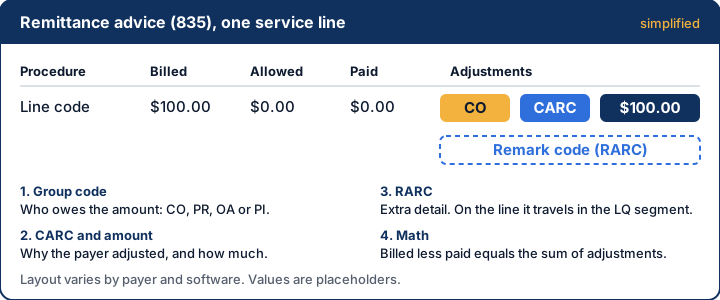
Post it as patient responsibility on the same line it appears on.
An allowed amount of $200.00 with $50.00 of deductible remaining.
Example of a PR-1 line
A family medicine visit in February has an allowed amount of $180. The patient still owes $120 of the plan's annual deductible.
Where a visit happens out of network in an emergency department, federal cost-sharing limits can apply to what the patient owes. See our No Surprises Act FAQ instead of working it here. Related lines are PR-2 for coinsurance and PR-3 for copay. This code shows up daily in family medicine billing, internal medicine billing and urgent care billing. If these denials keep coming back, our denial management team can work them.
Related codes
- X12 claim adjustment reason codes list · X12
- X12 remittance advice remark codes list · X12
- X12 claim adjustment group codes list · X12
- Medicare Claims Processing Manual, chapter 22, section 60.1 (group codes) · CMS
- 2026 Medicare Parts A and B premiums and deductibles · CMS
- What does Medicare cost? Part B costs · Medicare.gov
We check every rule, code and deadline against the official source. See our editorial policy.
Common questions
Straight answers from the team that does the work.
Ask a billing lead directly. A 20-minute call, Monday to Friday, 9am to 5pm Eastern.
01What does PR-1 mean on a remittance?
PR-1 is a patient responsibility adjustment for the deductible. X12 defines CARC 1 as Deductible Amount, and the PR group code marks it as an amount that may be billed to the patient or insured. The claim itself is not necessarily denied. Bill the patient only the PR-1 figure, less anything already collected.
02Is PR-1 a denial?
No. A PR-1 line is the portion of the allowed amount that the plan applied to the patient's deductible. The rest of the claim can still pay. Treat it as a balance to move to the patient, and do not appeal it unless the deductible figure conflicts with the benefit information you verified.
03Can I write off a PR-1 amount?
Only if your contract or a regulation bars billing it. X12 alert N364 says the agreement requires you to waive the deductible, and N781 flags a Qualified Medicare Beneficiary whose collected deductible must be reviewed. Without those, a PR line is an amount that may be billed to the patient.
04How much is the Medicare Part B deductible in 2026?
CMS published a 2026 Part B annual deductible of $283, up from $257 in 2025. The Part A inpatient hospital deductible is $1,736 for 2026. Commercial and Medicare Advantage plans set their own deductibles, so confirm those through the 271 eligibility response.
05What if the PR-1 amount is larger than the patient expected?
Compare it to the eligibility response from before the visit. Accumulators can change when another provider's claim posts first. If the payer's figure is wrong, ask for a reprocessing review with the benefit details. If it is right, send the statement and offer the payment plan your policy allows.

Deductible lines on real remits?
We reconcile the PR-1 amount to eligibility before a statement goes out.