
CO-55 denial code: procedure deemed experimental or investigational
CO-55 is a claim adjustment reason code for a procedure, treatment or drug the payer deems experimental or investigational. The argument is about the evidence for the treatment, so the appeal starts with the payer's own policy.
 Written by Salman Saeed, CEO and Co-Founder · Reviewed by a Certified Medical Coder · Last reviewed October 2026
In short: CO-55 means the payer treats the procedure, treatment or drug as experimental or investigational. Get the policy from the 835 or the plan documents, check the IDE or trial number on the claim, confirm any ABN, and appeal with literature and clinical rationale before the deadline.
What does CO-55 mean?
X12 defines claim adjustment reason code (CARC) 55 as: "Procedure/treatment/drug is deemed experimental/investigational by the payer." The usage note says to refer to the 835 Healthcare Policy Identification Segment (loop 2110 Service Payment Information REF), if present. The start date is 01/01/1995 and it was last modified on 07/01/2017.
This is a coverage decision about the treatment itself. It is not about coding, a missing form or timing. The REF segment can carry the policy number the payer applied, so open the 835 first and get the policy before you open the chart.
X12 assigns no single group code to CARC 55. Read the one on the remit.
How is CO-55 different from CO-56 and CO-50?
X12 has a sibling, CARC 56: "Procedure/treatment has not been deemed 'proven to be effective' by the payer." Same start date, same usage note, a different finding. CO-55 says the payer calls the service experimental or investigational. CO-56 says the evidence has not convinced the payer that it works.
CO-50 is the medical necessity denial for a service the payer otherwise accepts. With CO-55 the service is excluded as a type of care, so the argument is about the evidence for the treatment, not about this patient's chart alone.
Which remark codes come with CO-55?
| RARC | X12 wording | What it tells you |
|---|---|---|
| N623 | Not covered when deemed unscientific/unproven/outmoded/experimental/excessive/inappropriate. | The payer's own policy language, closest to CO-55. |
| MA50 | Missing/incomplete/invalid Investigational Device Exemption number or Clinical Trial number. | A trial or device-exemption number was missing from the claim. |
| N130 | Consult plan benefit documents/guidelines for information about restrictions for this service. | Get the plan's experimental and investigational definition. |
| N210 | Alert: You may appeal this decision. | Appeal rights exist. The deadline is in the payer's notice. |
How does Medicare treat experimental items?
Under 42 CFR 411.15(o), Medicare excludes experimental or investigational devices, with certain devices excepted. Chapter 30 of the Claims Processing Manual says Medicare denies services it considers experimental, such as "Research Use Only" laboratory tests, as not reasonable and necessary under section 1862(a)(1) of the Act. Section 50.2 states that in these circumstances the beneficiary must be given an ABN.
That ties CO-55 to liability. Without a valid ABN, a provider who should have known the service was excluded may be unable to bill the patient. Chapter 30 also notes that language about "Medicare coverage for clinical trials" may be used as the reason on the notice. See ABN rules and LCDs and NCDs.
What goes on the claim for a trial or investigational device?
On a CMS-1500, chapter 26 says item 23 holds the Investigational Device Exemption number when an investigational device is used in an FDA-approved clinical trial, and a Post Market Approval number when applicable. A claim for trial care that omits it can come back with MA50 beside the CO-55.
For trial or device claims, the number must match the study record. Ask the research office for it rather than reusing one from another patient.
How do you fix or appeal a CO-55 denial?
How does CO-55 read on the remittance?
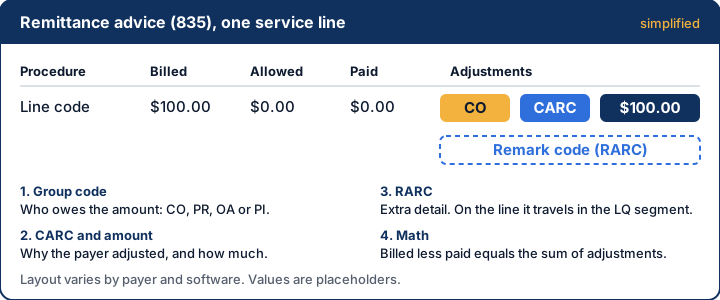
CO-55 says the service is considered experimental or investigational. The remark (N623, MA50, N130 or N210) shows the policy. For Medicare, a device study number goes in item 23 of the CMS-1500. Check whether the payer has a policy for this code and what documentation it names.
Where does CO-55 show up most?
It shows up in oncology billing for new agents and trial care, neurology billing and plastic surgery billing. Its neighbours are CO-58, CO-49 and CO-96. If these denials keep coming back, our denial management team can work them.
Related codes
- X12 claim adjustment reason codes list · X12
- X12 remittance advice remark codes list · X12
- X12 claim adjustment group codes list · X12
- 42 CFR 411.15, particular services excluded from coverage · eCFR
- Medicare Claims Processing Manual, chapter 30, sections 20 and 50 · CMS
- Medicare Claims Processing Manual, chapter 26 (CMS-1500) · CMS
- Medicare Claims Processing Manual, chapter 29, section 310.2 · CMS
- Medicare Claims Processing Manual, chapter 22, sections 60.1 to 60.3 (group codes, CARC, RARC on the remittance) · CMS
We check every rule, code and deadline against the official source. See our editorial policy.
Common questions
Straight answers from the team that does the work.
Ask a billing lead directly. A 20-minute call, Monday to Friday, 9am to 5pm Eastern.
01How do I appeal CO-55 experimental denials?
Get the policy the payer applied, then build the appeal on the evidence: peer-reviewed literature, the clinical rationale and the payer's own criteria. Ask for the reviewer's rationale. A Medicare redetermination is due within 120 days of receiving the notice. Commercial deadlines are in the payer's letter.
02What is the difference between CO-55 and CO-56?
CO-55 says the procedure, treatment or drug is deemed experimental or investigational. CO-56 says it has not been deemed proven to be effective. Both started on 01/01/1995 and carry the same usage note. The first is about status, the second is about the strength of the evidence.
03What does MA50 mean with CO-55?
MA50 reads: Missing/incomplete/invalid Investigational Device Exemption number or Clinical Trial number. Chapter 26 puts the IDE number in CMS-1500 item 23. Add the right number and resubmit as a corrected claim if the payer allows it, then appeal if it still denies.
04Do I need an ABN for experimental services under Medicare?
Chapter 30, section 50.2, says that when Medicare considers an item or service experimental, payment is denied under section 1862(a)(1) as not reasonable and necessary, and the beneficiary must be given an ABN. Without a valid notice the provider may be liable for the charge.
05Can I bill the patient after a CO-55?
Only if the payer's rules and your contract allow it. Check the group code on the remit. Under Medicare, liability turns on whether a valid ABN was given before the service. For commercial plans, a signed financial responsibility form naming the service can help but does not override the contract.
Keep reading

Experimental denials on new treatments?
We pull the policy, check the trial and device numbers and build the appeal around the evidence the payer's own criteria ask for.