
CPT 92557: comprehensive hearing test and the order rule
92557 reports a comprehensive hearing test. Medicare covers it only on a physician or NPP order, counts both ears as one unit, and excludes tests done to fit a hearing aid.
 Written by Salman Saeed, CEO and Co-Founder · Reviewed by a Certified Medical Coder · Last reviewed October 2026
In short: 92557 is the comprehensive audiometry code. It needs a physician or NPP order, covers both ears in one unit (modifier 52 for one ear), and is not paid when done to fit or change a hearing aid.
What does CPT 92557 report?
92557 reports a comprehensive hearing test performed as one service, not as separate single-purpose tests. The CPT descriptor is AMA text, so this page paraphrases it. CMS labels the code "Comprehensive hearing test". The pure tone tests 92552 (air only) and 92553 (air and bone) are separate codes.
| Item | Value in the file |
|---|---|
| Payment status | A (active code) |
| PC/TC indicator | 7 |
| Global period | XXX |
| Work RVU | 0.60 |
| Total RVU, non-facility and facility | 1.07 and 0.77 |
| Bilateral indicator | 2 (RVUs already assume both ears) |
| Multiple procedure indicator | 0 |
| MUE value and indicator | 1, with indicator 2 (date of service edit, policy) |
PC/TC indicator 7 is not the split seen on imaging. RVU26D defines it as a physical therapy service for which payment may not be made if it is given to a hospital outpatient or inpatient by an independently practicing physical or occupational therapist. In the same file 92552 and 92553 carry indicator 3, technical component only, with no work RVU. Read the indicator before assuming 26 and TC apply.
Who can bill 92557 and what does the order need?
A physician, a nonphysician practitioner or an enrolled audiologist can furnish it, but Medicare covers it only on a physician or NPP order. Chapter 15, section 80.3 of the Medicare Benefit Policy Manual says that if an audiologist tests without a physician order, the tests are not covered even if the audiologist finds a pathologic condition. Where the order names no tests, the audiologist may choose the battery.
In an office, an enrolled audiologist bills under his or her own NPI in the rendering field (Claims Processing Manual, chapter 12, section 30.3). A technician may record results but may not interpret them.
Audiologic tests are diagnostic tests with their own benefit, not services incident to a physician. Reporting standards are also fixed by NCCI chapter XI: codes 92552 to 92557 are reported only when calibrated electronic equipment is used, and qualitative screening by the physician is part of the E/M.
When will Medicare pay for 92557?
It pays when the test is ordered to get information for a medical or surgical decision about hearing, and it does not pay for hearing aid fitting. Section 80.3 relies on section 1862(a)(7) of the Social Security Act: payment is not allowed when the type and severity of the hearing status are already known to the physician, or when the test was ordered for the specific purpose of fitting or changing a hearing aid.
- Allowed: suspected change in hearing, finding the cause of a hearing, tinnitus or balance disorder, and measuring the effect of medication, surgery or other treatment.
- Not limited by confirming a prior diagnosis or by treatment that follows, including hearing aids.
- Excluded: 42 CFR 411.15(d) and chapter 16, section 100 of the Benefit Policy Manual exclude hearing aids and examinations to prescribe, fit or change them.
Put the clinical reason for the test in the order.
How do I bill one ear or both ears?
Bill one unit for both ears. NCCI chapter XI says audiologic function tests 92550 to 92588 include both ears, so only one unit is reported for testing both. If only one ear is tested, report the code with modifier 52, which is reduced services.
The bilateral indicator of 2 and the MUE of 1 agree. Do not use RT, LT or 50 to show two ears on this code. See also ear wax removal 69210, which is counted per ear, and the cerumen rule when a physician removes wax on the same date as the test.
That rule is in NCCI chapter XI: if the audiologist cannot remove impacted wax and a physician must, the physician reports G0268 and not 69209 or 69210. The comparison table is on the 69210 page.
Which fields hold the hearing test and order?
A comprehensive hearing test is 92557 in Item 24D with 1 unit in Item 24G and a pointer in Item 24E to the hearing complaint. Chapter 26 Item 17 carries the ordering physician, which matters for this code since the order is part of coverage. RVU26D sets the bilateral indicator to 2, so one line covers both ears.
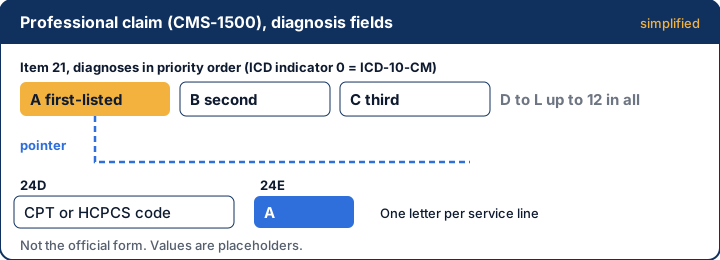
RVU26D gives 92557 status A and global XXX, and the MUE table allows 1 per date with indicator 2.
Example: A physician orders a hearing evaluation for dizziness and hearing loss. The audiology claim on 10/12 shows 92557, pointer A (H91.90), 1 unit, $74.00, with the ordering physician in Item 17 and the NPI in Item 17b. A missing ordering provider may bring CO-16.
Why does 92557 get denied?
| Code | What X12 says | Typical cause |
|---|---|---|
| CARC 50 | Not deemed a medical necessity by the payer | Order gives no reason, or the type and severity of hearing loss was already known |
| CARC 96 | Non-covered charge(s) | The test was done to fit or change a hearing aid |
| CARC 16 | Claim or service lacks information or has submission or billing errors | Order or ordering NPI missing, or modifier 52 left off a one-ear test |
| CARC 97 | Included in the payment for another service already adjudicated | Billed with another threshold test that the comprehensive code already contains |
If these denials keep coming back, our denial management team can work them. More ear, nose and throat rules are in ENT billing, with 31231 for the nasal scope.
Related codes
- Physician Fee Schedule relative value files, RVU26D (October 2026) · CMS
- Medicare NCCI medically unlikely edits, practitioner table effective 10-01-2026 · CMS
- NCCI Medicare Policy Manual, chapter XI (2026) · CMS
- Medicare Benefit Policy Manual, chapter 15, section 80.3 (audiology services) · CMS
- Medicare Benefit Policy Manual, chapter 16, section 100 (hearing aids) · CMS
- Medicare Claims Processing Manual, chapter 12, section 30.3 · CMS
- 42 CFR 411.15 Particular services excluded from coverage · eCFR
- X12 claim adjustment reason codes · X12
- Medicare Claims Processing Manual, Chapter 26: Completing and Processing Form CMS-1500 Data Set · CMS
We check every rule, code and deadline against the official source. See our editorial policy.
Common questions
Straight answers from the team that does the work.
Ask a billing lead directly. A 20-minute call, Monday to Friday, 9am to 5pm Eastern.
01How do I bill a comprehensive hearing test?
Report 92557 once for both ears, with a physician or NPP order that states why the test is needed. Add modifier 52 if only one ear was tested. Use calibrated electronic equipment, and keep a written interpretation in the record.
02Does 92557 cover both ears with one unit?
Yes. NCCI chapter XI of the Medicare Policy Manual says audiologic function tests 92550 to 92588 include both ears and only one unit is reported. For one ear only, add modifier 52. The October 2026 MUE for 92557 is 1 unit per date of service, so a second unit is cut.
03Does Medicare pay for a hearing test to fit a hearing aid?
No. Section 1862(a)(7) of the Social Security Act and 42 CFR 411.15(d) exclude examinations to prescribe, fit or change hearing aids. Section 80.3 of chapter 15 also denies a test when the physician already knows the type and severity of the loss.
04Does an audiologist need an order for 92557?
Yes. Chapter 15, section 80.3 of the Medicare Benefit Policy Manual says testing without a physician or NPP order is not covered, even if the audiologist finds a pathologic condition. The order may leave the choice of tests to the audiologist.
05Can modifiers 26 and TC be used with 92557?
Check the indicator first. In RVU26D 92557 has PC/TC indicator 7, defined by CMS as a therapy-type service with a hospital-patient payment limit, not the split used on imaging. Audiology codes 92552 and 92553 carry indicator 3, technical component only, so 26 and TC are not used.
06Can I bill 92557 with ear wax removal?
Not by the same practitioner in the usual case. NCCI chapter XI says an audiologist's cleaning before testing is not separate, and a physician who must remove impacted wax on the test date reports G0268, never 69209 or 69210. See the 69210 page for the table.


Hearing tests denied for necessity?
We check the order, the reason and the one-ear modifier before the claim leaves.