
CPT 69210: earwax removal with instruments vs 69209 and G0268
69210 reports removal of impacted ear wax from one ear with instruments. Irrigation is 69209, and a physician removing wax on the date of hearing tests reports G0268 instead.
 Written by Salman Saeed, CEO and Co-Founder · Reviewed by a Certified Medical Coder · Last reviewed October 2026
In short: 69210 is impacted ear wax removal with instruments, one ear. Irrigation is 69209, a physician removing wax on the date of audiologic testing reports G0268, and wax removed as access for an ear operation is not billed.
What does CPT 69210 report?
69210 reports removal of impacted ear wax (cerumen) from one ear when instruments are needed. NCCI chapter XI describes it as removal of impacted cerumen requiring instrumentation, unilateral. The CPT descriptor is AMA text, so this page paraphrases it. CMS labels the code "Remove impacted ear wax uni".
Three codes cover wax and they are easy to confuse. 69209 is removal by irrigation or lavage of one ear, 69210 is removal that needs instruments, and G0268 is the HCPCS code for a physician removing impacted wax on the same date as hearing tests.
| Item | 69209 | 69210 | G0268 |
|---|---|---|---|
| Meaning | Irrigation, one ear | Instruments, one ear | Physician removal on hearing test date |
| Payment status | A | A | A |
| PC/TC indicator | 5 (incident to) | 0 | 0 |
| Work RVU | 0.00 | 0.59 | 0.59 |
| Total RVU, non-facility | 0.51 | 1.43 | 1.51 |
| Total RVU, facility | 0.51 | 0.81 | 0.82 |
| Bilateral indicator | 1 | 2 | 2 |
| MUE | 1 | 1 | 1 |
All three have a 000 global period and a multiple procedure indicator of 2 in the file. The MUE for 69210 is 1 with indicator 2 and the stated reason is anatomic consideration. The other two are 1, indicator 2, with the reasons CMS policy for 69209 and the code descriptor for G0268.
When do I use 69209, 69210 or G0268?
Choose by method and by what else happened that day. Use 69210 when the note shows the wax was impacted and instruments were required, use 69209 when irrigation or lavage did the job, and use G0268 when the removal is by a physician on the same date as audiologic function testing.
- The audiologist can remove wax: NCCI chapter XI says removal of cerumen by an audiologist before testing is not separately reportable.
- The audiologist cannot: if the wax is impacted and a physician must remove it, report G0268. The manual says not to report 69209 or 69210 for that service.
- Impacted means documented: the note needs the ear, the finding that the canal is blocked, and the method.
The hearing test side of this rule is on 92557.
Why does the PC/TC indicator differ between 69209 and 69210?
Indicator 5 on 69209 marks an incident-to service. RVU26D defines it as covered when auxiliary staff employed by the physician provide it under direct personal supervision, and says A/B MACs cannot pay it when the patient is a hospital inpatient or hospital outpatient department patient.
69210 has indicator 0, a physician service, with a work RVU of 0.59, and 69209 has no work RVU. That difference is why the codes are priced apart. See the incident-to rules.
How do I bill both ears?
The code is unilateral in the descriptor, so a second ear is a second service, but the system rules are narrow. The bilateral indicator is 2 and the MUE is 1 per date of service, with anatomic consideration as the reason. Chapter 12, section 40.7 says a claim system identifies bilateral procedures by modifier 50 or by the same code on separate lines with RT and LT.
Because the 1-unit MUE and the indicator 2 payment rule (lower of the charge or 100 percent of one fee) interact, ask your MAC how it prices two ears before a first claim. The note should name each ear and the method. See RT and LT.
When is 69210 bundled into another ear procedure?
Wax removal is not billed when it is just the way into the ear. NCCI chapter I uses a myringotomy as its example: the procedure requires access to the tympanic membrane through the ear canal, so removal of impacted cerumen from the canal is not separately reportable.
A modifier 25 E/M can go with 69210 when the visit is significant and separate, since 69210 is a 000 code. The usual same-day rule of chapter 12 applies and is covered on the 31231 page.
Where do the ear code and side go?
Ear wax removal with an instrument is 69210 in Item 24D with 1 unit in Item 24G, one line per ear if both are treated. RVU26D gives it a bilateral indicator of 2, meaning the RVUs are already based on a bilateral service, so check how your payer wants RT and LT or 50 shown. Item 24E points to the impacted wax diagnosis.
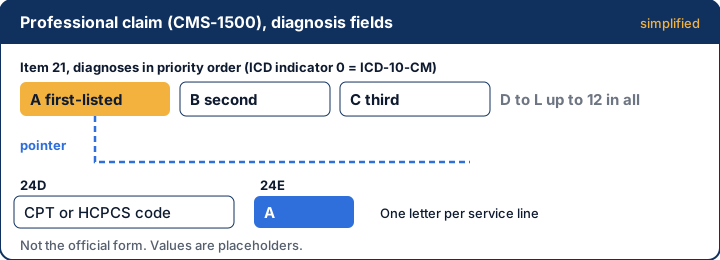
RVU26D gives 69210 status A and a 000 global, which means a same-day visit decision is generally not paid separately. The MUE table allows 1 per date with indicator 2, an anatomic consideration.
Example: A patient with hearing loss from wax has the right ear cleared on 10/13. The line is 69210 RT, pointer A (H61.21), 1 unit, $88.00. If the left ear is also treated, the note names each ear, and a call to the MAC on pricing comes before the first two-ear claim.
Why does 69210 get denied?
| Code | What X12 says | Typical cause |
|---|---|---|
| CARC 97 | Included in the payment for another service already adjudicated | Billed with a tympanostomy, myringotomy or other ear operation in the same session |
| CARC 234 | This procedure is not paid separately | Billed with 92557 by the same provider, where G0268 was the right path |
| CARC 4 | The procedure code is inconsistent with the modifier used | RT or LT missing or mismatched with the ear in the note |
| CARC 18 | Exact duplicate claim or service (OA group code unless state workers' compensation rules require CO) | Two ears sent on two identical lines with no RT and LT |
If these denials keep coming back, our denial management team can work them. Ear, nose and throat rules are in ENT billing, with the nasal scope on 31231.
Related codes
- Physician Fee Schedule relative value files, RVU26D (October 2026) · CMS
- Medicare NCCI medically unlikely edits, practitioner table effective 10-01-2026 · CMS
- NCCI Medicare Policy Manual, chapter XI (2026) · CMS
- NCCI Medicare Policy Manual, chapter I (2026) · CMS
- Medicare Claims Processing Manual, chapter 12 · CMS
- CMS HCPCS quarterly update, October 2026 alpha-numeric file · CMS
- X12 claim adjustment reason codes · X12
- Medicare Claims Processing Manual, Chapter 26: Completing and Processing Form CMS-1500 Data Set · CMS
We check every rule, code and deadline against the official source. See our editorial policy.
Common questions
Straight answers from the team that does the work.
Ask a billing lead directly. A 20-minute call, Monday to Friday, 9am to 5pm Eastern.
01When is earwax removal separately payable?
When the wax is documented as impacted, the method is stated, and it is not part of another ear procedure. Use 69209 for irrigation, 69210 for instruments, and G0268 when a physician removes it on the date of hearing tests. Access to the canal for a myringotomy is never separate.
02What is the difference between 69209 and 69210?
69209 is irrigation or lavage of one ear and 69210 needs instruments. In the October 2026 file 69209 has PC/TC indicator 5 (incident to), work RVU 0.00 and non-facility total 0.51. 69210 has indicator 0, work RVU 0.59 and non-facility total 1.43.
03Can I bill 69210 on the same day as a hearing test?
Not by the same practitioner in the usual case. NCCI chapter XI says an audiologist's cleaning before testing is not separate. If a physician must remove impacted wax on the test date, report G0268 and not 69209 or 69210. Document why the physician had to remove it.
04How do we bill bilateral ear procedures with 69210?
69210 is a unilateral code with a bilateral indicator of 2 and an MUE of 1. The claim system recognises two sides by modifier 50 or RT and LT lines. Ask your MAC which it prices, and name each ear in the note.
05Does 69210 have a global period?
Yes, 000. The October 2026 fee schedule file gives it a zero-day global period, so it is a minor procedure. A significant, separately identifiable visit the same day is reported with modifier 25 on the E/M, and visits on later days are not in the package.
06Can clinical staff bill 69210?
The file marks only 69209, the irrigation code, as incident to (PC/TC indicator 5), which allows auxiliary staff under direct personal supervision of a physician. 69210 has indicator 0 and work RVU 0.59, so the file treats it as a physician service. Check your MAC before billing it for staff.



Ear wax claims bundled or denied?
We pick between 69209, 69210 and G0268 from the note and appeal the rest.