
CPT 98940: chiropractic manipulation of 1 to 2 spinal regions
98940 reports chiropractic manipulative treatment of one or two spinal regions, the lowest of three region-count levels. For Medicare it needs the AT modifier when the care is active treatment, because a claim without AT is treated as maintenance and denied.
 Written by Salman Saeed, CEO and Co-Founder · Reviewed by a Certified Medical Coder · Last reviewed October 2026
In short: 98940 is the first of three manipulation codes by region count and is the only service Medicare pays a chiropractor for. AT marks active or corrective care, GA or GZ goes on maintenance care with an ABN, and the 000 global means a same-day visit needs separate support.
What does CPT 98940 report?
98940 is the CPT code for chiropractic manipulative treatment (CMT) of 1 to 2 spinal regions. The CMS fee schedule file labels it "Chiropract manj 1-2 regions", and the next code up, 98941, "Chiropract manj 3-4 regions". NCCI Chapter XI says Medicare covers CMT of 5 spinal regions.
The Benefit Policy Manual, Chapter 15, section 240.1.4, requires the chiropractor to name the precise level of the subluxation for each claim. Its table groups the spine into the neck, the back (dorsal or thoracic), the low back (lumbar), the pelvis and the sacrum, with vertebral short forms such as C1 to C7, T1 to T12 and L1 to L5.
| Item in RVU26D | 98940 |
|---|---|
| Payment status | A (active, paid separately) |
| Work RVU | 0.45 |
| Total RVU, non-facility | 0.80 |
| Global period | 000 |
| Practitioner MUE, effective 10-01-2026 | 1 (indicator 2, policy basis) |
How many spinal regions does 98940 cover?
1 to 2, and it is billed as 1 unit. The MUE for 98940 is 1 per date of service, so a second unit on the same date can deny, because the two regions are already inside the code. A visit with 3 or 4 regions is reported with 98941 instead.
The region count and the subluxation level must match the note. Medicare pays for one treatment a day: the manual says a clinic's "intensive care" model with several daily visits and room fees is not covered and reimbursement is limited to not more than one treatment per day.
What does Medicare cover for a chiropractor?
Manual manipulation of the spine to correct a subluxation, and nothing else. Chapter 15, section 240.1.1, says coverage is limited to treatment by manual manipulation, and that no other diagnostic or therapeutic service furnished by a chiropractor or ordered by one is covered, including x-rays or other tests the chiropractor orders.
The patient needs a neuromusculoskeletal condition, and the manipulation must have a direct therapeutic relationship to it and a reasonable expectation of recovery or improvement of function. An x-ray is not required to show the subluxation, and a physical exam can demonstrate it.
Chapter 15 also says that when manual devices are used, no additional payment is made. A therapy code such as 97140 performed in a region being manipulated is bundled under NCCI.
When do I use AT, GA and GZ?
Put AT on 98940 when the manipulation is active or corrective treatment of an acute or chronic subluxation. Chapter 15, section 240.1.3, says a chiropractor must place AT on the claim in that case, and that claims without AT are considered maintenance therapy and denied.
AT does not settle payment: the manual says its presence may not always mean the service is reasonable and necessary, and contractors may deny after medical review. The manual defines maintenance as care that prevents disease, promotes health or maintains a condition, when further improvement cannot reasonably be expected.
When maintenance therapy is provided and an ABN is given, the claim takes GA, or in rare cases GZ, and not AT. The AT modifier must not be placed on a claim for maintenance therapy.
How does 98940 appear on the claim?
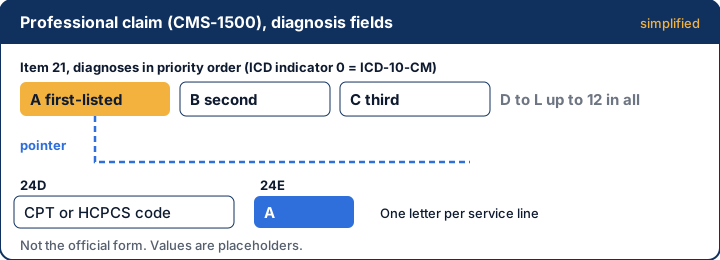
On the CMS-1500, Item 24D carries 98940 with AT (or GA or GZ), Item 24G carries 1, and Item 24E points to the spinal subluxation diagnosis. Chapter 26 requires the date the course of treatment began in Item 14, in 8-digit or 6-digit format.
If an x-ray was used to show the subluxation, its date goes in Item 19. Entering these dates certifies that the required documentation, including the level of subluxation, is on file for the MAC to review. Under Medicare a chiropractor's exam is not a covered service. NCCI says chiropractic manipulative treatment has a 000 global period, so an E/M on the same date follows the minor procedure rule and needs modifier 25 and separate work.
Which fields hold chiropractic regions and the AT modifier?
A spinal manipulation line is 98940 in Item 24D with the payer's modifier, 1 unit in Item 24G and a pointer in Item 24E to the spinal diagnosis. Item 24A holds the visit date. The number of regions treated picks the code, not the number of units.
RVU26D gives 98940 status A and a 000 global, and the MUE table allows 1 per date with indicator 2.
Example: A patient with neck and upper back pain is treated in two regions on 10/11. The line is 98940, pointer A (M99.01), 1 unit, $42.00. A line with 2 units for two regions is stopped by the MUE.
Why is 98940 denied?
| CARC | What X12 says | What usually causes it |
|---|---|---|
| 16 | Claim/service lacks information or has submission/billing error(s) | Item 14 date of initial treatment or exacerbation missing (RARC MA122 in Medicare policy) |
| B22 | This payment is adjusted based on the diagnosis | Diagnosis not tied to a subluxation at the spinal level billed |
| 50 | These are non-covered services because this is not deemed a 'medical necessity' by the payer | Condition other than those in the covered treatment policy, or maintenance care |
| 151 | Payment adjusted because the payer deems the information submitted does not support this many/frequency of services | More than one unit, or more than one treatment on a day |
If these denials keep coming back, our denial management team can work them. Related: CO-16, CO-50 and chiropractic billing.
Related codes
- Physician Fee Schedule relative value files, RVU26D (October 2026) · CMS
- Medicare NCCI Medically Unlikely Edits, practitioner table, effective 10-01-2026 · CMS
- Medicare Benefit Policy Manual, Chapter 15: Covered Medical and Other Health Services · CMS
- Medicare Claims Processing Manual, Chapter 12: Physicians/Nonphysician Practitioners · CMS
- Medicare Claims Processing Manual, Chapter 26: Completing and Processing Form CMS-1500 Data Set · CMS
- 2026 NCCI Medicare Policy Manual, Chapter XI: Medicine, Evaluation and Management Services · CMS
- 2026 NCCI Medicare Policy Manual, Chapter I: General Correct Coding Policies · CMS
- Claim Adjustment Reason Codes · X12
We check every rule, code and deadline against the official source. See our editorial policy.
Common questions
Straight answers from the team that does the work.
Ask a billing lead directly. A 20-minute call, Monday to Friday, 9am to 5pm Eastern.
01How many spinal regions does 98940 cover?
One or two. The CMS file labels 98940 as manipulation of 1 to 2 regions and 98941 as 3 to 4 regions. Medicare covers manipulation of five spinal regions in all, and the MUE for 98940 is 1 unit per date of service.
02When do I add the AT modifier to 98940?
When the manipulation is active or corrective treatment of an acute or chronic subluxation. Medicare's Benefit Policy Manual says claims without AT are treated as maintenance therapy and denied. Do not use AT for maintenance care, where GA or GZ applies.
03What does Medicare pay a chiropractor for under 98940?
Only manual manipulation of the spine to correct a subluxation. Chapter 15, section 240, says no other diagnostic or therapeutic service by a chiropractor is covered, including x-rays and other tests the chiropractor orders. Payment follows the physician fee schedule.
04Is an x-ray needed to bill 98940 for Medicare?
No. For dates of service on or after January 1, 2000, an x-ray is not required to demonstrate the subluxation, and a physical exam can do it. If an x-ray is used, its date goes in Item 19 of the CMS-1500.
05Can 98940 be billed with 98941 in the same visit?
No. The two codes describe different region counts for one treatment, so one code is reported for the regions treated. Medicare also limits payment to one treatment per day, and the Medicare MUE for 98940 is 1 unit, so the second code would be an extra unit.



Chiropractic claims denying?
We check AT, the subluxation level and the Item 14 date before the claim goes out.