
CPT 92134: Retinal OCT Imaging and Why OCT Claims Get Denied
92134 reports retinal OCT imaging with a written interpretation. Both eyes are one unit, the 26 and TC split is allowed, and denials center on medical necessity and bundling with fundus photography.
 Written by Salman Saeed, CEO and Co-Founder · Reviewed by a Certified Medical Coder · Last reviewed October 2026
In short: 92134 is the retinal OCT code, a special ophthalmological service that can be billed beside an eye exam. Both eyes are one unit, 26 and TC apply, and payers deny it when it only confirms a diagnosis already made.
What Does CPT 92134 Report?
92134 reports computerized scanning imaging of the retina, commonly called OCT (optical coherence tomography), with the interpretation and report. The CPT descriptor is AMA text, so this page paraphrases it. CMS labels the code "Cptrz oph dx img pst sgm rta". Its sibling 92133 covers the optic nerve and is labeled "Cptrzd oph dx img pst sgm on".
The code is a special ophthalmological service. NCCI chapter XI says these services are separately reportable because they are not part of a general eye exam, so 92014 or an E/M visit can sit beside it on the same date.
| Item | Global (no modifier) | Modifier 26 | Modifier TC |
|---|---|---|---|
| Payment status | A | A | A |
| Work RVU | 0.31 | 0.31 | 0.00 |
| Total RVU, non-facility | 0.98 | 0.53 | 0.45 |
| Total RVU, facility | 0.98 | 0.53 | 0.45 |
| PC/TC indicator | 1 | 1 | 1 |
| Multiple procedure indicator | 7 | 7 | 7 |
| Bilateral indicator | 2 | 2 | 2 |
The global period is XXX on all three lines. The MUE is 1 unit per date of service with indicator 2, a policy edit whose stated reason is the code descriptor.
When Do I Split 92134 with Modifiers 26 and TC?
Bill globally when your practice owns the scanner and does the reading, and split only when one party owns the equipment and another reads the scan. PC/TC indicator 1 means both modifiers are allowed. The RVU26D layout says the total for a 26 line is physician work, practice expense and malpractice, and the TC line carries practice expense and malpractice only.
The table above shows the arithmetic: 0.53 for the reading plus 0.45 for the technical part equals the 0.98 global total. The reading physician bills 92134-26 when someone else owns the scanner.
Multiple procedure indicator 7 is specific to this family. The file says the technical component of the second and each later diagnostic ophthalmology service the same day is reduced by 20 percent, so 92134-TC and 92133-TC together do not pay twice at full value.
How Are Both Eyes Billed?
Bill one unit. The bilateral indicator is 2, and RVU26D defines that to mean the RVUs are already based on the procedure being performed as a bilateral procedure, so the 150 percent adjustment does not apply and a second line adds nothing. If you report it with 50, or with RT and LT, payment is the lower of the charges or 100 percent of one fee.
The 1-unit MUE points the same way. Put RT, LT or 50 only if your payer requires an eye on the line, and put the eye in the note either way. See RT and LT.
What Can I Not Bill with 92134?
Do not bill fundus photography 92250 on the same eye by default. NCCI chapter XI says 92250 and scanning computerized imaging such as 92133 and 92134 are generally mutually exclusive, because one technique or the other is used to evaluate fundal disease. A limited number of conditions make both reasonable on the same eye, and then modifier 59 or XU goes on 92250.
- Cataract work-up: WPS billing article A59805 lists anterior or posterior segment OCT among tests that are not routinely indicated before cataract surgery, and not covered unless a statement in the record defends it.
- Glaucoma follow-up: CGS LCD L34061 for scanning computerized ophthalmic diagnostic imaging says it is not reasonable when it only confirms a diagnosis or treatment already decided, and that imaging with a visual field on the same day or within 3 months is usually not necessary.
- Where those policies apply: L34061 is a CGS policy for Kentucky and Ohio. Read your own MAC's policy; other jurisdictions may differ.
How Do Eye Scans Appear on the Form?
A retinal imaging line is 92134 in Item 24D with 26 or TC as needed and 1 unit in Item 24G for both eyes. RVU26D sets the bilateral indicator to 2, so the RVUs already cover both eyes. Item 24E points to the retinal diagnosis.
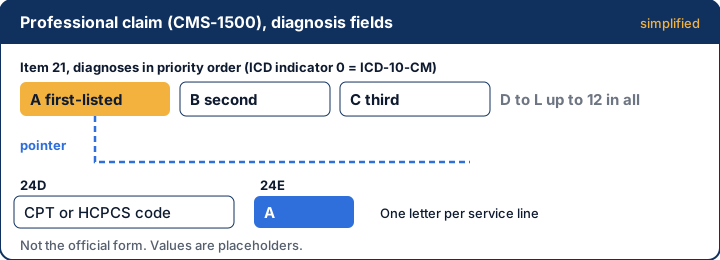
The file also shows multiple-procedure indicator 7, a 20% reduction of the second highest and later technical components of diagnostic ophthalmology services. On a hospital bill, 92134 is in FL 44 with the date in FL 45. The MUE table allows 1 per date with indicator 2.

Example: A patient with macular degeneration has scans of both eyes on 10/19. The line is 92134, pointer A (H35.30), 1 unit, $65.00. Adding RT and LT lines would double count a code whose RVUs are already bilateral.
Why Does 92134 Get Denied?
| Code | What X12 says | Typical cause |
|---|---|---|
| CARC 50 | Not deemed a medical necessity by the payer | Imaging that only confirms a known diagnosis, or OCT with no stated reason in the note |
| CARC 97 | Included in the payment for another service already adjudicated | 92250 or a second scan billed for the same eye and date without 59 or XU |
| CARC 151 | The information submitted does not support this many or this frequency of services | Repeat scans inside the payer's interval, or 2 units for both eyes |
| CARC 11 | The diagnosis is inconsistent with the procedure | A diagnosis that does not match the retinal or glaucoma reason for scanning |
If these denials keep coming back, our denial management team can work them. The eye family rules are on ophthalmology billing.
Related Codes
- Physician Fee Schedule relative value files, RVU26D (October 2026) · CMS
- Medicare NCCI medically unlikely edits, practitioner table effective 10-01-2026 · CMS
- NCCI Medicare Policy Manual, chapter XI (2026) · CMS
- CGS LCD L34061, Scanning Computerized Ophthalmic Diagnostic Imaging · CMS
- WPS billing and coding article A59805, Cataract Surgery · CMS
- X12 claim adjustment reason codes · X12
- Medicare Claims Processing Manual, Chapter 26: Completing and Processing Form CMS-1500 Data Set · CMS
- Medicare Claims Processing Manual, Chapter 25: Completing and Processing the Form CMS-1450 Data Set · CMS
We check every rule, code and deadline against the official source. See our editorial policy.
Common Questions
Straight answers from the team that does the work.
Ask a billing lead directly. A 20-minute call, Monday to Friday, 9am to 5pm Eastern.
01Why do OCT claims get denied?
The usual reasons are medical necessity (CARC 50), frequency (CARC 151) and bundling with fundus photography (CARC 97). Local policies say OCT that only confirms a known diagnosis is not necessary, so the note must state why the scan was needed on that date.
02Do I bill 92134 once or twice for both eyes?
Once, with 1 unit. The bilateral indicator is 2, which RVU26D defines as RVUs already based on a bilateral procedure, and the MUE is 1 per date of service. A second line for the other eye is not paid extra.
03Can I bill 92134 with fundus photography 92250?
Rarely. NCCI chapter XI calls 92250 and scanning imaging such as 92134 generally mutually exclusive on the same eye, because one technique or the other evaluates fundal disease. Where both are reasonable and necessary, 92250 takes modifier 59 or XU and the note must show why.
04When do I use modifier 26 or TC with 92134?
Only when the equipment owner and the reader are different. The PC/TC indicator is 1, so both modifiers are valid. In RVU26D the 26 line totals 0.53 and the TC line 0.45, adding to 0.98 for the global code billed when one practice does both parts.
05What is the difference between 92134 and 92133?
92134 images the retina and 92133 images the optic nerve. Both have status A, a PC/TC indicator of 1, and a bilateral indicator of 2 in the October 2026 file, and CMS lists work RVU 0.31 for 92134 against 0.30 for 92133.
06Is OCT covered before cataract surgery?
Not routinely under WPS article A59805, which lists anterior or posterior segment OCT among tests that are not a covered benefit in the cataract work-up unless a statement in the patient's record defends the medical necessity. Check your own MAC's article, because policies differ by jurisdiction.


OCT Claims Denied for Necessity?
We match the note to the payer policy and appeal with the clinical reason in hand.