
CPT 73721: MRI of a lower joint, such as the knee, without contrast
73721 reports an MRI of a lower-extremity joint, most often the knee, done without contrast, and Medicare pays it as an active code with a professional and a technical part. It is the one imaging code in this group that is paid per side, with a bilateral indicator of 3 and a per-date MUE of 3.
 Written by Salman Saeed, CEO and Co-Founder · Reviewed by a Certified Medical Coder · Last reviewed October 2026
In short: 73721 is the MRI of a joint of the lower leg without contrast, billed globally or split with 26 and TC. The fee schedule file gives a global total of 6.12 RVUs, of which 1.88 is the reading. Both knees are billed as two sides at 100 percent each, and the plan, not the code, decides authorization.
What does CPT 73721 report?
73721 reports an MRI of a joint in the lower leg, such as the knee, done without contrast. The October 2026 fee schedule file (RVU26D) lists it as an active code, status A, with a professional part and a technical part and no global period.
The word joint matters. The same file lists a separate code, 73718, for an MRI of the lower extremity other than a joint, also without contrast. 73722 is the joint MRI with contrast and 73723 is the joint MRI without contrast followed by contrast. Choosing the wrong one is a coding error that no modifier can fix.
| Item | Value in the file |
|---|---|
| Payment status | A (active code) |
| PC/TC indicator | 1 (modifiers 26 and TC allowed) |
| Work RVU | 1.32 |
| Total RVU, global / 26 / TC | 6.12 / 1.88 / 4.24 |
| Multiple procedure indicator | 4 (imaging reduction applies) |
| Bilateral indicator | 3 (each side paid at 100%) |
How do you bill both knees on the same day?
Report 73721 for each side. The bilateral indicator of 3 means the usual 150 percent bilateral adjustment does not apply: if the code is reported with modifier 50, with RT and LT, or with 2 units, payment for each side is the lower of the actual charge or 100 percent of the fee schedule amount for that side.
The practitioner MUE table effective October 1, 2026 lists 73721 at 3 per date, adjudication indicator 3, compared with 2 for 71046 and 74177. Do not bill two lines with the same code and no side modifier; payers read that as a duplicate.
A patient has both knees scanned in one visit. The reading group bills 73721-26-RT and 73721-26-LT, each with 1 unit. Each line is paid at 100 percent of its own amount, subject to the same-session technical reduction if another MRI in the family is also done.
What happens to the technical payment when a second MRI is done?
A multiple procedure indicator of 4 puts the technical component under the imaging reduction: 100 percent for the highest priced study and 50 percent for each later study in the same family on the same day. The file also shows family indicator 88, and a 5 percent cut to the professional component of diagnostic imaging from January 1, 2017.
The reduction is applied by the payer after you bill. Remittances show it with CARC 59; see the table below. Bill every study that was done and was ordered.
Is contrast billed with 73721?
No contrast is given in this study, so there is nothing to add. If contrast is later given, the study is 73722 or 73723 instead of 73721, not an add-on. NCCI Policy Manual Chapter IX adds that when parenteral contrast is used for MRI, vascular access and contrast administration codes are integral and are not billed separately.
Chapter 13 of the Claims Processing Manual sends coverage questions on MRI to the National Coverage Determinations Manual, chapter 1, section 220.2.
Does an MRI of the knee need prior authorization?
The code itself does not carry an authorization rule; the patient's plan does. For Medicare fee-for-service, CMS paused the Appropriate Use Criteria program and rescinded 42 CFR 414.94 effective January 1, 2024, so there is no AUC consultation to report on the claim.
For Medicare Advantage and commercial plans, check the requirement before the scan is booked and keep the authorization number on the claim. Our prior authorization team handles that step, and CO-197 is the denial when it is missing.
How does 73721 appear on the claim?
On the CMS-1500, item 24D carries 73721 with 26, TC and RT or LT, item 24G carries the units and item 24B carries the place of service. The facility technical claim is paid under OPPS with a status indicator and APC from OPPS Addendum B.
Read the split in modifier 26 and modifier TC, and the neighboring studies in CPT 71046 and CPT 74177.
How do I enter 73721 and a side modifier on each form?
A joint MRI lines up three things in Item 24D: the code, the split modifier 26 or TC when one party does each part, and RT or LT for the joint. Item 24E points to the symptom or injury diagnosis, and Item 24G holds 1 unit for the study. Chapter 26 allows four modifiers, so side and split fit together.
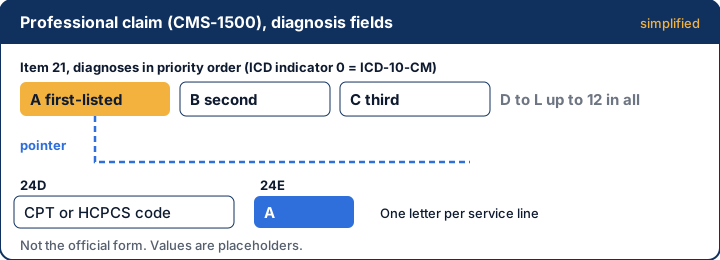
The technical claim from a hospital outpatient department uses FL 42 for the imaging revenue code, FL 44 for 73721 and its modifiers, FL 45 for the date and FL 46 for units. Chapter 25 asks for one dated line for each revenue and procedure code.

RVU26D lists 73721 as status A, and the MUE table allows 3 per date with indicator 3.
Example: A patient has right knee pain after a fall on 10/17. The line reads 73721 RT, pointer A (M25.561), 1 unit, $780.00 global. A line with no side modifier leaves the payer unable to tell which knee was scanned.
Why does a 73721 claim deny?
| CARC | What X12 says | What usually causes it |
|---|---|---|
| 197 | Precertification/notification/authorization/pre-treatment exceeded | No authorization on file with the plan |
| 50 | Not deemed a medical necessity by the payer | Order lacks the clinical reason for the scan |
| 59 | Processed based on multiple or concurrent procedure rules | Second MRI in the same session |
| 151 | Payment adjusted because the payer deems the information submitted does not support this many/frequency of services | Units above the MUE, or a repeat scan |
If these denials keep coming back, our denial management team can work them.
Related codes
- Physician Fee Schedule relative value files, RVU26D (October 2026) · CMS
- Medicare NCCI Medically Unlikely Edits, practitioner services table, effective 10-01-2026 · CMS
- Medicare Claims Processing Manual, Chapter 13: Radiology Services and Other Diagnostic Procedures · CMS
- 2026 NCCI Medicare Policy Manual, Chapter IX: Radiology Services · CMS
- Appropriate Use Criteria Program (current status) · CMS
- Medicare Claims Processing Manual, Chapter 26: Completing and Processing Form CMS-1500 Data Set · CMS
- Claim Adjustment Reason Codes · X12
- Medicare Claims Processing Manual, Chapter 25: Completing and Processing the Form CMS-1450 Data Set · CMS
We check every rule, code and deadline against the official source. See our editorial policy.
Common questions
Straight answers from the team that does the work.
Ask a billing lead directly. A 20-minute call, Monday to Friday, 9am to 5pm Eastern.
01Does an MRI of the knee need prior authorization?
It depends on the plan, not the code. Medicare fee-for-service has no AUC step since CMS rescinded 42 CFR 414.94 effective January 1, 2024. Medicare Advantage and commercial plans set their own rules, so verify before scheduling and put the authorization number on the claim.
02How do I bill an MRI of both knees?
Report 73721 once for each side, with RT and LT or modifier 50. The bilateral indicator is 3, so each side is paid at 100 percent rather than 150 percent for both. The practitioner MUE is 3 per date, which leaves room for the pair.
03What is the difference between 73721 and 73718?
73721 is the MRI of a joint of the lower extremity without contrast, such as a knee. 73718 is the MRI of the lower extremity other than a joint, without contrast. The fee schedule file lists both, so the choice depends on what the order and report cover.
04Can I bill 73721 with the contrast codes?
No. A study with contrast is a different code: 73722, or 73723 when it is done without contrast and then with it. NCCI Chapter IX also says vascular access and contrast administration for MRI are integral and not billed separately.
05Why was the technical payment on my second MRI cut in half?
Multiple procedure indicator 4 pays the technical component at 100 percent for the highest priced study and 50 percent for each later study in the same imaging family on the same day. The remittance shows CARC 59, which is a reduction rather than a denial.



MRI claims denied for authorization?
We check plan requirements and side modifiers before MRI claims go out.