
CPT 52000: diagnostic cystoscopy, global period, edits and billing
52000 reports a diagnostic cystourethroscopy, a look at the urethra and bladder through a scope with no treatment. It is the base of the urology scope family, and its 000-day global means a same-day visit is paid only when it is separate from the decision to scope.
 Written by Salman Saeed, CEO and Co-Founder · Reviewed by a Certified Medical Coder · Last reviewed October 2026
In short: 52000 is the base for the 52005, 52204, 52310, 52320 and 52332 family in the fee schedule file. Treatment at the same session replaces it, catheterization and fluoroscopy are included, and a bilateral modifier does not apply.
What does CPT 52000 report?
52000 reports a cystourethroscopy for diagnosis: the physician passes a scope through the urethra, inspects the bladder and treats nothing. CMS labels it "Cystourethroscopy". In the October 2026 fee schedule file, 52005, 52204, 52310, 52320 and 52332 each name 52000 as their endoscopic base.
| Check | Result |
|---|---|
| Status and global (RVU26D) | A; global 000 |
| Multiple procedure indicator | 2, with no endoscopic base listed |
| Bilateral and assistant indicators | Bilateral 0, so modifier 50 does not apply; assistant 1, may not be paid |
| Setting values | The file lists both office and facility practice expense, with no NA indicator |
| MUE, effective October 1, 2026 | 1, indicator 3 (clinical), rationale "Nature of Service/Procedure" |
| ASC, October 2026 addendum AA | A2, discounting applies, weight 5.5152, rate $310.63 |
When does a treatment code replace 52000?
Whenever the scope is used to treat at the same session, bill the treatment code and drop 52000. NCCI Chapter VII, section C, item 10, says surgical endoscopy includes diagnostic endoscopy, so a diagnostic look that leads to treatment at the same encounter is reported with the treatment code only. A stent is 52332.
When several treatment codes are needed, item 11 requires the most comprehensive code and allows multiple codes with modifier 51 only when no single code covers the work. Item 14 adds that endoscopy through a different approach, such as a renal endoscopy through a nephrostomy and a cystourethroscopy, may be reported with modifier 51 on the less extensive code when both are necessary.
Can I bill a visit on the same day as a cystoscopy?
Only for a significant, separately identifiable service. The file defines global period 000 as an endoscopic or minor procedure, with the E/M on the day of the procedure generally not payable. NCCI Chapter VII, section B, says the decision to do a minor procedure is included in its payment and that a separate visit takes modifier 25. The visit does not need a different diagnosis.
Chapter 12, section 40.1, describes the same point for minor surgeries and endoscopies. A visit that only decides on the scope is included in the procedure. A separately identifiable problem evaluated and managed that day can be reported, and its level follows the E/M rules, as in 99213 or 99214.
What is included in a cystoscopy and not billed separately?
- Bladder catheterization 51701 to 51703 at the time of or just before a procedure (NCCI Chapter VII, section C, item 1).
- Bladder irrigation 51700 used to gain access or visualize the urinary system (item 12).
- Fluoroscopy 76000 or guidance such as 77002 with a cystourethroscopy or transurethral procedure (items 24 and 25).
- A cystourethroscopy done near the end of an abdominal, pelvic or retroperitoneal operation to check the ureters and bladder for injury (Chapter VI, section H, item 30).
A scope inside a transurethral prostatectomy is also included: item 15 says that procedure includes meatotomy, urethral dilation, urethroscopy and cystoscopy.
How does 52000 appear on the claim?
On the CMS-1500, 52000 goes in Item 24D, 1 unit in Item 24G and the place of service in Item 24B: 11 for an office, 24 for an ASC, 22 for an on-campus hospital outpatient department. Modifier 25 sits on the visit, not on 52000. The ASC addendum marks 52000 as subject to multiple procedure discounting, which chapter 14, section 40.5, sets at 50 percent for the other procedures in the session.
Which fields hold 52000 and its place of service?
A diagnostic cystoscopy is one line, 52000 in Item 24D with 1 unit in Item 24G. Item 24E points to the urinary finding, such as hematuria. Item 24B shows the place of service for the office or facility. RVU26D gives 52000 a 000 global, which means the visit decision on the same day is generally not paid separately.
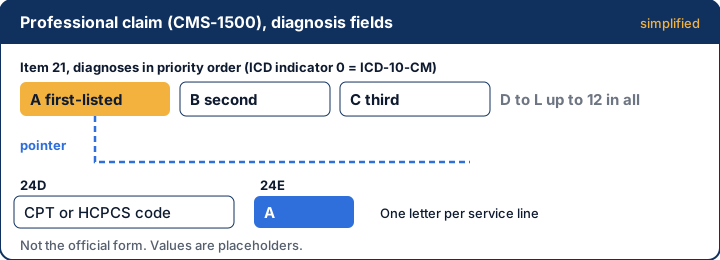
On a hospital outpatient bill, the revenue code goes in FL 42, 52000 in FL 44, the date in FL 45 and units in FL 46. The MUE table allows 1 per date with indicator 3.

Example: A patient with blood in the urine has the exam on 10/16. The line is 52000, pointer A (R31.9), 1 unit, $390.00. A same-day visit with modifier 25 needs a separate reason.
Why is 52000 denied?
| Code | What X12 says | What usually causes it |
|---|---|---|
| CARC 97 | The benefit is included in the payment for another service already adjudicated | 52000 billed with a treatment scope code or with catheterization |
| CARC 4 | The procedure code is inconsistent with the modifier used | Modifier 50 or 25 placed on the wrong line |
| CARC 151 | Payment adjusted because the information submitted does not support this many services | Two units for a repeat look the same day |
| CARC 50 | Not deemed a medical necessity by the payer | A scope with no hematuria, retention or other diagnosis on the claim |
If these denials keep coming back, our denial management team can work them. The urology codes on this page's family are summarized in urology billing.
Related codes
- Physician Fee Schedule relative value files, RVU26D (October 2026) · CMS
- Medicare NCCI Medically Unlikely Edits, practitioner services table, effective 10-01-2026 · CMS
- ASC payment rates and addenda, October 2026 Addenda AA and DD1 · CMS
- 2026 NCCI Medicare Policy Manual, Chapter I: General Correct Coding Policies · CMS
- 2026 NCCI Medicare Policy Manual, Chapter VI: Digestive System · CMS
- 2026 NCCI Medicare Policy Manual, Chapter VII: Urinary, Male Genital, Female Genital, Maternity Care and Delivery Systems · CMS
- Medicare Claims Processing Manual, Chapter 12: Physicians/Nonphysician Practitioners · CMS
- Medicare Claims Processing Manual, Chapter 14: Ambulatory Surgical Centers · CMS
- Medicare Claims Processing Manual, Chapter 26: Completing and Processing Form CMS-1500 Data Set · CMS
- Place of Service Code Set · CMS
- Claim Adjustment Reason Codes · X12
- Medicare Claims Processing Manual, Chapter 25: Completing and Processing the Form CMS-1450 Data Set · CMS
We check every rule, code and deadline against the official source. See our editorial policy.
Common questions
Straight answers from the team that does the work.
Ask a billing lead directly. A 20-minute call, Monday to Friday, 9am to 5pm Eastern.
01How do I bill a diagnostic cystoscopy?
Report 52000 with 1 unit in Item 24G and the place of service in Item 24B, and point Item 24E to the diagnosis that supports the scope. Do not add 52000 when a treatment code from its family describes the work. A same-day visit needs modifier 25 and a separate reason.
02Does 52000 have a global period?
Yes, 000 days in the October 2026 fee schedule file, which means an endoscopic or minor procedure. The decision to scope is included in the payment. A separate, significant visit can be reported with modifier 25, and pre- and post-procedure care that day is part of the code.
03Can I bill 52000 with a ureteral stent code?
No. NCCI Chapter VII, item 10, says surgical endoscopy includes diagnostic endoscopy, so only the treatment code is reported, whether that is a stent or the biopsy code 52204. The fee schedule file lists both of those codes as members of the 52000 family.
04Can I bill fluoroscopy with a cystoscopy?
No. NCCI Chapter VII, items 24 and 25, say fluoroscopy is integral to endoscopic procedures and to cystourethroscopy, so 76000 and fluoroscopic guidance such as 77002 are not reported separately with the scope code. The imaging is part of the procedure.


Cystoscopy visits and edits getting denied?
We check modifier 25 support and family bundling before the claim is sent.