
Medicaid billing guide: timely filing, managed care and appeals
Medicaid is run state by state, so the filing limit, portal and appeal steps that bind you are in your state's rules and your managed care contract. Federal rules set the floor: 42 CFR 447.45 requires the state agency to make providers submit claims within 12 months of the date of service and sets payment targets, and 42 CFR part 438 governs managed care decisions and appeals.
 Written by Salman Saeed, CEO and Co-Founder · Reviewed by a Certified Medical Coder · Last reviewed October 2026
In short: Medicaid billing is set by each state, within federal floors. Providers must submit claims within 12 months of the date of service, a managed care plan allows the member one appeal level within 60 days of its notice, and the state revalidates your enrollment at least every 5 years. State pages carry the local numbers.
Medicaid filing, prior authorization and portal
Appeal levels
Top denials from Medicaid
| Code | Meaning | Our fix |
|---|---|---|
| CO-27 | Expenses were incurred after coverage terminated. | Re-verify eligibility on the date of service and bill the right payer. |
| CO-22 | This care may be covered by another payer per coordination of benefits. | Bill the primary payer first. See CO-22. |
| CO-197 | Precertification, authorization or notification is absent. | Check for an approval on file and appeal with the date. |
| CO-29 | The time limit for filing has expired. | Check the state limit and the proof of timely filing. |
| CO-16 | Claim lacks information or has a submission or billing error. | Read the remark code, correct and resubmit. |
| CO-50 | Non-covered because the payer does not deem it a medical necessity. | Appeal with records against the state or plan policy. |
Who pays a Medicaid claim, the state or a plan?
Either one, depending on how the patient is enrolled. A fee-for-service member is paid by the state Medicaid agency, and a managed care member is paid by the managed care plan under a contract with the state. 42 CFR 447.46 is the rule for those contracts: it requires an MCO contract to meet the state payment targets in 447.45 unless the contract sets an alternative payment schedule.
Check eligibility and the member's plan on the date of service every time, because the claim goes to a different place for each. The eligibility verification step is where plan and coverage errors get caught. Portals, payer IDs, corrected claim steps and plan lists are state-specific, and the state billing guides cover all 50 states and the District of Columbia.
For plan-level filing limits and appeal steps, see our CareSource and Molina Healthcare guides. Medicare claims on the same patients are in the Medicare guide.
What is the federal Medicaid timely filing and payment rule?
42 CFR 447.45(d)(1) says the Medicaid agency must require providers to submit all claims no later than 12 months from the date of service. The same section sets how fast the agency must pay.
| Requirement | What 42 CFR 447.45 says |
|---|---|
| Claim submission | Providers submit all claims no later than 12 months from the date of service (d)(1). |
| Clean claim, 30 days | The agency pays 90 percent of clean claims from practitioners in individual or group practice or shared health facilities within 30 days of receipt (d)(2). |
| Clean claim, 90 days | It pays 99 percent of those clean claims within 90 days of receipt (d)(3). |
| All other claims | Paid within 12 months of the date of receipt (d)(4). |
| Medicare crossover | If a Medicare claim was filed on time, the agency may pay the Medicaid claim within 6 months after the agency or provider gets notice of the Medicare disposition (d)(4)(ii). |
| Date of receipt | The date the agency receives the claim, per its date stamp (d)(5). |
| Date of payment | The date of the check or other form of payment (d)(6). |
A clean claim is one that can be processed without more information from the provider or a third party. It includes a claim with errors that began in the state's claims system, and it excludes a claim from a provider under investigation for fraud or abuse and a claim under review for medical necessity. The 30 and 90 day targets are written for practitioners, so other claims, which would include hospital claims, fall under the 12-month outer limit.
The state may also be granted a waiver. The CMS Administrator can waive the 30 and 90 day targets for an agency that shows good faith, with a written plan of correction (447.45(e)). Your state's own filing limit and the plan's contract limit are on the timely filing limits by payer page and the state guides, and the timely filing calculator returns a date.
How long does a Medicaid plan have to decide a prior authorization?
Under 42 CFR 438.210(d)(1), standard authorization decisions must come within state-set timeframes that may not exceed 7 calendar days for rating periods that start on or after January 1, 2026, and 14 calendar days for earlier rating periods. The plan can extend either one by up to 14 calendar days if the enrollee or the provider asks, or if the plan justifies the need for more information and shows it is in the enrollee's interest.
For an expedited request, where waiting could seriously jeopardize the enrollee's life, health or ability to attain, maintain or regain maximum function, the decision is due as quickly as the condition requires and no later than 72 hours after receipt. A decision that misses the standard timeframe counts as a denial and an adverse benefit determination, and the notice is due on the date the timeframe expires (42 CFR 438.404(c)(5)).
The decision to deny or cut a requested service must be made by someone with appropriate expertise in the enrollee's needs (438.210(b)(3)). Beginning January 1, 2026, each plan must also post prior authorization data on its website each year, including a list of services that require it and approval and denial percentages (438.210(f)). Fee-for-service prior authorization rules are the state's, and the state page names the program.
How do Medicaid managed care appeals work?
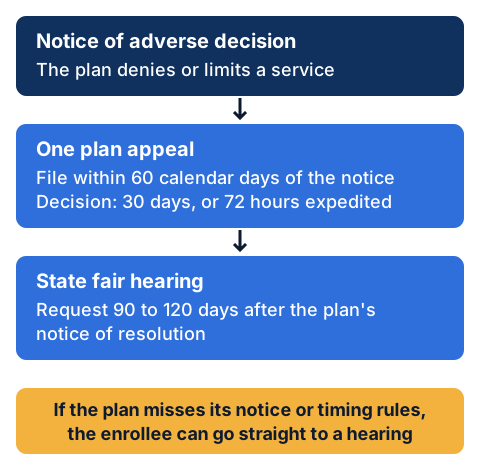
A managed care plan may have only one level of appeal under 42 CFR 438.402(b), and the enrollee has 60 calendar days from the date on the denial notice to file it. After the plan upholds its decision, the enrollee can ask for a state fair hearing. The levels are listed above.
Providers have a narrower role. Under 438.402(c)(1)(ii), if state law permits and the enrollee gives written consent, a provider can request an appeal, file a grievance or request a state fair hearing on the enrollee's behalf, but cannot request continuation of benefits. Check your state's rules and your contract for a payment appeal in your own name, since those steps are not set by this rule.
The plan's clock is 30 calendar days for a standard appeal and 72 hours for an expedited one, with an extension of up to 14 calendar days in listed cases (438.408(b), (c)). If the plan misses the notice and timing rules, the enrollee is treated as having exhausted its appeal process and can go to the state fair hearing. Our denial management team tracks both clocks, and the Medicare appeal levels page covers the different Medicare path.
What federal rules limit what I can bill and collect on Medicaid?
You must accept the Medicaid payment as payment in full, plus any cost sharing the plan requires, and you cannot collect more from the patient. These federal rules sit under every state program and every managed care contract.
| Rule | What it says |
|---|---|
| Payment in full (42 CFR 447.15) | The agency may only let providers participate who accept its payment plus required deductible, coinsurance or copayment as payment in full. A provider may deny service for inability to pay cost sharing only as 447.52(e) allows, and the patient still owes the charge. |
| Third party pays less than Medicaid (447.20) | If the third party's liability is at least the Medicaid amount, you cannot collect from the patient. If it is lower, you may collect only the lesser of cost sharing or the gap between the Medicaid amount and the third party liability. |
| No refusal over third party liability (447.20(b)) | You may not refuse a covered service because a third party may be liable. |
| Late claims with Medicare involved (447.45(d)(4)) | If the Medicare claim was filed on time, the agency may pay the related Medicaid claim within 6 months after notice of the Medicare disposition. |
| Claims paid by court order or hearing (447.45(d)(4)) | The 12-month payment limit does not stop payments made under a court order or to carry out a hearing decision or corrective action. |
| Notice of a payment denial (438.404(c)(2)) | A managed care plan must send the written notice at the time of any action affecting the claim. A service authorization not decided in time is a denial, and the notice is due when the time expires. |
| Benefits during an appeal (438.420) | Continuation applies to termination, suspension or reduction of a previously authorized service, requested within 10 calendar days of the notice or by the effective date, whichever is later. The plan may recover the cost if it wins. |
What do I need to keep my Medicaid enrollment active?
The state Medicaid agency must revalidate the enrollment of all providers, regardless of provider type, at least every 5 years under 42 CFR 455.414. It must also screen all enrolled providers under 455.410(a) and require ordering or referring physicians and other professionals to be enrolled as participating providers (455.410(b)).
Two details matter for hospitals and groups. The agency may rely on screening done by Medicare contractors or by another state's Medicaid program (455.410(c)), and it must allow Medicare-enrolled providers and suppliers to enroll for processing Medicare cost-sharing claims, if they meet the federal Medicaid enrollment requirements (455.410(d)). Watch your state agency's notices for the due date, since the application and portal are the state's.
What does it mean that Medicaid pays last?
Under 42 CFR 433.139, when the agency knows a third party probably owes payment at the time the claim is filed, it must reject the claim and return it to the provider to determine the liability amount. Once the amount is known, it pays the allowed amount that exceeds the third party's payment.
There are carve-outs. The agency pays first and then pursues the other payer for preventive pediatric services, including early and periodic screening, diagnosis and treatment services, and for services to a person in a child support enforcement case (433.139(b)(3)). Bill the other payer first, keep its remittance, and attach it to the Medicaid claim. The matching denial is CO-22.
Can I use open negotiation and IDR for a Medicaid claim?
No. The CMS No Surprises Act key protections document, revised June 2026, says the surprise billing protections do not apply to coverage through Medicaid, including Medicaid managed care plans. State Medicaid payment rules and the plan contract decide the rate, so the route for an underpayment is whatever payment appeal your state rules and plan contract provide. Commercial out-of-network disputes start at out-of-network billing and IDR.
- 42 CFR 447.45, Timely claims payment · eCFR
- 42 CFR 447.46, Timely claims payment by MCOs · eCFR
- 42 CFR part 438, subpart F, Grievance and appeal system · eCFR
- 42 CFR 438.210, Coverage and authorization of services · eCFR
- 42 CFR 455.410 and 455.414, Provider enrollment, screening and revalidation · eCFR
- 42 CFR 433.139, Payment of claims (third party liability) · eCFR
- No Surprises Act: Key protections for consumers (revised 06/2026) · CMS
We check every rule, code and deadline against the official source. See our editorial policy.
Common questions
Straight answers from the team that does the work.
Ask a billing lead directly. A 20-minute call, Monday to Friday, 9am to 5pm Eastern.
01What is the Medicaid timely filing limit for claims?
Under 42 CFR 447.45(d)(1), the state Medicaid agency must require providers to submit all claims no later than 12 months from the date of service. Your state page and your plan agreement give the working limit, so read both before you rely on the federal figure.
02What are the Medicaid appeal levels and deadlines for a denied claim?
For managed care, the plan has one level of appeal, which the enrollee files within 60 calendar days of the denial notice. The plan resolves it in 30 calendar days, or 72 hours if expedited. A state fair hearing follows, and the enrollee has 90 to 120 days from the plan's resolution notice to request it.
03How do I check eligibility and submit prior authorization for Medicaid members?
Verify eligibility and the plan on the date of service through the state portal or the plan, then submit prior authorization to the managed care plan or state program. A plan standard decision cannot exceed 7 calendar days for rating periods from January 1, 2026, and an expedited decision is due within 72 hours.
04What are the most common Medicaid denial reasons for hospital and ER claims?
The common ones are CO-27 (coverage ended), CO-22 (another payer may be responsible), CO-197 (authorization absent), CO-29 (filing limit passed), CO-16 (missing information) and CO-50 (not medically necessary). Eligibility and third party liability checks before billing help prevent most of these, and the remark code beside each one names the fix.
05How do I dispute an out-of-network underpayment from Medicaid through open negotiation and IDR?
You cannot, because the CMS No Surprises Act key protections document lists Medicaid, including managed care plans, among programs where the surprise billing protections do not apply. Disputes go through the payment appeal your state rules and the plan contract provide, not open negotiation or federal IDR.
06Which portal or clearinghouse do I use to submit claims and check status with Medicaid?
It depends on the state and, for managed care, the plan. Each state agency and each plan names its own portal, payer ID and clearinghouse in its provider manual, so use your state page and the plan's manual. The federal rules do not name one portal.
Talk to a billing lead.
A 20-minute call about your payers, volume and setup. Monday to Friday, 9am to 5pm Eastern.