
ICD-10-CM R10.9: Unspecified Abdominal Pain
R10.9 is the FY2027 ICD-10-CM code for abdominal pain when the record does not say where in the abdomen it is. It is the index default for abdominal pain, and it stays acceptable only until the note gives a site.
 Written by Salman Saeed, CEO and Co-Founder · Reviewed by a Certified Medical Coder · Last reviewed October 2026
In short: R10.9 reports abdominal pain with no location documented. It is the Alphabetic Index default for abdominal pain, so it is correct when the note names no site, but R10 has codes for each quadrant, the flank and the pelvis once the note does.
What Does R10.9 Mean?
R10.9 reads "Unspecified abdominal pain" in the FY2027 code file from CDC/NCHS, effective October 1, 2026. It sits in category R10, Abdominal and pelvic pain, in the section for symptoms and signs involving the digestive system and abdomen (R10-R19) of ICD-10-CM.
The FY2027 Alphabetic Index sends "Pain, abdominal" to R10.9. Guideline I.A.18 calls a code beside a main term a default code, the one most commonly associated with the term or the unspecified code, and says to assign it when the record gives no more detail.
When Is R10.9 an Acceptable Diagnosis Code?
R10.9 is acceptable when the provider documents abdominal pain and nothing more specific about location or cause. Guideline I.B.18 says unspecified codes are right when they most accurately reflect what is known at that encounter, and that choosing a code the record does not support is inappropriate.
It is also the fallback for an uncertain cause. Section IV.H tells outpatient coders not to report "suspected" or "rule out" conditions, such as a note reading "possible appendicitis," and to report the symptom. Inpatient short-term acute care follows Section II.H instead and codes an uncertain discharge diagnosis as established.
Section IV.G adds that a symptom can be the first-listed diagnosis when no diagnosis is established. Guideline I.B.5 stops R10.9 being added once a confirmed condition routinely causes the pain.
- Supports R10.9: pain documented without a quadrant, region or side, and no confirmed cause.
- Does not: a documented quadrant, a confirmed diagnosis, or pain the provider describes as colic or acute abdomen.
Which R10 Codes Are More Specific Than R10.9?
The FY2027 file lists these. Several still say "unspecified" but already name a region, which is more than R10.9 reports.
| Code | FY2027 title | What the note would need to say |
|---|---|---|
| R10.10 | Upper abdominal pain, unspecified | Upper abdomen, no quadrant. |
| R10.11, R10.12 | Right or left upper quadrant pain | The quadrant. |
| R10.13 | Epigastric pain | Epigastric location. |
| R10.30 | Lower abdominal pain, unspecified | Lower abdomen, no quadrant. |
| R10.31, R10.32 | Right or left lower quadrant pain | The quadrant. |
| R10.84, R10.85 | Generalized pain, pain of multiple sites | Whole abdomen, or several sites. |
| R10.83 | Colic | The provider documents colic. |
| R10.0 | Acute abdomen | The provider documents acute abdomen. |
| R10.A1 | Flank pain, right side | Flank location and side. |
Tenderness found on exam is a separate subcategory, R10.81-, with a code for each site and R10.819 when the site is unspecified. Pain the patient reports and tenderness the examiner finds are different statements.
Which Codes Conflict with R10.9?
Category R10 has an Excludes1 note for renal colic (N23). Guideline I.A.12.a says an Excludes1 code is never reported with the code above the note, except when the two conditions are unrelated, and a query is the answer when it is unclear.
The Excludes2 notes allow both codes together. Category R10 lists costovertebral angle tenderness (R39.85), dorsalgia (M54.-) and flatulence and related conditions (R14.-). The R10-R19 section also lists gastrointestinal hemorrhage (K92.0-K92.2), intestinal obstruction (K56.-), urinary system symptoms (R30-R39), symptoms of female genital organs (N94.-) and of male genital organs (N48-N50).
How Does R10.9 Go on the Claim?
On the CMS-1500, put the diagnosis chiefly responsible for the service first in item 21, without a decimal point, and point each service line to it in item 24E with a letter from A to L (Medicare Claims Processing Manual, chapter 26). Section IV.G says the same about the first-listed condition.
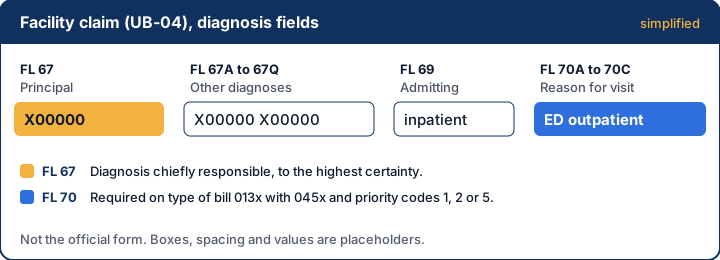
On the UB-04, form locator 67 carries the diagnosis chiefly responsible for the outpatient service, reported to the highest degree of certainty, and 67A through 67Q carry coexisting conditions (chapter 25). An ED visit for abdominal pain with no diagnosis reports the symptom.
What Happens to R10.9 on Payment and Denials?
In the FY2027 MS-DRG Definitions Manual (Version 44), R10.9 as a principal diagnosis groups to MS-DRG 391 and 392, Esophagitis, Gastroenteritis and Miscellaneous Digestive Disorders. Appendix C does not list it as a CC or MCC.
| CARC | X12 description | What to check on an abdominal pain claim |
|---|---|---|
| 11 | The diagnosis is inconsistent with the procedure. | Whether the CT (74177) points to the abdominal pain code in 24E. |
| 50 | These are non-covered services because this is not deemed a 'medical necessity' by the payer. | The payer's imaging or lab policy against the symptom documented. |
| 167 | This (these) diagnosis(es) is (are) not covered. | Whether the note supports a code that names a site. |
A site-specific R10 code is available only when the note names the site, so the fix for a diagnosis edit starts with the documentation. If these denials keep coming back, our denial management team can work them.
Related Codes
- ICD-10-CM FY2027 tabular list, index and code descriptions (CDC/NCHS) · CDC/NCHS
- ICD-10-CM Official Guidelines for Coding and Reporting, FY 2027 · CDC/NCHS
- Medicare Claims Processing Manual, Chapter 26 (CMS-1500 completion) · CMS
- Medicare Claims Processing Manual, Chapter 25 (UB-04 completion) · CMS
- Claim Adjustment Reason Codes · X12
- ICD-10 MS-DRG Definitions Manual, FY 2027 final rule, Version 44 · CMS
We check every rule, code and deadline against the official source. See our editorial policy.
Common Questions
Straight answers from the team that does the work.
Ask a billing lead directly. A 20-minute call, Monday to Friday, 9am to 5pm Eastern.
01When is R10.9 an acceptable diagnosis code?
When the provider documents abdominal pain and gives no location or cause. Guideline I.B.18 says an unspecified code is right when it most accurately reflects what is known at that encounter. A documented quadrant, flank or generalized pain moves the claim to a more specific R10 code.
02Can R10.9 be reported with a confirmed diagnosis?
Usually not. Guideline I.B.5 says signs and symptoms routinely associated with a disease process are not coded as additional codes unless the classification says otherwise. Guideline I.B.6 allows it when the pain is not routinely part of that condition and the provider documents it.
03Does flank pain use R10.9?
Only if the note says abdominal pain with no site. The FY2027 file has a flank group, R10.A-, with R10.A0 for unspecified side, R10.A1 right, R10.A2 left and R10.A3 bilateral. Renal colic is an Excludes1 note under R10, pointing to N23.
04Is R10.9 a CC for an inpatient stay?
No. The FY2027 MS-DRG Definitions Manual, Version 44, Appendix C, does not list R10.9 as a CC or MCC. As a principal diagnosis it groups to MS-DRG 391 or 392. Facility coders still code to the record, not to the DRG outcome.



Abdominal Pain Claims Getting Denied?
We match the diagnosis on the claim to what the chart says.