
ICD-10-CM I50.9: Heart Failure, Unspecified
I50.9 is the FY2027 ICD-10-CM code for heart failure when the record gives no type and no acuity. It is the Alphabetic Index default for heart failure, and it is the code that more detailed documentation most often replaces.
 Written by Salman Saeed, CEO and Co-Founder · Reviewed by a Certified Medical Coder · Last reviewed October 2026
In short: I50.9 reports heart failure with no type or acuity documented, including congestive heart failure NOS. Once the provider states systolic, diastolic or combined failure and whether it is acute or chronic, an I50.2 to I50.4 code replaces it. With hypertension, the I11 or I13 combination code goes first.
What Does I50.9 Mean?
I50.9 reads "Heart failure, unspecified" in the FY2027 code file from CDC/NCHS, effective October 1, 2026. It closes category I50, Heart failure, in the chapter for diseases of the circulatory system in ICD-10-CM.
The tabular list gives three inclusion terms under I50.9: cardiac, heart or myocardial failure NOS, congestive heart disease and congestive heart failure NOS. The FY2027 Alphabetic Index sends "Failure, heart" to I50.9, and so do the subterms congestive, compensated, decompensated and low output. An Excludes2 note allows E87.70 alongside it for fluid overload unrelated to congestive heart failure.
When Should I Choose a More Specific Heart Failure Code Than I50.9?
Choose a more specific code as soon as the provider documents the type of heart failure, its acuity, or both. Guideline I.B.2 asks for the highest level of specificity documented, and guideline I.B.18 keeps the unspecified code for records that do not support more.
| The note says | FY2027 codes | What the code adds |
|---|---|---|
| Systolic, or reduced ejection fraction (HFrEF) | I50.20-I50.23 | 0 unspecified, 1 acute, 2 chronic, 3 acute on chronic |
| Diastolic, or preserved ejection fraction (HFpEF) | I50.30-I50.33 | Same four |
| Combined systolic and diastolic | I50.40-I50.43 | Same four |
| Left heart failure | I50.1 | Left ventricular failure, unspecified |
| Right heart failure | I50.810-I50.814 | Unspecified, acute, chronic, acute on chronic, due to left failure |
| Biventricular, high output, end stage (stage D) | I50.82, I50.83, I50.84 | Code also the type, if known |
The HFrEF and HFpEF terms are inclusion terms in the tabular list, under I50.2 and I50.3. Category I50.2 and I50.3 each have an Excludes1 note for combined failure (I50.4-), so the three types are not stacked.
The Alphabetic Index also helps with the word "decompensation." Heart failure with decompensation and a documented type goes to the acute on chronic code: I50.23 for systolic, I50.33 for diastolic and I50.43 for combined. Decompensated alone, with no type, stays at I50.9.
An ejection fraction on an echo report (93306) does not choose the code. Guideline I.A.19 rests code assignment on the provider's diagnostic statement, not on the clinical criteria behind it.
Does Hypertension Change How I50.9 Is Coded?
Yes. Guideline I.C.9.a presumes a causal link between hypertension and heart involvement, so hypertension with heart failure goes to category I11, Hypertensive heart disease, unless the provider says the two are unrelated. Guideline I.C.9.a.1 then adds a code from I50 to identify the heart condition.
I11.0, Hypertensive heart disease with heart failure, has its own note to use an additional code for the type of heart failure. The code first note at category I50 lists I11.0 and I13.- for the same reason. In practice I50.9 follows the hypertension code and is not first-listed. If the provider documents that the heart failure is unrelated, I10 and the I50 code are sequenced by the circumstances of the encounter.
How Does I50.9 Go on the Claim?
On the UB-04, form locator 67 holds the principal diagnosis with its POA indicator, and 67A through 67Q hold the others (chapter 25). Chronic heart failure is a condition the POA guidelines treat as Y even if it is first diagnosed after admission.
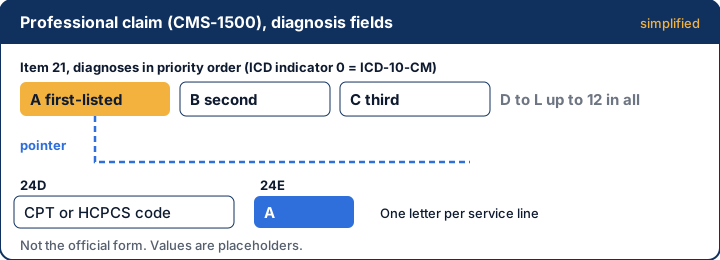
A single code that holds both acute and chronic concepts, such as I50.23, follows the guideline for codes with multiple clinical concepts: assign N if at least one concept was not present on admission. On the CMS-1500, item 21 holds the diagnoses and Medicare's item 24E allows one reference letter per line (chapter 26).
What Happens to I50.9 on Payment and Denials?
In the FY2027 MS-DRG Definitions Manual (Version 44), I50.9 as a principal diagnosis groups to MS-DRG 291, 292 and 293, Heart Failure and Shock. Appendix C does not list I50.9 as a CC or MCC, but it does list the type codes.
| Code pattern | Appendix C level as a secondary diagnosis |
|---|---|
| I50.20, I50.30, I50.40 (unspecified type) | CC |
| I50.22, I50.32, I50.42 (chronic) | CC |
| I50.21, I50.31, I50.41 (acute) | MCC |
| I50.23, I50.33, I50.43 (acute on chronic) | MCC |
| I50.1 (left ventricular failure) | CC |
| I50.9 | Not listed |
The tables treat I50.9 and the type codes differently, so the record has to support whichever one is reported.
| CARC | X12 description | What to check |
|---|---|---|
| 11 | The diagnosis is inconsistent with the procedure. | Whether 24E points the echocardiogram at the heart failure code and not at a symptom. |
| 50 | These are non-covered services because this is not deemed a 'medical necessity' by the payer. | The payer's policy for the test or admission against the documented findings. |
| 150 | Payer deems the information submitted does not support this level of service. | Whether the visit note supports the level of hospital care billed, such as 99232. |
Full guides: CO-11 and CO-50. If these denials keep coming back, our denial management team can work them.
Related Codes
- ICD-10-CM FY2027 tabular list, index and code descriptions (CDC/NCHS) · CDC/NCHS
- ICD-10-CM Official Guidelines for Coding and Reporting, FY 2027 · CDC/NCHS
- Medicare Claims Processing Manual, Chapter 26 (CMS-1500 completion) · CMS
- Medicare Claims Processing Manual, Chapter 25 (UB-04 completion) · CMS
- Claim Adjustment Reason Codes · X12
- ICD-10 MS-DRG Definitions Manual, FY 2027 final rule, Version 44 · CMS
We check every rule, code and deadline against the official source. See our editorial policy.
Common Questions
Straight answers from the team that does the work.
Ask a billing lead directly. A 20-minute call, Monday to Friday, 9am to 5pm Eastern.
01When should I choose a more specific heart failure code than I50.9?
When the provider documents the type, the acuity, or both. Systolic or HFrEF goes to I50.2-, diastolic or HFpEF to I50.3-, combined to I50.4-, and the fifth character shows unspecified, acute, chronic or acute on chronic. Guideline I.B.2 asks for the highest specificity the record supports.
02Does congestive heart failure code to I50.9?
Yes when nothing more is documented. Congestive heart failure NOS is an inclusion term under I50.9, and the Alphabetic Index lists congestive under Failure, heart at I50.9. If the provider also states systolic, diastolic or combined, the type code replaces it.
03Can I code HFpEF or HFrEF from an ejection fraction?
Not from the number alone. HFpEF is an inclusion term under I50.3 and HFrEF under I50.2, but guideline I.A.19 bases the code on the provider's diagnostic statement, not on the clinical criteria behind it. A coder with only an ejection fraction on file needs the provider's stated diagnosis.
04How is heart failure coded with hypertension?
With a combination code from category I11, or I13 with chronic kidney disease, followed by an I50 code for the type. Guideline I.C.9.a presumes the link unless the provider says the conditions are unrelated, so I50.9 follows the hypertension code and is not first-listed.
05Is I50.9 a CC or MCC for an inpatient stay?
No. Appendix C of the FY2027 MS-DRG Definitions Manual, Version 44, does not list I50.9, though it lists I50.20, I50.30 and I50.40 as CCs and the acute and acute on chronic codes as MCCs. As a principal diagnosis I50.9 groups to MS-DRG 291, 292 or 293.



Heart Failure Stays Under Review?
Our coders check the type, the acuity and the hypertension sequencing against the record.