
CPT 97161: low complexity physical therapy evaluation
97161 reports a physical therapy evaluation of low complexity, the simplest of three levels. It is untimed, so it is billed as 1 unit whatever the minutes, and it is billed once per episode of care.
 Written by Salman Saeed, CEO and Co-Founder · Reviewed by a Certified Medical Coder · Last reviewed October 2026
In short: 97161 fits a patient with no complicating personal factors, a stable presentation and a short exam, and it is one unit with GP. The three evaluation levels pay the same in the CMS file, so choosing the right level is about support in the note, not revenue.
What does CPT 97161 report?
97161 is the CPT code for a physical therapy evaluation of low complexity. CMS's MLN Matters article MM9782 explains that in 2017 three complexity-based codes, 97161, 97162 and 97163, replaced the single evaluation code 97001, and 97164 replaced the re-evaluation code 97002.
Low complexity requires all four of the following, in the article's long descriptor, restated here in plain words: a history with no personal factors or comorbidities that affect the plan of care; an exam of body systems with standardized tests addressing 1 or 2 elements of body structure and function, activity limitation or participation restriction; a stable or uncomplicated clinical presentation; and low complexity decision making supported by a standardized assessment or measured functional outcome.
The descriptor says about 20 minutes are typically spent face to face. Time is a guide, not a billing test.
How do I choose the right PT evaluation level?
Match the note to the components, and pick the level where all of them are met. The MLN article sets the step up in plain counts: moderate (97162) means 1 or 2 personal factors or comorbidities, 3 or more elements examined and an evolving presentation; high (97163) means 3 or more factors, 4 or more elements and an unstable presentation.
| Level | Code | Personal factors | Elements examined | Typical time |
|---|---|---|---|---|
| Low | 97161 | None | 1 to 2 | 20 minutes |
| Moderate | 97162 | 1 to 2 | 3 or more | 30 minutes |
| High | 97163 | 3 or more | 4 or more | 45 minutes |
In the October 2026 CMS fee schedule file, 97161, 97162 and 97163 carry the same work RVU of 1.54 and the same non-facility total of 2.93. Moving up a level does not raise Medicare payment, so a higher level adds audit exposure without adding payment.
How many times can 97161 be billed?
Once per episode of care. NCCI Chapter XI says physical therapy evaluations 97161 through 97163 shall not be reported with more than one unit of service per episode of care, and the Medicare practitioner MUE for 97161 is 1. The Claims Processing Manual's therapy unit table also allows 1 unit for physical therapy and 0 for occupational therapy or speech-language pathology.
Later changes in the patient's status are handled with re-evaluation code 97164, not a new 97161. NCCI says re-evaluation is not routinely reported during a planned course of care, and when the status really changes it needs modifier 59 or XU on 97164.
A physical therapist may report only one evaluation or re-evaluation on a date. A physical therapy and an occupational therapy evaluation by the same practitioner on one date cannot both be reported. Services by two different practitioners may be.
How does 97161 appear on the claim?
On the CMS-1500, Item 24D carries 97161 with GP, and Item 24G carries 1. MM9782 lists 97161 as an always-therapy code that must be reported with GP, and for institutional claims Chapter 5 says evaluation codes are always paired with the modifier for their discipline, on a revenue code 042X line.
Because 97161 is an evaluation, not a treatment code, the treatment lines that follow, such as 97110 and 97140, are billed under the plan of care that the evaluation sets up.
The same-day payment cut in Chapter 5, section 10.7, ranks services by practice expense. The practice expense RVU of 97161 in the file is 1.38, against 0.41 for 97110 and 0.39 for 97140, so on a visit with treatment the evaluation is ranked first and paid in full, and the treatment lines take the 50 percent reduction.
Where do the evaluation level and plan date go?
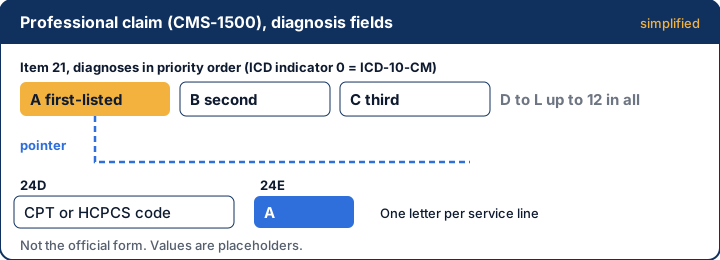
A low-complexity PT evaluation is one line, 97161 in Item 24D with the therapy modifier and 1 unit in Item 24G. Item 24E points to the condition to be treated. Item 24A holds the date of the evaluation.
RVU26D gives 97161 status A and multiple-procedure indicator 5. The MUE table allows 1 per date with indicator 2, a CMS policy edit.
Example: A patient with shoulder pain is evaluated on 10/07. The line is 97161, pointer A (M25.511), 1 unit, $98.00. A claim for 97161 and 97162 on the same date is a mismatch and may be denied under CO-97.
Why is 97161 denied?
| CARC | What X12 says | What usually causes it |
|---|---|---|
| 4 | The procedure code is inconsistent with the modifier used | GP missing, or GO used on a physical therapy evaluation |
| 151 | Payment adjusted because the payer deems the information submitted does not support this many/frequency of services | A second 97161 inside the same episode of care |
| 97 | The benefit for this service is included in the payment/allowance for another service/procedure that has already been adjudicated | 97161 and an occupational therapy evaluation by one practitioner on one date |
| 50 | These are non-covered services because this is not deemed a 'medical necessity' by the payer | Evaluation level not supported by the history and exam in the note |
If these denials keep coming back, our denial management team can work them. See physical therapy billing and modifier 59.
Related codes
- Physician Fee Schedule relative value files, RVU26D (October 2026) · CMS
- Medicare NCCI Medically Unlikely Edits, practitioner table, effective 10-01-2026 · CMS
- MLN Matters MM9782: 2017 Annual Update to the Therapy Code List · CMS
- 2026 NCCI Medicare Policy Manual, Chapter XI: Medicine, Evaluation and Management Services · CMS
- Medicare Claims Processing Manual, Chapter 5: Part B Outpatient Rehabilitation and CORF/OPT Services · CMS
- Medicare Claims Processing Manual, Chapter 26: Completing and Processing Form CMS-1500 Data Set · CMS
- Annual Therapy Update: CY 2026 therapy code list and dispositions · CMS
- Claim Adjustment Reason Codes · X12
We check every rule, code and deadline against the official source. See our editorial policy.
Common questions
Straight answers from the team that does the work.
Ask a billing lead directly. A 20-minute call, Monday to Friday, 9am to 5pm Eastern.
01How do I choose the right PT evaluation level?
Use the level where every component is met: low (97161) for no personal factors, 1 or 2 elements examined and a stable presentation; moderate (97162) for 1 to 2 factors and 3 or more elements; high (97163) for 3 or more factors and 4 or more elements.
02Does the time spent decide between 97161, 97162 and 97163?
No. The descriptors list typical face-to-face times of 20, 30 and 45 minutes, but the level comes from the history, exam, clinical presentation and decision making. A short evaluation of a complex patient can still support a higher level when the note shows it.
03Does the higher PT evaluation level pay more?
Not in the October 2026 CMS fee schedule file, where 97161, 97162 and 97163 all show a work RVU of 1.54 and a non-facility total of 2.93 under Medicare, so the choice is about support in the note. Check each commercial fee schedule separately before assuming the same.
04How many units of 97161 can I bill?
One per episode of care. NCCI Chapter XI limits PT evaluations 97161 through 97163 to one unit per episode, and the Medicare MUE for 97161 is 1. Use 97164 for a re-evaluation when the patient's status changes and it is medically necessary.
05Does 97161 need the GP modifier?
Yes. CMS lists 97161 as an always-therapy code, and Medicare requires the discipline modifier on evaluation codes: GP for physical therapy. Claims for always-therapy codes without a therapy modifier are returned with group code CO and CARC 4, so add it every time.



Evaluation claims denying?
We check the level against the note, the GP modifier and the episode of care before the claim goes out.