
CPT 11102: Tangential Skin Biopsy, Single Lesion
11102 reports a tangential biopsy of skin, the shave-type sample taken off the surface, for a single lesion. Each additional lesion biopsied the same way is reported with the add-on 11103, and the biggest billing risk is a biopsy that Medicare treats as part of removing the same lesion.
 Written by Salman Saeed, CEO and Co-Founder · Reviewed by a Certified Medical Coder · Last reviewed October 2026
In short: 11102 is a 000-global biopsy with an MUE of 1, and 11103 adds lesions at up to 6 units. A biopsy of a lesion that is also removed at the same visit is not paid, so the claim needs separate lesions and modifier 59, XE or XS where an edit applies.
What Does CPT 11102 Report?
11102 is a tangential biopsy of skin for one lesion, labeled "Tangntl bx skin single les" in the CMS file, and 11103 is the add-on "ea sep/addl" for each separate lesion. The technique decides the pair, and the detail by technique is on the dermatology billing page.
| Code | CMS label | Work RVU | Global | MUE (practitioner) |
|---|---|---|---|---|
| 11102 | Tangential biopsy, single lesion | 0.64 | 000 | 1 |
| 11103 | Tangential biopsy, each separate or additional | 0.37 | ZZZ | 6 |
| 11104 and 11105 | Punch biopsy, single and additional | 0.81 and 0.44 | 000 and ZZZ | 1 and 3 |
| 11106 and 11107 | Incisional biopsy, single and additional | 0.98 and 0.53 | 000 and ZZZ | 1 and 2 |
The add-on MUE of 6 for 11103 means one date of service can carry the first lesion plus up to six more by the tangential method.
When Is a Biopsy Not Paid with a Lesion Removal?
A biopsy of the lesion you remove at the same encounter is not paid. NCCI Chapter III says lesion removal codes include the procurement of tissue from the same lesion by biopsy, so 11102 to 11107 shall not be reported separately for it. The biopsy can be reported only if it was taken from a different lesion than the removal procedure.
The same section allows only one removal code per lesion.
What Is the NCCI Edit with 17000 and 17004?
NCCI has procedure-to-procedure edits pairing 11102, 11104 and 11106 with 17000 and 17004. Chapter III says those edits are often bypassed with modifier 59, XE or XS, and that doing so is appropriate only if the two procedures were performed on separate lesions or at separate patient encounters.
In plain terms, a biopsy of one lesion and destruction of another can both be billed, with the modifier showing they were distinct lesions and each line tied to its own site. See CPT 17000 and modifier 59.
A patient has a suspicious lesion on the left forearm and three actinic keratoses on the scalp. The physician shave-biopsies the forearm lesion and freezes the scalp lesions. The claim carries 11102, then 17000 plus two units of 17003, with modifier 59 or XS where the edit requires one, and each line is tied to its own site and diagnosis.
How Are the Pathology Codes Billed with the Biopsy?
Removed tissue is generally reported with the surgical pathology codes 88300 to 88309. NCCI Chapter III says that if several lesions are submitted as one specimen, only one pathology code may be reported for all of them, even if each is processed separately. When it is medically reasonable and necessary to submit lesions separately and identify the precise location of each, a separate pathology code may be reported for each lesion.
Reviewing slides from an earlier removal during a visit, to decide whether more surgery is needed, is included in the E/M service, and codes 88321 to 88325 are not added.
What If the Biopsy Leads to Mohs Surgery?
A biopsy taken to diagnose a suspected skin cancer before Mohs surgery can be reported separately. NCCI Chapter III says the Mohs codes 17311 to 17315 include the skin biopsy codes 11102 to 11107 and the pathology services, so billing them with Mohs is inappropriate, but a diagnostic biopsy taken before Mohs may be reported with modifier 59, XS or XU, or with modifier 58 to show it was staged or planned. See CPT 17311.
How Does 11102 Appear on the Claim?
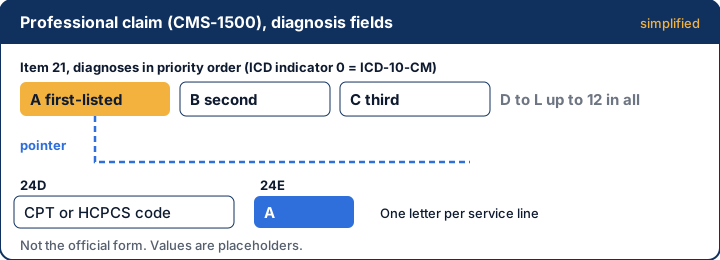
On the CMS-1500, Item 24D carries 11102 and Item 24G carries 1, with 11103 on its own line and the number of added lesions in Item 24G. Item 24E points each line to the diagnosis for that lesion, and Item 24B is usually 11 for an office.
With a 000 global, NCCI Chapter I treats the decision to biopsy as part of the biopsy, so a same-day visit needs a significant, separately identifiable service and modifier 25.
How Do I Enter 11102 and a Lesion on the Claim?
Each skin biopsy session is one line, 11102 in Item 24D with 1 unit in Item 24G for the first lesion. Item 24E points to the lesion or suspicion diagnosis, such as a changing mole, and the site and size belong in the note. A second lesion biopsied by the same method goes on its own line under the add-on 11103.
RVU26D lists 11102 as status A with a 000 global, and the MUE table shows 1 per date with indicator 2. The pathology reading is a different claim from a different provider, with its own code and date.
Example: A shave biopsy is taken from the left forearm on 10/08. The line is 11102, pointer A (D48.5), 1 unit, $165.00. The specimen label names the site. If the same line were also billed with a lesion removal at the site on the same date, a bundling denial under CO-97 is the usual outcome.
Why Is 11102 Denied?
| CARC | What X12 says | What usually causes it |
|---|---|---|
| 236 | The procedure combination is not compatible under NCCI | Biopsy billed with 17000 or 17004 without a distinct-lesion modifier |
| 97 | The benefit is included in the payment for another service already adjudicated | Biopsy of the lesion that was also removed, or billed with Mohs |
| 151 | The information submitted does not support this many or this frequency of services | 11103 units above 6, or more units than lesions in the note |
| 4 | The procedure code is inconsistent with the modifier used | A modifier on a code that does not take it, such as 25 on the biopsy line |
| 11 | The diagnosis is inconsistent with the procedure | One diagnosis pointed to every lesion line |
If these denials keep coming back, our denial management team can work them.
Related Codes
- Physician Fee Schedule relative value files, RVU26D (October 2026) · CMS
- Medicare NCCI Medically Unlikely Edits, practitioner and outpatient hospital tables, effective 10-01-2026 · CMS
- 2026 NCCI Medicare Policy Manual, Chapter III: Integumentary System · CMS
- 2026 NCCI Medicare Policy Manual, Chapter I: General Correct Coding Policies · CMS
- Medicare Claims Processing Manual, Chapter 26: Completing and Processing Form CMS-1500 Data Set · CMS
- Claim Adjustment Reason Codes · X12
We check every rule, code and deadline against the official source. See our editorial policy.
Common Questions
Straight answers from the team that does the work.
Ask a billing lead directly. A 20-minute call, Monday to Friday, 9am to 5pm Eastern.
01What does CPT 11102 mean?
It reports a tangential skin biopsy of a single lesion, a shave-type sample taken off the surface. Each separate or additional lesion biopsied the same way is reported with the add-on 11103. Punch and incisional biopsies have their own pairs, 11104 and 11105, and 11106 and 11107.
02How do I bill a skin biopsy?
Choose the pair by technique: 11102 and 11103 for tangential, 11104 and 11105 for punch, 11106 and 11107 for incisional. Report the single-lesion code once, add the add-on for each further lesion, tie every line to its own site and diagnosis, and bill pathology on the lab's claim.
03Can I bill 11102 and 17000 on the same day?
Yes, when they are on separate lesions or at separate encounters. NCCI Chapter III says the edit pairing 11102 with 17000 and 17004 can be bypassed with modifier 59, XE or XS only in those cases. A biopsy of the lesion you destroy is not paid.
04How many units of 11102 can I bill?
One. The NCCI practitioner and outpatient hospital MUE tables effective October 1, 2026 list 11102 at 1, with a policy adjudication indicator of 2. Further lesions go on 11103, whose MUE is 6 with a clinical adjudication indicator of 3.
05Is a skin biopsy before Mohs surgery billed separately?
Yes, if it was a diagnostic biopsy taken before the Mohs surgery. NCCI Chapter III says to use modifier 59, XS or XU, or modifier 58 for a staged or planned procedure. A biopsy taken during Mohs is included in the Mohs codes.



Biopsy Lines Bundled into Removals?
We check lesion sites, modifiers and add-on units before the claim goes out.